
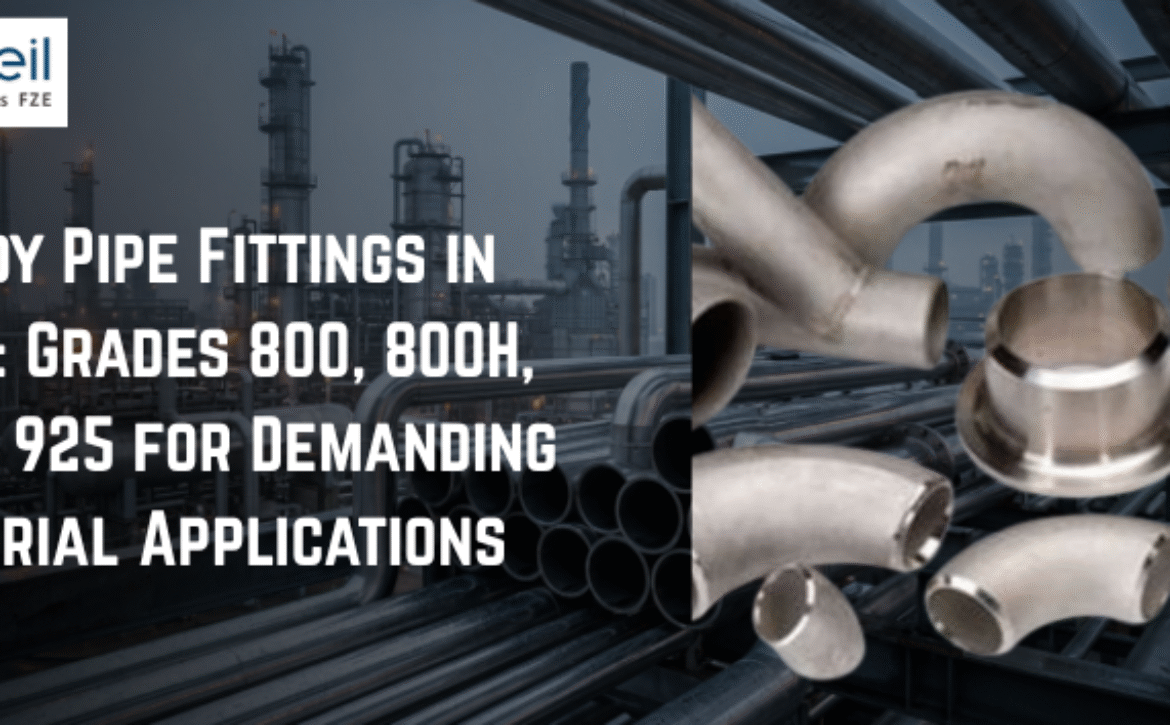
Incoloy Pipe Fittings in Kuwait: Grades 800, 800H, 825 and 925 for Demanding Industrial Applications
Kuwait’s oil and gas, petrochemical, refining, power generation, and industrial sectors rely on piping systems capable of handling elevated temperatures, pressure, and corrosive process environments. In such applications, material selection plays an important role in maintaining piping integrity and long-term performance.
Incoloy Pipe Fittings are nickel-iron-chromium alloy components developed for demanding service conditions. The Incoloy 800, 800H, 825, and 925 grades offer different combinations of high-temperature strength, creep resistance, corrosion resistance, and mechanical performance, making them suitable for different industrial requirements.
Mcneil Alloys offers Incoloy 800, Incoloy 800H, Incoloy 825, and Incoloy 925 Pipe Fittings for industrial applications and international markets.
What Are Incoloy Pipe Fittings?
Incoloy pipe fittings are corrosion-resistant and high-temperature alloy fittings used to connect, redirect, reduce, or terminate piping systems.
Depending on the selected grade, they can be used in environments involving:
- High operating temperatures
- High pressure
- Chemical exposure
- Chloride-containing environments
- Hydrocarbon processing
- Marine conditions
- Steam and heat-transfer systems
Common fitting configurations include:
- Elbows
- Tees
- Reducers
- Caps
- Crosses
- Stub ends
- Butt-weld fittings
The correct grade should always be selected according to the project’s temperature, pressure, process medium, corrosion conditions, and applicable specifications.
Incoloy 800 Pipe Fittings
Incoloy 800 (UNS N08800) is a nickel-iron-chromium alloy designed for elevated-temperature applications.
Its combination of nickel, chromium, and iron provides resistance to oxidation and high-temperature degradation.
Typical applications include:
- Heat exchangers
- Furnace equipment
- Petrochemical systems
- Power-generation equipment
- High-temperature process piping
- Thermal processing systems
For Kuwait’s industrial infrastructure, Incoloy 800 can be considered for piping applications where elevated temperatures and oxidation resistance are important.
Incoloy 800H Pipe Fittings
Incoloy 800H (UNS N08810) is a higher-temperature version of the 800 alloy family, developed for applications where long-term exposure to elevated temperatures makes creep and rupture resistance particularly important.
Typical applications include:
- Reformer systems
- Pressure vessels
- Heat-treatment equipment
- Petrochemical plants
- High-temperature process systems
- Industrial furnaces
The selection of 800H over 800 depends on the operating temperature, stress conditions, service duration, and engineering requirements of the application.
Incoloy 825 Pipe Fittings
Incoloy 825 (UNS N08825) is particularly useful where corrosion resistance is a major consideration.
Its alloy composition provides resistance to a range of aggressive chemical environments, making it suitable for applications involving corrosive process media.
Common applications include:
- Chemical processing
- Acid production
- Petrochemical facilities
- Marine equipment
- Desalination systems
- Pollution-control equipment
- Oil and gas processing
For industrial facilities in Kuwait where piping may encounter aggressive chemicals or chloride-containing environments, Incoloy 825 can be considered where its material properties match the service conditions.
Incoloy 925 Pipe Fittings
Incoloy 925 (UNS N09925) is a precipitation-hardened nickel alloy combining high mechanical strength with corrosion resistance.
It is particularly associated with demanding oilfield and offshore applications.
Typical uses include:
- Oilfield piping
- Offshore equipment
- Valve components
- High-pressure systems
- Petrochemical equipment
- Corrosive oil and gas environments
Incoloy 925 can be considered where both mechanical strength and resistance to corrosive environments are important.
Incoloy 800 vs 800H vs 825 vs 925
| Grade | Primary Advantage | Typical Applications |
| Incoloy 800 | High-temperature performance | Heat exchangers, furnaces, power systems |
| Incoloy 800H | Enhanced creep and rupture resistance | Reformers, pressure vessels, thermal equipment |
| Incoloy 825 | Strong corrosion resistance | Chemical, marine, desalination applications |
| Incoloy 925 | High strength and corrosion resistance | Oilfield, offshore and high-pressure systems |
The highest-grade alloy is not automatically the best choice. Material selection should be based on the actual operating environment and project specification.
Why Incoloy Pipe Fittings Are Relevant to Kuwait
Kuwait’s industrial infrastructure includes applications where piping components can encounter high temperatures, hydrocarbons, chemicals, pressure, and corrosive environments.
In these conditions, conventional carbon steel fittings may not always provide the required combination of properties.
Incoloy alloys can offer advantages such as:
- High-temperature stability
- Corrosion resistance
- Oxidation resistance
- Mechanical strength
- Resistance to demanding process environments
- Long-term performance in appropriate applications
The appropriate alloy should be selected based on actual process conditions rather than geography alone.
Applications of Incoloy Pipe Fittings in Kuwait
Oil and Gas
Kuwait’s oil and gas industry requires piping components for production, processing, transportation, and related infrastructure.
Incoloy 925 can be considered for applications requiring high strength and corrosion resistance, while other grades may be selected for specific temperature or chemical conditions.
Refineries
Refineries contain process piping exposed to elevated temperatures, hydrocarbons, pressure, and potentially corrosive compounds.
Incoloy 800, 800H, and 825 may be considered for different services depending on the operating environment.
Petrochemical Plants
Petrochemical facilities require materials capable of maintaining mechanical and corrosion performance during continuous operation.
Incoloy fittings can be used where their properties match the process requirements.
Power Generation
High-temperature steam and heat-transfer systems require suitable piping materials for reliable operation.
Incoloy 800 and 800H can be considered for selected high-temperature applications.
Chemical Processing
Chemical processing systems can expose piping components to aggressive media.
Incoloy 825 is particularly relevant where corrosion resistance is a primary material-selection consideration.
Desalination and Marine Applications
Chloride and seawater exposure can create significant corrosion challenges.
Incoloy 825 can be considered for suitable applications requiring enhanced corrosion resistance.
ASTM B366 / ASME SB366 Incoloy Pipe Fittings
Incoloy fittings for industrial piping projects are commonly specified according to applicable material and manufacturing standards.
The Mcneil Alloys product range covers ASTM B366 / ASME SB366 Incoloy Pipe Fittings across the 800, 800H, 825, and 925 grades.
Before procurement, buyers should verify:
- Material grade
- Applicable ASTM/ASME standard
- Nominal pipe size
- Wall thickness
- Schedule
- Fitting type
- End connection
- Pressure requirements
- Temperature requirements
- Testing and inspection requirements
Types of Incoloy Pipe Fittings
Depending on the piping design, Incoloy fittings can include:
Incoloy Elbows
Used to change the direction of piping, commonly at 45° or 90°.
Incoloy Tees
Used to create branch connections from a main pipeline.
Incoloy Reducers
Used when the pipe diameter needs to transition from one size to another.
Incoloy Caps
Used to close the end of a piping system.
Incoloy Crosses
Used where multiple branches are required from a common connection point.
Incoloy Stub Ends
Used with certain flanged piping arrangements.
How to Select Incoloy Fittings for a Kuwait Project
Before purchasing Incoloy pipe fittings, engineering and procurement teams should evaluate several factors.
Operating Temperature
Determine both normal and maximum operating temperatures.
This is particularly important when selecting between grades such as 800 and 800H.
Operating Pressure
Confirm the design and operating pressure of the piping system and ensure the selected fitting is appropriate.
Process Medium
Consider whether the system contains:
- Hydrocarbons
- Acids
- Chlorides
- Seawater
- Steam
- Chemical solutions
- Other corrosive media
Corrosion Conditions
Determine the expected corrosion mechanisms and select the alloy accordingly.
Pipe Dimensions
Confirm:
- Nominal pipe size
- Outside diameter
- Wall thickness
- Schedule
- Fitting dimensions
Welding Requirements
For butt-weld fittings, the welding procedure and material compatibility should be reviewed before fabrication and installation.
Documentation
For critical industrial projects, buyers may require:
- Material Test Certificates
- Heat number traceability
- Chemical analysis
- Mechanical test results
- Dimensional inspection
- Non-destructive testing
- Third-party inspection
Requirements depend on the project specification and purchaser’s quality plan.
Why Material Traceability Matters
Incoloy fittings are typically used in applications where material performance is important to overall system reliability.
Traceability helps confirm that the supplied fittings correspond to the specified grade and purchase requirements.
Important documentation may include:
- Material certificates
- Heat numbers
- Chemical composition
- Mechanical properties
- Test reports
- Inspection documentation
This becomes especially important for critical oil and gas, refinery, petrochemical, and power-generation projects.
Mcneil Alloys Incoloy Pipe Fittings for Kuwait
Mcneil Alloys supplies Incoloy 800, 800H, 825 and 925 Pipe Fittings for demanding industrial applications.
The product range is intended for industries including:
- Oil and gas
- Petrochemical
- Chemical processing
- Power generation
- Marine
- Offshore
- Heat-transfer systems
- Desalination
The available grade should be matched to the project’s specific operating conditions and technical requirements.
Conclusion
Incoloy Pipe Fittings in Kuwait can provide a suitable material option for industrial piping systems exposed to high temperatures, pressure, corrosion, and demanding process conditions.
The four commonly specified grades serve different purposes:
Incoloy 800 is suited to high-temperature applications, 800H provides enhanced creep and rupture resistance for prolonged high-temperature service, 825 focuses on corrosion resistance, while 925 combines high strength with corrosion resistance for demanding oilfield and offshore environments.
For Kuwait’s oil and gas, refinery, petrochemical, chemical, power, and industrial sectors, choosing the correct Incoloy grade requires careful evaluation of temperature, pressure, process chemistry, corrosion exposure, dimensions, and applicable standards.
Frequently Asked Questions
What are Incoloy pipe fittings used for?
Incoloy pipe fittings are used in demanding piping systems across oil and gas, petrochemical, chemical, power generation, marine, offshore, and high-temperature industrial applications.
Which Incoloy grades are available?
The Mcneil Alloys product range covers Incoloy 800, 800H, 825 and 925 Pipe Fittings.
What is the difference between Incoloy 800 and 800H?
Both are designed for elevated-temperature service, but Incoloy 800H is specifically suited to applications where improved long-term creep and rupture resistance is required.
What is Incoloy 825 used for?
Incoloy 825 is commonly considered for applications where strong corrosion resistance is required, including chemical, marine, desalination, and petrochemical environments.
What is Incoloy 925 used for?
Incoloy 925 combines high mechanical strength with corrosion resistance and is particularly relevant to oilfield, offshore, and other demanding applications.
What standard applies to Incoloy pipe fittings?
The Mcneil Alloys range is specified to ASTM B366 / ASME SB366 for the listed Incoloy pipe fittings.
Who supplies Incoloy pipe fittings for Kuwait?
Mcneil Alloys supplies Incoloy 800, 800H, 825 and 925 pipe fittings for industrial applications and international markets, including requirements serving the Kuwait market.
