
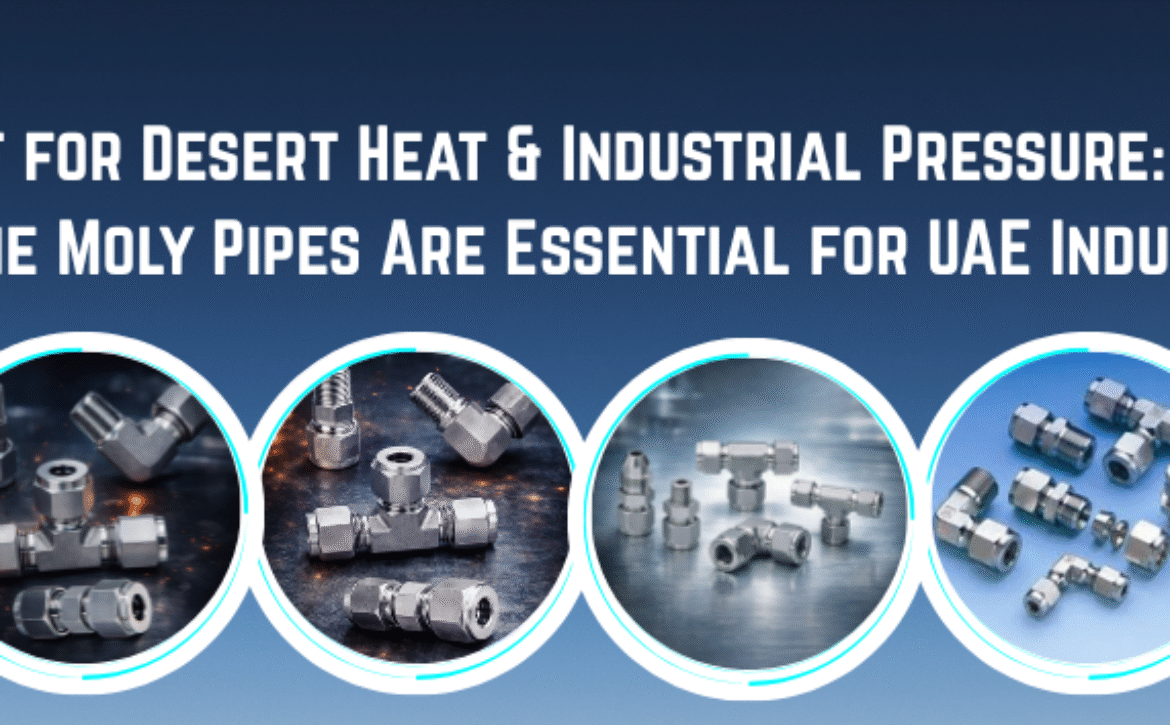
Built for Heat, Salt & Scale: Why Stainless Steel Pipe Fittings Are Critical for Gulf Industrial Infrastructure
Introduction: Gulf Conditions Demand More Than Standard Materials
Let’s get straight to it—industries across the Gulf region operate in some of the harshest environments on the planet. High temperatures, saline air, and chemical exposure push materials to their limits.
That’s why stainless steel pipe fittings in grades 304, 316, 316L, 321, and 347 are widely used. A trusted manufacturer, supplier, and exporter ensures these fittings deliver corrosion resistance, strength, and long-term reliability across demanding applications.
From oil & gas facilities in Saudi Arabia to desalination plants in the UAE, industries rely on experienced pipe fittings manufacturers, suppliers, and exporters to keep systems running without failure.
What Are Stainless Steel Pipe Fittings?
Pipe fittings are components used to connect, redirect, or control flow within piping systems. Stainless steel fittings are specifically designed to handle corrosion, pressure, and temperature variations.
Common Types
- Elbows (45°, 90°, 180°)
• Tees and crosses
• Reducers
• Caps and stub ends
• Couplings and adapters
A reliable supplier and exporter ensures availability across all sizes and configurations for industrial use.
Why Stainless Steel Grades Matter
Not all stainless steel performs the same. Each grade is designed for specific conditions.
Key Insight
The difference between grades lies in composition, corrosion resistance, and temperature capability.
Understanding Key Grades
304 / 304L
- Most commonly used stainless steel
• Good corrosion resistance and cost efficiency
• Suitable for general industrial applications
316 / 316L
- Contains molybdenum for improved corrosion resistance
• Performs well in chloride and marine environments
• Ideal for Gulf coastal and offshore applications
321
- Titanium-stabilized grade
• Resists carbide precipitation at high temperatures
• Used in boilers, heat exchangers, and exhaust systems
347
- Niobium-stabilized for enhanced high-temperature strength
• Better creep resistance in refinery and petrochemical systems
Each grade is selected based on environmental exposure and system requirements.
Technical Specifications Table
| Parameter | Specification |
| Product Type | Stainless Steel Pipe Fittings |
| Standards | ASTM A403 / ASME B16.9 |
| Grades | 304, 304L, 316, 316L, 321, 347 |
| Size Range | ½″ to 48″ NB |
| Thickness | SCH 10 to SCH XXS |
| Type | Seamless / Welded / Forged |
| Pressure Rating | Up to 6000 PSI |
| End Connections | Buttweld / Threaded / Socket Weld |
Leading manufacturers, suppliers, and exporters ensure these fittings meet international industrial standards.
Grade Comparison Table
| Grade | Corrosion Resistance | Temperature Resistance | Strength | Best Use |
| 304 | Good | Medium | Medium | General use |
| 316 | Very High | High | Medium | Marine & chemical |
| 316L | Very High | High | Medium | Welded systems |
| 321 | High | Very High | High | High-temp systems |
| 347 | High | Extreme | Very High | Refineries |
Additional Performance Comparison Table
| Factor | 304 | 316 | 316L | 321 | 347 |
| Chloride Resistance | Medium | High | High | Medium | Medium |
| Heat Resistance | Medium | High | High | Very High | Extreme |
| Weldability | Good | Good | Excellent | Good | Good |
| Service Life | Long | Longer | Longer | Long | Very Long |
316 and 316L are widely preferred in Gulf countries due to their superior resistance to saltwater corrosion.
Why These Fittings Are Essential in Gulf Countries
The Gulf environment creates unique industrial challenges:
- High ambient temperatures
• Saline coastal conditions
• Chemical exposure in refineries
• Continuous industrial operations
Stainless steel fittings handle these conditions because:
- They resist corrosion from salt and chemicals
• They maintain strength under high temperatures
• They provide long-term durability with minimal maintenance
This is why industries depend on reliable manufacturers, suppliers, and exporters.
Industrial Applications in the Gulf
These pipe fittings are used across critical sectors:
Oil & Gas Industry
Refineries, pipelines, offshore platforms
Petrochemical Plants
Handling aggressive chemicals
Desalination Plants
Saltwater processing systems
Power Generation
Boilers and high-temperature systems
Construction & Infrastructure
Water distribution and structural piping
Industries rely on consistent supply from trusted suppliers and exporters for uninterrupted operations.
Manufacturing Process
Top manufacturers, suppliers, and exporters follow strict production standards:
Process Flow
- Raw material selection
• Forging or forming
• Heat treatment
• Machining and finishing
• Surface treatment
• Final inspection
This ensures durability, precision, and performance in extreme conditions.
Key Advantages of Stainless Steel Pipe Fittings
Corrosion Resistance
Ideal for saline and chemical environments
High Temperature Stability
Performs in extreme heat
Durability
Long service life
Versatility
Available in multiple grades and types
Low Maintenance
Reduces operational costs
These benefits make them a preferred solution from leading manufacturers, suppliers, and exporters.
Quality Testing and Assurance
To ensure reliability, fittings undergo strict testing:
- Hydrostatic testing
• Ultrasonic inspection
• Chemical composition analysis
• Mechanical testing
• Dimensional verification
A trusted manufacturer and exporter ensures every fitting meets industrial standards.
Conclusion
Stainless steel pipe fittings are not just connectors—they are critical components that ensure the strength, safety, and efficiency of industrial systems.
In the Gulf region, where heat, salt, and pressure are constant challenges, working with a reliable manufacturer, supplier, and exporter ensures long-term performance and reliability.
If your operations demand durability, corrosion resistance, and high-temperature performance, choosing the right pipe fittings supplier and exporter in the Gulf is what keeps your systems running without failure.
