
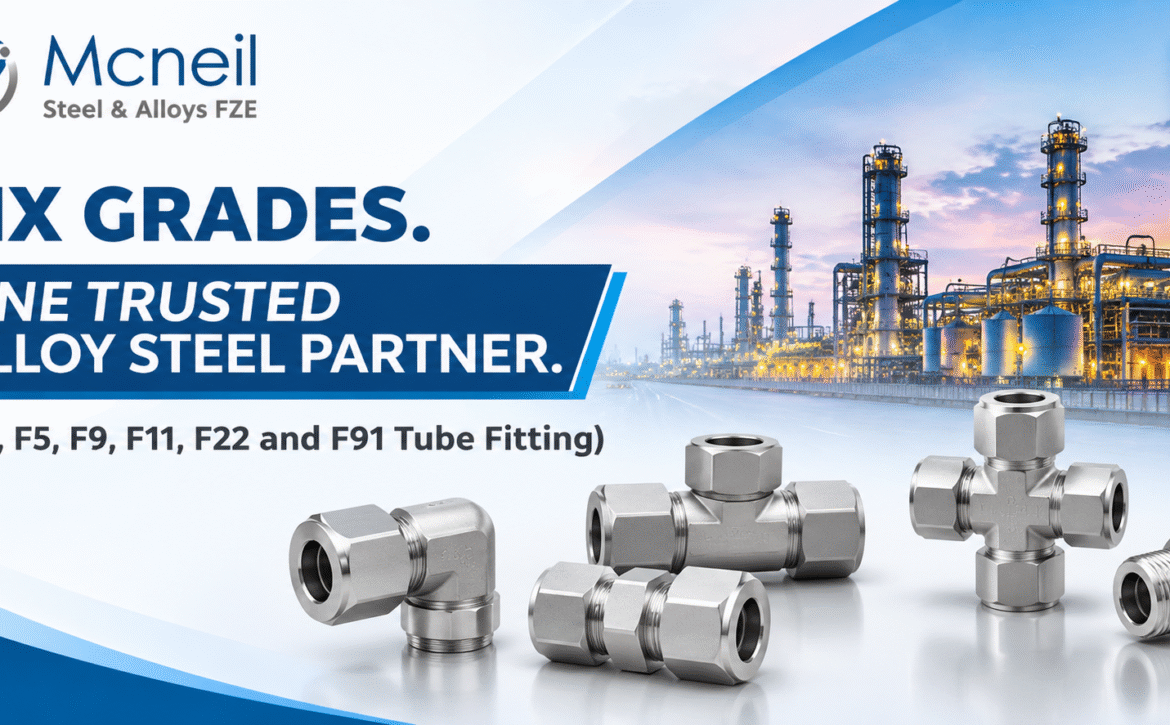
SIX GRADES. ONE TRUSTED ALLOY STEEL PARTNER.
F1, F5, F9 , F11, F22 and F91 Tube Fittings – Mcneil Alloys
Introduction
In industries where high pressure, elevated temperatures, and demanding operating conditions are part of everyday operations, selecting the right alloy steel tube fittings is essential. From power generation and oil & gas to petrochemical plants and refineries, industrial piping systems require fittings that deliver strength, durability, and reliable performance.
Different applications require different material grades depending on operating temperatures, pressure conditions, corrosion exposure, and mechanical requirements. This is why alloy steel grades such as F1, F5, F9, F11, F22, and F91 are widely specified for industrial piping applications.
At Mcneil Alloys, we bring together six important alloy steel grades under one trusted product range. Our focus is on providing quality-oriented alloy steel tube fittings designed to meet diverse industrial requirements.
Understanding Alloy Steel Tube Fittings
Alloy steel tube fittings are essential components used to connect, redirect, branch, or control fluid flow within industrial piping systems. They are manufactured using alloy steel materials containing elements such as chromium, molybdenum, and other alloying additions to improve mechanical strength and high-temperature performance.
These fittings are commonly used in applications involving high pressure, elevated temperatures, steam transportation, and demanding industrial processes.
Common types include:
Alloy Steel Elbows
Alloy Steel Tees
Alloy Steel Reducers
Alloy Steel Couplings
Alloy Steel Caps
Alloy Steel Cross Fittings
The selection of the correct grade helps ensure compatibility with the operating conditions and design requirements of the piping system.
Six Important Alloy Steel Grades for Industrial Applications
Each alloy steel grade offers specific chemical and mechanical characteristics. Understanding their differences helps industries select suitable materials for their projects.
F1 Alloy Steel Tube Fittings
F1 is a chromium-molybdenum alloy steel grade used in selected elevated-temperature industrial applications. It offers useful strength and thermal performance for piping systems designed around its material properties.
Applications: Industrial piping, power generation equipment, and selected high-temperature services.
F5 Alloy Steel Tube Fittings
F5 is a 5% chromium-molybdenum alloy steel grade known for its elevated-temperature strength and oxidation resistance. It is commonly considered for demanding refinery and petrochemical applications.
Applications: Refineries, petrochemical plants, heat exchangers, and industrial processing systems.
F9 Alloy Steel Tube Fittings
F9 is a 9% chromium-molybdenum alloy steel grade designed for applications requiring enhanced high-temperature performance and oxidation resistance.
Applications: High-temperature piping, refinery equipment, and power generation systems.
F11 Alloy Steel Tube Fittings
F11 is a chromium-molybdenum alloy steel grade widely used in industrial applications requiring good strength and resistance to elevated-temperature conditions.
Applications: Oil & gas facilities, petrochemical plants, boilers, and pressure piping systems.
F22 Alloy Steel Tube Fittings
F22 is a 2.25% chromium-1% molybdenum alloy steel grade. It is valued for its strength, creep resistance, and performance in high-temperature applications.
Applications: Thermal power plants, refineries, pressure vessels, and high-temperature piping systems.
F91 Alloy Steel Tube Fittings
F91 is an advanced 9% chromium-molybdenum-vanadium-niobium alloy steel grade. It offers excellent creep strength and is suitable for demanding high-temperature and high-pressure applications.
Applications: Supercritical power plants, ultra-supercritical power plants, steam pipelines, and advanced boiler systems.
Why Are These Six Alloy Steel Grades Important?
The availability of multiple alloy steel grades allows industries to select materials according to specific operating conditions.
High-Temperature Performance: Chromium and molybdenum additions help improve material performance in elevated-temperature environments.
Mechanical Strength: These alloy steel grades provide mechanical properties suitable for demanding industrial piping systems.
Creep Resistance: Grades such as F22 and F91 offer important creep-resistant properties for prolonged high-temperature service.
Oxidation Resistance: Chromium improves resistance to oxidation and scaling under suitable operating conditions.
Application Flexibility: Different grades support a wide range of requirements across power generation, oil & gas, and petrochemical industries.
Major Industries Using Alloy Steel Tube Fittings
Alloy steel tube fittings are essential across several industrial sectors where reliable piping connections are required.
Power Generation: Used in boilers, steam pipelines, reheaters, and other high-temperature piping systems.
Oil & Gas: Suitable for selected high-pressure piping applications, processing facilities, and industrial installations.
Petrochemical Industry: Used in process piping, heat exchangers, and refinery equipment.
Refineries: Support fluid transportation and high-temperature processing operations.
Chemical Processing: Used in industrial piping systems where material selection depends on temperature, pressure, and process conditions.
Importance of Quality Standards and Material Selection
Selecting the correct alloy steel tube fittings involves more than choosing a material grade. Buyers must consider applicable manufacturing standards, chemical composition, mechanical properties, dimensions, heat treatment, and inspection requirements.
Important quality checks include:
Chemical composition analysis
Tensile and mechanical testing
Hardness testing
Heat treatment verification
Dimensional inspection
Non-destructive testing, where specified
Material Test Certificate (MTC)
Traceability and product identification
For ASTM A234 alloy steel butt-welding fittings, grades such as WP5, WP9, WP11, WP22, and WP91 are commonly specified. It is important to distinguish these fitting designations from the corresponding ASTM A182 forging grades F5, F9, F11, F22, and F91.
Selecting the correct specification ensures that the fittings meet the technical and engineering requirements of the intended application.
Why Choose Mcneil Alloys?
Finding a reliable alloy steel partner is important for industries managing critical piping projects. Consistent material quality, accurate specifications, proper documentation, and product availability all contribute to successful procurement.
At Mcneil Alloys, we focus on supporting industrial requirements with a range of alloy steel products covering different grades and applications.
Our six-grade product range includes:
F1 Alloy Steel Tube Fittings
F5 Alloy Steel Tube Fittings
F9 Alloy Steel Tube Fittings
F11 Alloy Steel Tube Fittings
F22 Alloy Steel Tube Fittings
F91 Alloy Steel Tube Fittings
With a focus on industrial quality requirements and customer specifications, Mcneil Alloys aims to be a dependable sourcing partner for alloy steel piping components.
Conclusion
Every industrial piping system has different material requirements. While F1, F5, F9, F11, F22, and F91 offer different mechanical and chemical properties, each grade serves an important purpose in suitable industrial applications.
From refinery piping to advanced power generation systems, choosing the correct alloy steel grade is essential for performance, safety, and operational reliability.
Six Grades. One Trusted Alloy Steel Partner. Choose Mcneil Alloys for alloy steel solutions that support demanding industrial applications.
Looking for Reliable Alloy Steel Tube Fittings?
From F1, F5, F9, and F11 to F22 and F91, Mcneil Alloys offers alloy steel solutions for demanding industrial piping applications.
Partner with us for quality-oriented products and dependable industrial sourcing.
Contact Mcneil Alloys Today!
Website: www.mcneilalloys.ae
Email: info@mcneilalloys.ae
Contact: +91 98708 83613
Frequently Asked Questions (FAQs)
1. What are alloy steel tube fittings?
Alloy steel tube fittings are piping components manufactured using alloy steel materials to connect, redirect, or branch piping systems operating under demanding temperature and pressure conditions.
2. What are the six alloy steel grades offered in this range?
The six grades are F1, F5, F9, F11, F22, and F91, each offering different chemical compositions and mechanical properties for industrial applications.
3. What is the difference between F5 and F9 alloy steel fittings?
F5 contains approximately 5% chromium, while F9 contains approximately 9% chromium. Both are chromium-molybdenum alloy steel grades, but their properties and suitable applications differ.
4. Why are F11 alloy steel fittings used in industrial applications?
F11 fittings offer suitable strength and high-temperature performance, making them useful in selected oil & gas, refinery, petrochemical, and power generation applications.
5. What makes F22 alloy steel fittings suitable for high-temperature applications?
F22 contains approximately 2.25% chromium and 1% molybdenum, providing good high-temperature strength and creep resistance.
6. Where are F91 alloy steel fittings used?
F91 fittings are used in demanding applications such as advanced power plants, high-temperature steam pipelines, and selected supercritical and ultra-supercritical power generation systems.
7. Which industries use alloy steel tube fittings?
Major industries include power generation, oil & gas, petrochemicals, refineries, chemical processing, and heavy engineering.
8. How do I select the right alloy steel tube fitting grade?
Grade selection depends on operating temperature, pressure, chemical exposure, design specifications, and applicable industry standards.
9. What quality tests are important for alloy steel tube fittings?
Chemical analysis, tensile testing, hardness testing, heat treatment verification, dimensional inspection, and applicable non-destructive testing are important quality checks.
10. What should buyers check before purchasing alloy steel tube fittings?
Buyers should verify material grade, applicable ASTM/ASME specifications, dimensions, manufacturing quality, inspection reports, and Material Test Certificates.
