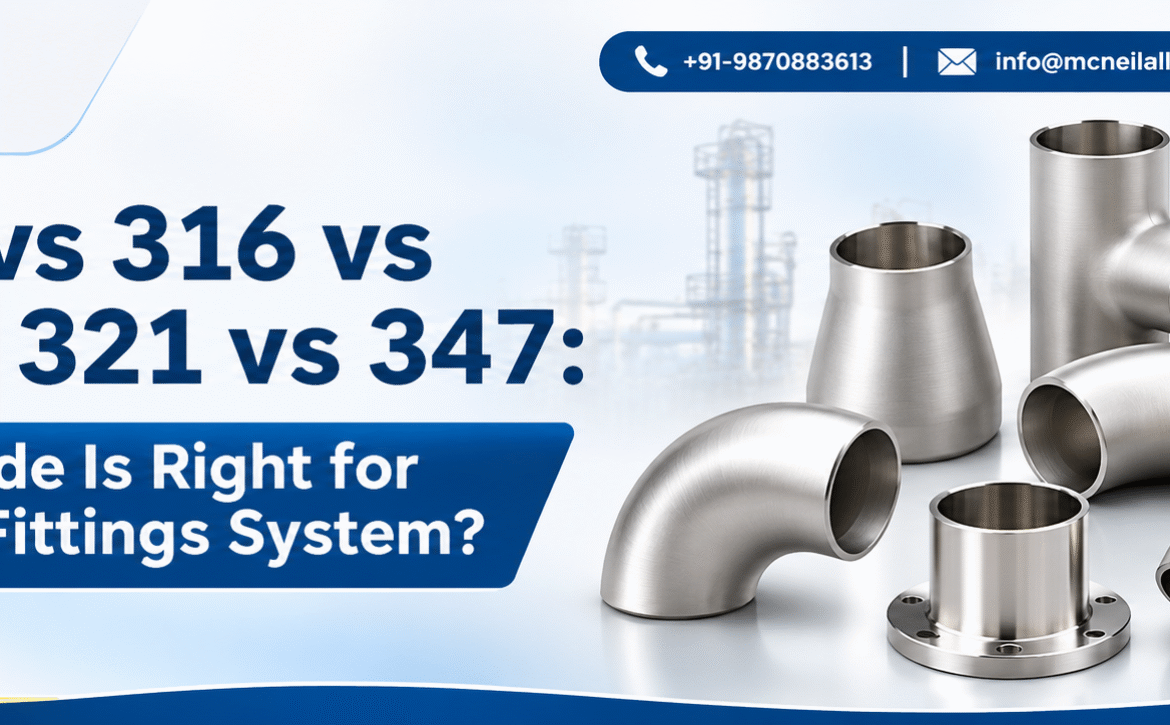
SS 304 vs 316 vs 316L vs 321 vs 347: Which Grade Is Right for Your Pipe Fittings System?
Selecting the right stainless steel grade is an important decision when designing or upgrading an industrial piping system. The material used in pipe fittings directly affects corrosion resistance, mechanical strength, temperature performance, weldability and long-term reliability.
Among the most commonly used stainless steel grades are SS 304, SS 316, SS 316L, SS 321 and SS 347. Although these grades share several properties, each has different characteristics that make it suitable for specific industrial environments.
For industries such as oil and gas, petrochemicals, chemical processing, pharmaceuticals, power generation and water treatment, choosing the correct grade can help reduce maintenance requirements, prevent premature material failure and improve operational efficiency.
At Mcneil Alloys, we understand the importance of material selection for industrial piping applications. In this guide, we compare SS 304, SS 316, SS 316L, SS 321 and SS 347 to help you identify the right stainless steel grade for your pipe fittings requirements.
Understanding Stainless Steel Grades Used in Pipe Fittings
Stainless steel is an iron-based alloy containing chromium, which forms a protective oxide layer on the material surface. This layer provides resistance against corrosion and oxidation.
Different alloying elements, including nickel, molybdenum, titanium and niobium, are added to improve specific properties such as corrosion resistance, high-temperature performance and resistance to intergranular corrosion.
For industrial pipe fittings, the most suitable grade depends on several factors:
Operating temperature and pressure.
Exposure to chemicals, moisture and corrosive substances.
Chloride concentration in the operating environment.
Welding and fabrication requirements.
Mechanical strength and service life.
Applicable ASTM and ASME standards.
Understanding these factors helps engineers and procurement professionals select the appropriate material for their piping systems.
SS 304 vs 316 vs 316L vs 321 vs 347: Key Differences
SS 304 Stainless Steel – Versatile and Cost-Effective
SS 304 is one of the most widely used austenitic stainless steel grades. It generally contains 18–20% chromium and 8–10.5% nickel, offering a good combination of corrosion resistance, formability and mechanical properties.
It is suitable for general industrial applications where exposure to highly corrosive chemicals or chloride-rich environments is limited.
Key Properties:
Good general corrosion resistance.
Excellent formability and fabrication characteristics.
Good weldability.
Suitable for a wide range of indoor and outdoor applications.
Economical compared with several higher-alloy alternatives.
Typical Applications:
General industrial piping.
Food and beverage processing.
Water treatment systems.
Architectural applications.
General-purpose pipe fittings.
When to Choose SS 304: Choose SS 304 when your application requires reliable corrosion resistance under normal operating conditions without exposure to aggressive chloride environments.
SS 316 Stainless Steel – Enhanced Corrosion Resistance
SS 316 contains approximately 16–18% chromium, 10–14% nickel and 2–3% molybdenum. The addition of molybdenum improves resistance to pitting and crevice corrosion, particularly in chloride-containing environments.
Compared with SS 304, SS 316 is generally a better choice for marine, offshore and chemical processing applications.
Key Properties:
Improved resistance to pitting and crevice corrosion.
Better performance in many chloride-containing environments than SS 304.
Good weldability and fabrication characteristics.
Suitable for demanding industrial environments.
Good resistance to various industrial chemicals.
Typical Applications:
Marine and offshore piping systems.
Chemical processing plants.
Pharmaceutical manufacturing.
Oil and gas installations.
Industrial fluid handling systems.
When to Choose SS 316: Select SS 316 when your piping system operates in environments where exposure to chlorides, chemicals or moisture creates a higher corrosion risk.
SS 316L Stainless Steel – Low Carbon for Better Weldability
SS 316L is the low-carbon version of SS 316. Its carbon content is limited to a maximum of 0.03%, compared with 0.08% maximum for standard SS 316 under common ASTM specifications.
The lower carbon content helps reduce carbide precipitation during welding, thereby reducing the risk of sensitization and intergranular corrosion in welded components.
SS 316L also retains the molybdenum-enhanced corrosion resistance associated with SS 316.
Key Properties:
Low carbon content.
Improved resistance to sensitization during welding.
Good corrosion resistance.
Excellent weldability.
Suitable for fabricated and welded piping assemblies.
Typical Applications:
Welded industrial piping systems.
Pharmaceutical and biotechnology plants.
Chemical processing equipment.
Food processing facilities.
High-corrosion-risk fluid handling systems.
When to Choose SS 316L: Choose SS 316L when extensive welding or fabrication is involved and you require good corrosion resistance with reduced risk of weld-related sensitization.
SS 321 Stainless Steel – Designed for Elevated Temperatures
SS 321 is a titanium-stabilized austenitic stainless steel grade. Titanium is added to help prevent chromium carbide precipitation during exposure to elevated temperatures.
This stabilization makes SS 321 suitable for certain applications involving elevated temperatures and repeated thermal exposure.
Key Properties:
Titanium-stabilized composition.
Good resistance to intergranular corrosion after exposure to sensitizing temperatures.
Suitable for elevated-temperature service.
Good oxidation resistance.
Good weldability.
Typical Applications:
Heat exchangers.
Exhaust systems.
High-temperature piping.
Thermal processing equipment.
Power generation installations.
When to Choose SS 321: Consider SS 321 when your piping system operates at elevated temperatures and requires resistance to sensitization during thermal exposure.
SS 347 Stainless Steel – Niobium-Stabilized for High-Temperature Applications
SS 347 is a niobium-stabilized austenitic stainless steel grade. Niobium, also known as columbium, helps prevent chromium carbide precipitation and improves resistance to intergranular corrosion following exposure to sensitizing temperatures.
It is particularly useful in applications involving elevated temperatures, thermal cycling and welded components.
Key Properties:
Niobium-stabilized composition.
Good resistance to intergranular corrosion.
Suitable for elevated-temperature applications.
Good mechanical properties.
Good fabrication and welding characteristics.
Typical Applications:
High-temperature process piping.
Refinery equipment.
Petrochemical installations.
Heat exchangers.
Thermal and exhaust systems
.When to Choose SS 347: Select SS 347 when your application requires a stabilized stainless steel grade for welded components and elevated-temperature operating conditions.
Comparison of SS 304, 316, 316L, 321 and 347
The following table provides a general comparison of their chemical composition, properties and typical applications.
Grade Main Alloying Characteristics Key Advantage Typical Applications
SS 304 18–20% Cr, 8–10.5% Ni General corrosion resistance Food processing, water systems, general piping
SS 316 16–18% Cr, 10–14% Ni, 2–3% Mo Improved chloride corrosion resistance Marine, chemical and offshore
SS 316L Similar to 316, with max. 0.03% C Better resistance to weld sensitization Welded piping, pharmaceutical and chemical plants
SS 321 Titanium-stabilized Resistance to sensitization during elevated-temperature exposure Heat exchangers and high-temperature piping
SS 347 Niobium-stabilized Resistance to intergranular corrosion Refineries and thermal process systems
Note: Chemical composition ranges are typical values and may vary according to the applicable material specification. Always verify the material test certificate (MTC) and applicable ASTM/ASME requirements.
Which Stainless Steel Grade Offers Better Corrosion Resistance?
Corrosion resistance is one of the most important considerations when selecting pipe fittings for industrial applications.
SS 304 provides good general corrosion resistance and performs well in many normal industrial environments.
SS 316 and SS 316L offer improved resistance to pitting and crevice corrosion because of their molybdenum content. They are often preferred for applications involving chloride exposure.
SS 321 and SS 347 are stabilized grades primarily selected for resistance to sensitization and intergranular corrosion after exposure to elevated temperatures. They should not automatically be considered more corrosion-resistant than SS 316 or SS 316L in chloride-rich environments.
The final selection should always consider the chemical composition of the process fluid, temperature, chloride concentration and operating conditions.
Which Grade Is Best for High-Temperature Applications?
Temperature plays a major role in determining the suitability of stainless steel pipe fittings.
SS 304: Suitable for many general-purpose applications at moderate temperatures.
SS 316: Offers good corrosion resistance, but temperature suitability must be evaluated against the design conditions.
SS 316L: Preferred where low carbon content and welded fabrication are important.
SS 321: Suitable for elevated-temperature applications requiring titanium stabilization.
SS 347: Suitable for elevated-temperature applications requiring niobium stabilization.
For high-temperature piping systems, engineers should evaluate creep strength, oxidation resistance, pressure ratings and applicable design codes rather than selecting a grade based on temperature alone.
Common Stainless Steel Pipe Fittings Available in These Grades
The right stainless steel material must be combined with the correct fitting design to ensure safe and efficient piping system performance.
Depending on material availability, dimensions and applicable standards, stainless steel grades are used in manufacturing different types of pipe fittings, including:
Butt Weld Pipe Fittings
Stainless Steel Elbows
Stainless Steel Tees
Stainless Steel Reducers
Stainless Steel Caps
Stainless Steel Stub Ends
Stainless Steel Crosses
Other Piping Components
Socket Weld Fittings
Threaded Fittings
Forged Fittings
Flanges
Custom-engineered piping components
At Mcneil Alloys, material selection and product specifications are important considerations when supplying industrial piping components for different operating environments.
Important Standards for Stainless Steel Pipe Fittings
Selecting the correct stainless steel grade is only one part of material procurement. Buyers must also verify the applicable manufacturing and dimensional standards.
Some commonly referenced standards include:
ASTM A403 – Wrought Austenitic Stainless Steel Piping Fittings.
ASME B16.9 – Factory-Made Wrought Buttwelding Fittings.
ASME B16.11 – Forged Fittings, Socket-Welding and Threaded.
ASME B16.5 – Pipe Flanges and Flanged Fittings.
ASTM A182 – Forged or Rolled Alloy and Stainless Steel Pipe Flanges, Forged Fittings, Valves and Parts.
The correct specification depends on the product type, material form, dimensions and application requirements. Buyers should confirm the required ASTM grade designation, dimensions, pressure class and inspection requirements before placing an order.
How to Select the Right Stainless Steel Grade for Your Project
Before finalizing a stainless steel pipe fittings order, consider the following factors:
1. Operating Environment: Identify whether your system handles water, chemicals, hydrocarbons, steam or chloride-containing fluids.
2. Temperature Requirements: Determine the minimum, normal and maximum operating temperatures.
3. Corrosion Exposure: Evaluate the possibility of pitting, crevice corrosion and intergranular corrosion.
4. Welding Requirements: Consider whether the system requires extensive welding or fabrication. Low-carbon and stabilized grades may be suitable depending on the application.
5. Industry Standards: Confirm the relevant ASTM and ASME standards for your fittings.
6. Material Certification: Request material test certificates to verify chemical composition and mechanical properties.
7. Total Project Cost: Consider the initial material cost alongside expected maintenance, replacement and operational costs.
Choosing the right grade based on these parameters can improve piping system reliability and help prevent unnecessary maintenance expenses.
Why Choose Mcneil Alloys for Stainless Steel Pipe Fittings?
At Mcneil Alloys, we understand that industrial piping systems require materials and components that meet specific engineering and operational requirements.
We focus on supplying quality-driven piping products for customers across the UAE, GCC and international markets.
Our product range includes stainless steel, alloy steel, carbon steel, nickel alloy and other industrial piping components.
Why Work With Mcneil Alloys?
Wide range of industrial piping products.
Stainless steel grades including 304, 316, 316L, 321 and 347, subject to availability.
Product selection based on project requirements.
Support for applicable ASTM and ASME specifications.
Material documentation and certification as per order requirements.
Solutions for oil and gas, petrochemical, marine, chemical and power industries.
Focus on quality, reliability and customer requirements.
Whether you require stainless steel elbows, tees, reducers, caps or other pipe fittings, selecting the correct material is essential for achieving dependable performance.
Conclusion
SS 304, SS 316, SS 316L, SS 321 and SS 347 each offer specific advantages for industrial piping systems.
SS 304 is a practical choice for general applications, while SS 316 and SS 316L are suitable for environments requiring improved corrosion resistance. SS 321 and SS 347 are useful alternatives for elevated-temperature applications where stabilization against sensitization is important.
There is no single stainless steel grade that is ideal for every application. The right selection depends on process conditions, corrosion exposure, operating temperature, fabrication requirements and applicable engineering standards.
Mcneil Alloys supports industrial buyers and project requirements with stainless steel and other alloy piping products designed around demanding application needs.
Contact our team to discuss your stainless steel pipe fittings requirements and identify a suitable material grade for your project.
Looking for the Right Stainless Steel Pipe Fittings for Your Industrial Project?
Choose the right material grade for your operating conditions with support from Mcneil Alloys.
We cater to industrial piping requirements across the UAE, Dubai, Abu Dhabi, Sharjah, Saudi Arabia and other international markets.
📞 Phone: +91 98708 83613
✉️ Email: info@mcneilalloys.ae
🌐 Website:https://mcneilalloys.ae/
Mcneil Alloys – Your Partner for Quality Industrial Piping Solutions.
Frequently Asked Questions (FAQs)
1. What is the main difference between SS 304 and SS 316 pipe fittings?
The main difference is the addition of molybdenum in SS 316. This improves its resistance to pitting and crevice corrosion, especially in chloride-containing environments. SS 304 is generally suitable for less aggressive environments.
2. Is SS 316L better than SS 316?
SS 316L has a lower carbon content than SS 316, helping reduce carbide precipitation and sensitization during welding. Both grades offer similar general corrosion resistance, but SS 316L is often preferred for welded applications.
3. Which stainless steel grade is best for marine applications?
SS 316 and SS 316L are commonly preferred for marine applications because their molybdenum content improves resistance to chloride-related corrosion. However, severe marine exposure may require more highly alloyed materials.
4. What is the difference between SS 321 and SS 347?
SS 321 is stabilized with titanium, whereas SS 347 is stabilized with niobium. Both grades help reduce sensitization and intergranular corrosion following exposure to elevated temperatures.
5. Which stainless steel grade is suitable for high-temperature pipe fittings?
SS 321 and SS 347 are commonly considered for elevated-temperature applications. The final selection depends on operating temperature, pressure, service duration and applicable engineering requirements.
6. Can SS 304 pipe fittings be used in chemical processing plants?
Yes, SS 304 can be used in chemical processing applications involving compatible process fluids. However, for more aggressive chemicals or chloride-containing environments, SS 316 or other suitable alloy grades may be more appropriate.
7. Are SS 316 and SS 316L interchangeable?
They are similar in many applications, but they are not always interchangeable. Their carbon limits differ, which can affect welding and material selection. Always check the project specification before substitution.
8. Which ASTM standard applies to stainless steel butt weld pipe fittings?
ASTM A403 is a commonly used material specification for wrought austenitic stainless steel piping fittings. ASME B16.9 covers dimensions and tolerances for factory-made wrought butt-welding fittings.
9. What information should I check before purchasing stainless steel pipe fittings?
Check the material grade, applicable ASTM specification, fitting type, nominal pipe size, schedule, pressure requirements, end connections, dimensions and material test certificates.
10. Does Mcneil Alloys supply SS 304, SS 316, SS 316L, SS 321 and SS 347 pipe fittings?
Mcneil Alloys offers industrial piping products across various stainless steel and alloy grades, subject to product availability and project specifications. Contact our team to discuss your required grade, dimensions and quantity.