Incoloy Pipe Fittings: Understanding Grades 800, 800H, 825 and 925 for Demanding Industrial Applications
Industrial piping systems operating under high temperatures, corrosive chemicals, pressure, and marine exposure require materials that can maintain their mechanical and corrosion-resistant properties over long periods. This is where Incoloy Pipe Fittings become valuable.
Incoloy is a family of nickel-iron-chromium alloys developed for demanding industrial environments. Different grades provide different combinations of high-temperature strength, creep resistance, corrosion resistance, and mechanical performance.
Mcneil Alloys supplies Incoloy 800, 800H, 825, and 925 Pipe Fittings, manufactured to ASTM B366 / ASME SB366 requirements and available in different sizes and configurations.
What Are Incoloy Pipe Fittings?
Incoloy pipe fittings are nickel-based alloy components used to connect, redirect, reduce, or terminate piping systems exposed to demanding operating conditions.
They are particularly useful where conventional carbon steel or lower-alloy materials may not provide the required combination of temperature resistance and corrosion performance.
Common applications include:
- Oil & gas processing
- Petrochemical plants
- Chemical processing
- Power generation
- Heat exchangers
- Furnace systems
- Offshore installations
- Marine equipment
- Desalination
- High-temperature process systems
Mcneil Alloys’ product range includes Incoloy 800, 800H, 825, and 925 grades.
Why Material Grade Matters
Choosing an Incoloy fitting is not simply a matter of selecting the strongest available alloy.
Different operating environments require different properties.
For example:
High-temperature furnace service may prioritize thermal stability and creep resistance, while acidic or chloride-containing environments may require stronger corrosion resistance.
This is why the four grades offered by Mcneil Alloys serve different industrial requirements.
Incoloy 800 Pipe Fittings
Incoloy 800 (UNS N08800) is a nickel-iron-chromium alloy designed for high-temperature industrial service.
Mcneil Alloys lists Incoloy 800 pipe fittings to ASTM B366 / ASME SB366, with sizes from ½ inch to 24 inches and applications including heat exchangers, nuclear power plants, and furnace components. The page specifies operation up to 1100°F (593°C).
Key characteristics
- High-temperature stability
- Good resistance to oxidation
- High-temperature creep strength
- Resistance to surface degradation
- Suitable for continuous and cyclic thermal loading
- Compatible with butt-weld piping systems
Typical applications
Incoloy 800 fittings can be considered for:
- Heat exchangers
- Furnace components
- Petrochemical equipment
- Thermal processing systems
- Power-generation equipment
- High-temperature piping
Incoloy 800H Pipe Fittings
Incoloy 800H (UNS N08810) is designed for applications where prolonged exposure to elevated temperatures makes creep and rupture resistance particularly important.
Mcneil Alloys specifies Incoloy 800H fittings to ASTM B366 / ASME SB366, with sizes from ½ inch to 24 inches. Its listed applications include reformer tubing, pressure vessels, and heat-treatment baskets.
The product page identifies a controlled carbon range of 0.05% to 0.10% and highlights enhanced resistance to creep and rupture during long-term high-temperature service.
Typical applications
- Reformer systems
- Pressure vessels
- Heat-treatment equipment
- Petrochemical plants
- Thermal processing equipment
- Power-generation systems
- High-temperature process piping
For installations where components remain exposed to elevated temperatures for extended periods, the creep and rupture characteristics of the selected alloy become particularly important.
Incoloy 825 Pipe Fittings
Incoloy 825 (UNS N08825) is particularly relevant when corrosion resistance is a major design requirement.
Mcneil Alloys describes Incoloy 825 as a nickel-iron-chromium alloy with additions of molybdenum and copper, designed for aggressive chemical and marine environments. The product page lists resistance to sulfuric and nitric acid environments and applications including acid production, marine exhaust systems, and pollution-control equipment.
Key characteristics
- Strong corrosion resistance
- Resistance to acidic environments
- Performance in chloride-containing conditions
- Reduced susceptibility to stress-related cracking
- Good mechanical stability
- Suitability for marine environments
Typical applications
- Chemical processing
- Acid production plants
- Desalination
- Marine systems
- Offshore equipment
- Pollution-control equipment
- Oil & gas processing
- Petrochemical facilities
This makes Incoloy 825 an option for applications where corrosion exposure is more important than extreme high-temperature strength.
Incoloy 925 Pipe Fittings
Incoloy 925 (UNS N09925) is a precipitation-hardened nickel alloy designed to combine high mechanical strength with corrosion resistance.
Mcneil Alloys lists Incoloy 925 pipe fittings to ASTM B366 / ASME SB366, with sizes from ½ inch to 12 inches. The product page highlights applications such as oilfield piping, valve components, and industrial fasteners.
Key characteristics
- High mechanical strength
- Resistance to chloride-containing environments
- Resistance to sulfur compounds
- Resistance to sulfide stress corrosion
- Suitable for pressure-intensive systems
- Performance in offshore and sour-service environments
Typical applications
- Oilfield piping
- Offshore installations
- Oil & gas equipment
- Petrochemical systems
- Marine equipment
- Valve components
- High-pressure industrial systems
Incoloy 800 vs 800H vs 825 vs 925
| Grade | Main Advantage | Typical Applications |
| Incoloy 800 | High-temperature stability | Heat exchangers, furnaces, power systems |
| Incoloy 800H | Enhanced creep and rupture resistance | Reformers, pressure vessels, heat-treatment equipment |
| Incoloy 825 | Strong corrosion resistance | Chemical processing, acid plants, marine and desalination |
| Incoloy 925 | High strength + corrosion resistance | Oilfield, offshore and pressure-intensive systems |
The selection should always be based on the actual design temperature, pressure, process chemistry, corrosion conditions, applicable standards, and engineering specification.
Types of Incoloy Pipe Fittings
Incoloy fittings can be supplied in various configurations depending on the piping design.
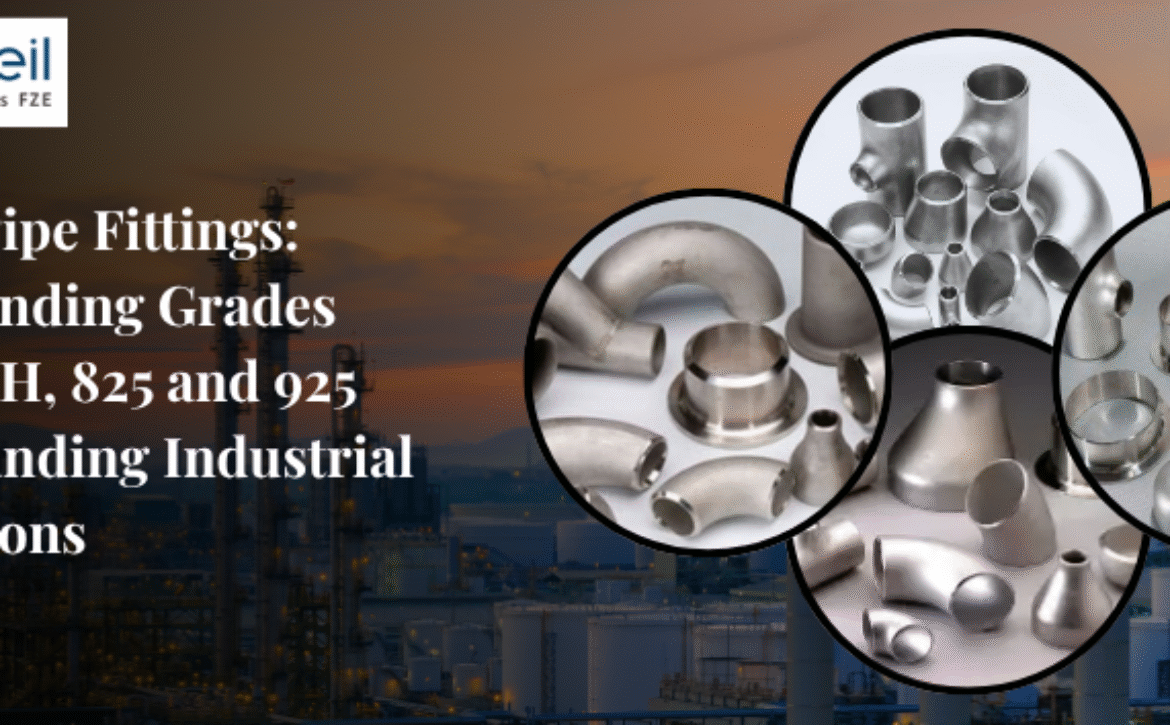
Common butt-weld fitting configurations include:
- Elbows
- Equal tees
- Reducing tees
- Concentric reducers
- Eccentric reducers
- Caps
- Stub ends
- Crosses
Mcneil Alloys specifically describes its Incoloy range as including precision-manufactured butt-welding fittings designed for secure connections, alignment, flow continuity, and long-term service.
Why Butt-Weld Incoloy Fittings Are Used
Butt-weld fittings are joined directly to the piping through welding.
This configuration can provide:
- Strong permanent joints
- Good alignment
- Smooth internal flow paths
- Reduced leakage risk
- Suitability for demanding process systems
The welding procedure and post-weld requirements should, however, be established according to the material grade and applicable project specification.
Applications of Incoloy Pipe Fittings
Oil & Gas
Incoloy fittings can be used in oil and gas processing systems where piping components encounter high temperatures, pressure, corrosive fluids, or demanding offshore conditions.
Incoloy 925 is particularly relevant to applications where high strength and corrosion resistance are required.
Petrochemical Industry
Petrochemical plants contain process piping exposed to elevated temperatures and chemically aggressive environments.
Incoloy 800, 800H, and 825 can be considered for different service conditions.
Chemical Processing
Chemical plants may handle acidic and corrosive media.
Incoloy 825 is particularly suited to applications requiring strong resistance to aggressive chemical environments.
Power Generation
High-temperature systems in power-generation facilities require materials capable of maintaining mechanical integrity during prolonged thermal exposure.
Incoloy 800 and 800H can be used in suitable high-temperature applications.
Heat Exchangers
Heat exchangers operate through continuous heat transfer and may expose fittings to elevated temperatures and corrosive process media.
Incoloy 800 and 800H are listed by Mcneil Alloys for heat-exchanger and related thermal applications.
Offshore and Marine
Marine environments can expose piping systems to chloride-containing conditions and seawater.
Incoloy 825 and 925 provide options for applications where corrosion resistance is a major consideration.
Desalination
Desalination systems can involve seawater and chloride exposure, making corrosion resistance an important material-selection factor.
Mcneil Alloys identifies Incoloy 825 among the materials used for desalination-related applications.
How to Select the Right Incoloy Pipe Fitting
Before ordering an Incoloy fitting, procurement and engineering teams should confirm several parameters.
1. Material Grade
Determine whether the system requires:
- Incoloy 800
- Incoloy 800H
- Incoloy 825
- Incoloy 925
These grades should not be treated as interchangeable.
2. Operating Temperature
For high-temperature applications, determine the continuous operating temperature as well as peak temperature.
3. Operating Pressure
The fitting must be compatible with the design pressure of the piping system.
4. Process Medium
Identify whether the system contains:
- Acids
- Chlorides
- Seawater
- Hydrocarbons
- Steam
- Other aggressive chemicals
5. Pipe Size
Confirm the nominal pipe size and fitting dimensions.
6. Wall Thickness
The fitting must correspond with the pipe’s wall thickness and piping schedule.
7. Connection Type
Confirm whether the project requires butt-weld or another connection configuration.
8. Applicable Standard
Mcneil Alloys’ listed Incoloy fittings are manufactured according to ASTM B366 / ASME SB366. Project-specific standards should always be verified before procurement.
Why Quality and Traceability Matter
Specialty alloy fittings are typically selected for demanding applications where material performance is critical.
Procurement teams should therefore consider:
- Material certification
- Heat number traceability
- Chemical composition
- Mechanical properties
- Dimensional inspection
- Surface condition
- Applicable testing
- Third-party inspection where specified
The objective is to ensure that the supplied fitting matches the material and dimensional requirements stated in the purchase specification.
Why Choose Mcneil Alloys for Incoloy Pipe Fittings?
Mcneil Alloys supplies Incoloy 800, 800H, 825, and 925 Pipe Fittings for high-temperature, corrosive, offshore, chemical, oil & gas, and other demanding industrial applications.
The company identifies its fittings as precision-manufactured butt-weld products and states that it supplies across the UAE and exports throughout the GCC region.
Its published range includes:
- Incoloy 800
- Incoloy 800H
- Incoloy 825
- Incoloy 925
- ASTM B366 / ASME SB366 manufacturing
- Butt-weld configurations
- Multiple pipe sizes
- Applications across oil & gas, petrochemical, chemical, power, marine, and offshore industries
Conclusion
Incoloy Pipe Fittings are designed for industrial environments where ordinary materials may not provide the required combination of high-temperature performance, corrosion resistance, and mechanical strength.
The four grades covered by Mcneil Alloys serve different requirements:
Incoloy 800 is suited to high-temperature industrial systems, 800H provides enhanced long-term creep and rupture resistance, 825 focuses strongly on corrosion resistance, while 925 combines high strength with resistance to demanding corrosive environments.
The right choice ultimately depends on the application’s temperature, pressure, process chemistry, corrosion exposure, piping dimensions, and applicable engineering standards.
For demanding piping projects, selecting the correct alloy grade and working with a supplier capable of providing the required fitting configuration and documentation can help support long-term system reliability.
Frequently Asked Questions
What are Incoloy pipe fittings used for?
They are used in demanding piping systems across oil & gas, petrochemical, chemical processing, power generation, heat exchangers, offshore, marine, and desalination applications.
Which Incoloy grades does Mcneil Alloys supply?
Mcneil Alloys’ published range includes Incoloy 800, 800H, 825, and 925.
What standard are these fittings manufactured to?
The product page specifies ASTM B366 / ASME SB366 for the listed Incoloy pipe fittings.
What is the difference between Incoloy 800 and 800H?
Both are intended for high-temperature service, but 800H is specifically developed for improved creep and rupture resistance during prolonged exposure to elevated temperatures.
When is Incoloy 825 preferred?
Incoloy 825 is particularly relevant when resistance to aggressive chemical and marine environments is important, including applications involving acidic and chloride-containing conditions.
What is Incoloy 925 used for?
Incoloy 925 is used where high mechanical strength and corrosion resistance are required, including oilfield, offshore, and pressure-intensive applications.