
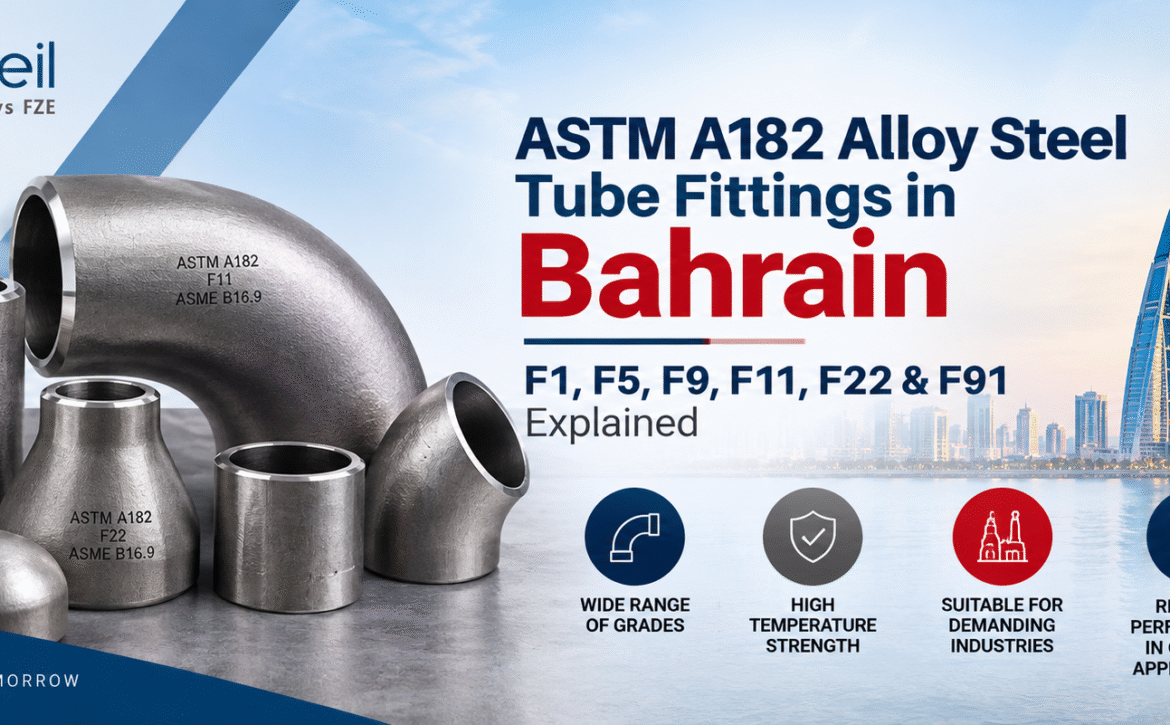
ASTM A182 Alloy Steel Tube Fittings in Bahrain: F1, F5, F9, F11, F22 & F91 Explained
Industrial piping and tubing systems used in Bahrain’s energy and process industries often operate under elevated temperatures, pressure fluctuations, and demanding service conditions. In such environments, selecting the right material for tube and pipe fittings is essential for maintaining mechanical integrity, reliable connections, and long-term operating performance.
ASTM A182 alloy steel fittings are engineered for demanding pressure and temperature applications where conventional carbon steel may not provide the required combination of strength and thermal stability. The ASTM A182 F-series includes grades such as F1, F5, F9, F11, F22, and F91, each offering different alloy compositions and performance characteristics.
Mcneil Alloys supplies and exports ASTM A182 alloy steel fittings in these grades for high-pressure and high-temperature piping applications. The company’s published export markets include Bahrain, along with other GCC and international destinations.
What Are ASTM A182 Alloy Steel Tube Fittings?
ASTM A182 covers forged or rolled alloy and stainless steel components for pressure applications. Alloy steel grades within the specification are selected when piping systems require enhanced strength, thermal stability, creep resistance, or oxidation resistance.
The F-series grades supplied by Mcneil Alloys include:
- ASTM A182 F1
- ASTM A182 F5
- ASTM A182 F9
- ASTM A182 F11
- ASTM A182 F22
- ASTM A182 F91
These grades contain varying amounts of chromium, molybdenum, and, in the case of F91, additional alloying elements. This allows engineers to select a fitting according to the actual temperature, pressure, and service requirements of a piping system.
Why ASTM A182 Alloy Steel Fittings Matter in Bahrain
Bahrain’s industrial environment includes oil and gas operations, refinery facilities, petrochemical processing, energy infrastructure, and other process industries where high-performance piping components may be required.
Fittings in these systems need to withstand mechanical loading while maintaining their integrity during exposure to elevated temperatures and pressure.
ASTM A182 alloy steel fittings can provide important advantages such as:
- High-temperature strength
- Improved thermal stability
- Resistance to oxidation and scaling
- Creep resistance
- Pressure-handling capability
- Dimensional stability
- Long-term service performance
- Compatibility with permanent welded piping systems
Mcneil Alloys specifically describes its A182 F-series fittings as solutions for high-pressure and high-temperature piping systems where mechanical strength, creep resistance, and long-term structural stability are important.
ASTM A182 F1 Tube Fittings
ASTM A182 F1 is a low-alloy chromium-molybdenum steel grade intended for elevated-temperature piping applications.
According to Mcneil Alloys’ published specifications, F1 contains approximately 0.5% chromium and 0.5% molybdenum, with a listed temperature range of −29°C to +480°C.
Key F1 Properties
| Property | ASTM A182 F1 |
| Chromium | Approx. 0.5% |
| Molybdenum | Approx. 0.5% |
| Tensile Strength | ≥ 415 MPa |
| Yield Strength | ≥ 205 MPa |
| Hardness | ≤ 85 HRB |
| Standard | ASTM A182 / ASME SA182 |
| Published Temperature Range | −29°C to +480°C |
F1 fittings can be considered for industrial piping where moderate elevated-temperature service and mechanical stability are required.
ASTM A182 F5 Tube Fittings
ASTM A182 F5 contains a higher chromium content than F1 and is intended for more demanding thermal environments.
Mcneil Alloys lists approximately 5% chromium and 0.5% molybdenum for F5, with a published temperature range of −29°C to +600°C.
The increased chromium content contributes to improved resistance to oxidation and scaling at elevated temperatures.
Typical F5 Applications
F5 fittings can be considered for:
- Refinery piping
- High-temperature process systems
- Power-generation equipment
- Heat-intensive industrial piping
- Pressure piping systems
The source lists a minimum tensile strength of 485 MPa and minimum yield strength of 275 MPa for its F5 specification.
ASTM A182 F9 Tube Fittings
ASTM A182 F9 provides a higher chromium content than lower-alloy F-series grades.
Mcneil Alloys specifies approximately 9% chromium and 1% molybdenum for F9 and lists a temperature range of −29°C to +675°C.
Why F9 Is Used
The alloy composition provides:
- Enhanced oxidation resistance
- High-temperature stability
- Improved strength retention
- Creep resistance
- Suitability for pressure-critical systems
F9 fittings are particularly relevant where the piping system is exposed to sustained elevated temperatures.
ASTM A182 F11 Tube Fittings
ASTM A182 F11 is a widely used chromium-molybdenum alloy steel grade for high-temperature pressure systems.
Mcneil Alloys lists approximately 1.25% chromium and 0.5% molybdenum for F11, with a published temperature range of −29°C to +600°C.
Typical F11 Applications
F11 fittings can be considered for:
- Steam piping
- Boilers
- Power plants
- Refinery systems
- Heat-transfer systems
- High-temperature pressure piping
The grade combines elevated-temperature strength with thermal stability and is suitable for applications where long-term service performance is important.
ASTM A182 F22 Tube Fittings
ASTM A182 F22 is a chromium-molybdenum alloy steel grade commonly selected for demanding high-temperature pressure applications.
Mcneil Alloys lists approximately 2.25% chromium and 1% molybdenum, with a published temperature range of −29°C to +670°C.
Advantages of F22
F22 offers:
- High-temperature strength
- Improved creep resistance
- Oxidation resistance
- Thermal stability
- Resistance to pressure fluctuations
- Long-term structural integrity
It can be considered for high-temperature steam systems, boilers, power-generation facilities, heat exchangers, and process piping.
ASTM A182 F91 Tube Fittings
ASTM A182 F91 is one of the higher-performance grades in this product range.
Unlike the simpler Cr-Mo grades, F91 incorporates chromium, molybdenum, vanadium, and other alloying additions that support high-temperature strength and creep resistance.
Mcneil Alloys lists approximately 9% chromium, 1% molybdenum, and 0.2% vanadium, with a published temperature range of −29°C to +705°C.
Typical F91 Applications
F91 fittings may be selected for demanding systems such as:
- High-pressure steam lines
- Advanced power-generation systems
- Boilers
- Superheaters
- Reheaters
- Critical high-temperature piping
The published F91 specification lists minimum tensile strength of 620 MPa and minimum yield strength of 415 MPa.
ASTM A182 F1 vs F5 vs F9 vs F11 vs F22 vs F91
| Grade | Approx. Alloy Composition* | Published Temperature Range | General Service Position |
| F1 | Cr 0.5%, Mo 0.5% | −29°C to +480°C | Moderate high-temperature service |
| F5 | Cr 5%, Mo 0.5% | −29°C to +600°C | High-temperature/oxidation-resistant service |
| F9 | Cr 9%, Mo 1% | −29°C to +675°C | High-temperature pressure systems |
| F11 | Cr 1.25%, Mo 0.5% | −29°C to +600°C | Steam, boiler and pressure systems |
| F22 | Cr 2.25%, Mo 1% | −29°C to +670°C | Demanding thermal and pressure service |
| F91 | Cr 9%, Mo 1%, V 0.2% | −29°C to +705°C | Critical high-temperature service |
*Values shown are from Mcneil Alloys’ published product information and are intended as a product-reference comparison. Final material selection should follow the applicable specification and engineering requirements.
Applications of ASTM A182 Alloy Steel Fittings in Bahrain
Oil & Gas Industry
Oil and gas facilities can contain high-pressure process lines, utility systems, steam services, and equipment connections.
A182 alloy steel fittings can be considered where elevated temperature and pressure demand greater performance than standard carbon steel components.
Refineries
Refinery units frequently operate at elevated temperatures and require reliable connections between process piping and equipment.
F5, F9, F11, F22, and F91 may be considered for different refinery services depending on operating conditions and engineering specifications.
Petrochemical Plants
Petrochemical processes can combine high temperature, pressure, thermal cycling, and aggressive process environments.
Correctly selected alloy steel fittings help provide the required mechanical and thermal performance in appropriate services.
Power Generation
Power plants use extensive steam, boiler, reheater, superheater, and high-temperature piping systems.
F11, F22, and F91 can be relevant to different high-temperature applications depending on the system’s design parameters.
Boiler and Steam Systems
Boiler and steam piping require materials capable of retaining mechanical integrity during prolonged thermal exposure.
The selection between different A182 grades should be based on temperature, pressure, creep requirements, design code, and fabrication procedures.
Heat-Transfer Systems
Heat exchangers and related high-temperature process systems can require alloy steel fittings capable of maintaining dimensional and mechanical stability under thermal cycling.
Butt-Weld Alloy Steel Fittings for Bahrain Projects
Mcneil Alloys supplies A182 alloy steel fittings in configurations suitable for butt-welding and permanent piping connections.
Common fitting configurations include:
- Elbows
- Tees
- Reducers
- Caps
- Custom-forged fittings
Butt-weld connections can provide a continuous, permanent connection when properly designed, welded, inspected, and tested.
For high-temperature alloy steel systems, welding procedures and post-weld heat treatment requirements should be established according to the applicable material specification and engineering code.
How to Choose the Right ASTM A182 Grade
Choosing an A182 fitting should be based on the complete operating environment.
1. Determine Operating Temperature
Establish normal, maximum, and design temperatures.
2. Determine Design Pressure
The fitting must be compatible with the required pressure rating and piping design.
3. Evaluate the Process Fluid
Consider whether the system carries:
- Steam
- Hydrocarbons
- Gas
- Water
- Chemical solutions
- Process fluids
4. Evaluate Creep Requirements
For prolonged high-temperature service, creep resistance becomes an important consideration.
5. Select the Appropriate Grade
Compare F1, F5, F9, F11, F22, and F91 against the actual service requirements rather than automatically selecting the highest alloy grade.
6. Consider Welding Requirements
Alloy steel fittings require appropriate welding procedures and, where applicable, preheating and post-weld heat treatment.
7. Confirm Documentation
For critical Bahrain projects, procurement specifications may require material certificates, inspection reports, testing records, and traceability.
Quality and Inspection of A182 Alloy Steel Fittings
Quality assurance is particularly important when fittings are used in pressure-containing and high-temperature systems.
Mcneil Alloys states that its A182 fittings are manufactured with attention to chemical composition, heat treatment, dimensional accuracy, and international standards. The company also identifies Material Test Certificates (MTCs), third-party inspection reports, and project documentation as available upon request.
Depending on project requirements, buyers may specify:
- Chemical analysis
- Tensile testing
- Yield-strength verification
- Hardness testing
- Dimensional inspection
- Hydrostatic testing
- Non-destructive examination
- Heat-treatment records
- Material traceability
- Third-party inspection
The required inspection plan should be established before procurement.
Mcneil Alloys: Supplying ASTM A182 Fittings to Bahrain
Mcneil Alloys is a UAE-based manufacturer, supplier, distributor, and exporter of alloy and stainless steel piping products. Its published product range includes ASTM A182 F1, F5, F9, F11, F22, and F91 alloy steel fittings.
The company’s broader product portfolio includes pipes, tubes, pipe fittings, instrumentation tube fittings, flanges, valves, and other industrial components. Its website specifically states that it exports to Bahrain, along with Saudi Arabia, Oman, Qatar, Kuwait, Iraq, and other markets.
For Bahrain projects, this export capability can support procurement requirements for oil & gas, refinery, petrochemical, power, and other industrial applications.
Key supply advantages include:
- Multiple A182 alloy steel grades
- F1, F5, F9, F11, F22 and F91 availability
- Butt-welding fitting configurations
- High-temperature and high-pressure applications
- Project-specific dimensions
- Material documentation
- Quality inspection
- Export supply to Bahrain
- Support for standard and custom requirements
Frequently Asked Questions
What is ASTM A182 used for?
ASTM A182 is used for forged or rolled alloy and stainless steel components intended for pressure applications. Mcneil Alloys supplies alloy steel A182 grades F1, F5, F9, F11, F22, and F91 for high-temperature and high-pressure piping systems.
Which ASTM A182 grades does Mcneil Alloys supply?
The listed alloy steel grades are F1, F5, F9, F11, F22, and F91.
Which A182 grade is suitable for high-temperature applications?
The appropriate grade depends on the operating conditions. F5, F9, F11, F22, and F91 are all used for elevated-temperature applications, but their alloy composition and performance characteristics differ.
What is ASTM A182 F91 used for?
F91 is used for demanding high-temperature and high-pressure applications where enhanced creep strength and thermal stability are required. Potential applications include critical steam piping, boilers, superheaters, reheaters, and power-generation systems.
Are ASTM A182 fittings suitable for refinery applications?
Yes. The Mcneil Alloys product information identifies refinery units among the applications for its A182 alloy steel fittings.
Does Mcneil Alloys export A182 fittings to Bahrain?
Yes. Bahrain is listed among the international export destinations on the Mcneil Alloys website.
Can Mcneil Alloys provide custom alloy steel fittings?
Yes. The company states that it can provide custom dimensions, special wall thicknesses, and project-specific configurations according to engineering requirements.
Conclusion
ASTM A182 alloy steel fittings provide an important solution for pressure-containing piping systems exposed to elevated temperatures and demanding mechanical conditions. For Bahrain’s oil & gas, refinery, petrochemical, power-generation, boiler, and process industries, selecting the correct alloy grade is essential for achieving reliable long-term performance.
Mcneil Alloys supplies ASTM A182 F1, F5, F9, F11, F22, and F91 alloy steel fittings, providing different levels of thermal stability, oxidation resistance, mechanical strength, and creep resistance for industrial applications.
The right grade should be selected based on operating temperature, design pressure, process medium, creep requirements, welding procedure, applicable standards, and inspection requirements. Rather than choosing a fitting solely by grade or price, engineers and procurement teams should evaluate the complete operating environment.
With its UAE-based supply network and established export capability to Bahrain and other GCC markets, Mcneil Alloys can support industrial requirements for alloy steel piping components and project-specific fitting configurations.
Untuk informasi lebih lanjut tentang toto slot online, Anda dapat merujuk pada Slot Toto Online
