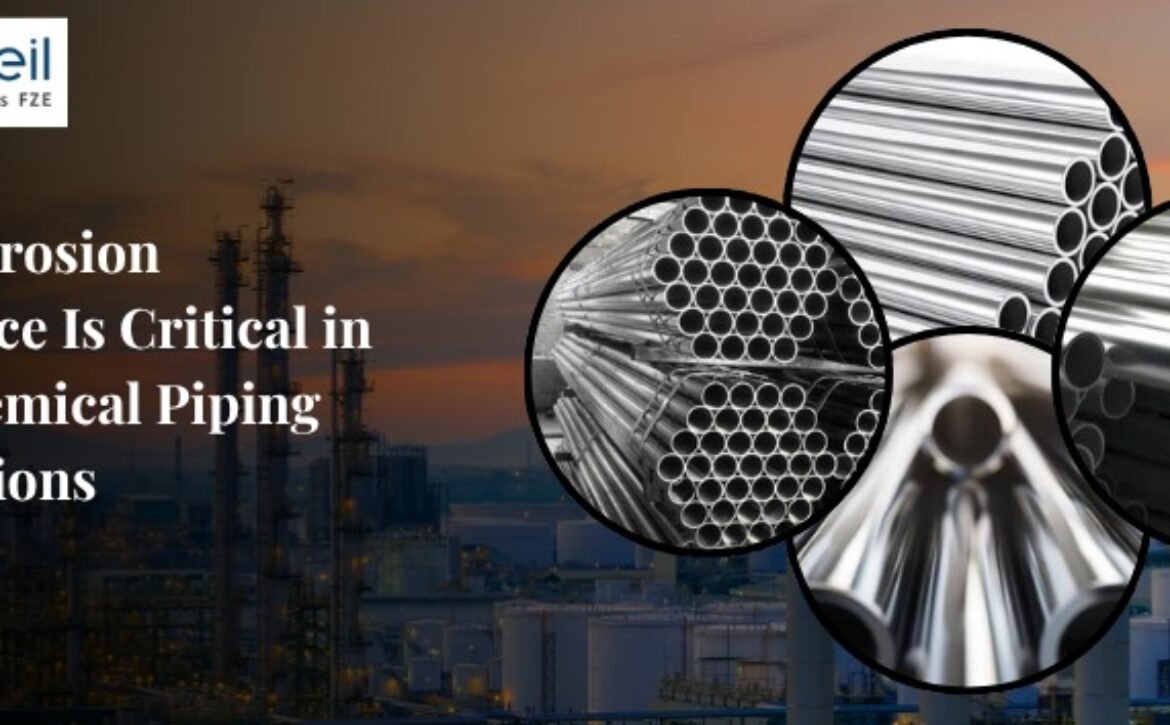
Why Corrosion Resistance Is Critical in Petrochemical Piping Applications
Petrochemical piping systems operate under some of the most demanding conditions in industrial processing. High temperatures, pressure fluctuations, hydrocarbons, acids, chlorides, moisture, sulfur-containing compounds and other aggressive process media can gradually attack piping materials and reduce their service life.
For this reason, corrosion resistance is a critical consideration when selecting pipes, flanges, pipe fittings, valves and other pressure-containing components for petrochemical applications.
Corrosion does more than affect the appearance of a metal surface. Depending on the mechanism and operating conditions, it can cause wall thinning, pitting, cracking, leakage, loss of mechanical integrity and unplanned shutdowns.
Material selection therefore needs to consider the complete service environment rather than simply choosing a material based on pressure or temperature.
Mcneil Alloys supplies industrial piping products in carbon steel, stainless steel, alloy steel, duplex, super duplex and nickel-based alloys for demanding applications across oil & gas, petrochemical, chemical processing, power and other industries.
What Is Corrosion in Petrochemical Piping?
Corrosion is the deterioration of a material caused by interaction with its surrounding environment.
In petrochemical piping, corrosion can occur internally, externally, or at localized areas such as welds, joints and crevices.
Common factors that contribute to corrosion include:
Water and moisture
Chlorides
Acids
Sulfur-containing compounds
Oxygen
Carbon dioxide
High temperatures
Contaminants
Chemical process fluids
Marine or coastal environments
Poor material compatibility
Incorrect fabrication or surface treatment
The specific corrosion mechanism depends on the process chemistry, temperature, pressure, material and operating conditions.
ASME’s technical literature on corrosion and materials in hydrocarbon production identifies corrosion threats, material selection and corrosion mitigation as important parts of hydrocarbon facility engineering and integrity management.
Why Corrosion Resistance Matters in Petrochemical Piping
A petrochemical plant can contain hundreds or thousands of metres of interconnected piping.
If the selected material has inadequate corrosion resistance, degradation can progressively affect:
Pipe walls
Elbows
Tees
Reducers
Flanges
Valves
Welded joints
Instrumentation connections
Pumps and equipment connections
The resulting problems can include:
Reduced wall thickness
Localized holes or pits
Leakage
Loss of pressure containment
Contamination
Reduced flow capacity
Increased maintenance requirements
Unplanned shutdowns
Replacement costs
Safety and environmental risks
Corrosion-resistant material selection is therefore closely connected to piping reliability and long-term plant operation.
Common Types of Corrosion in Petrochemical Piping
Different environments can produce different corrosion mechanisms.
1. General Corrosion
General corrosion occurs relatively uniformly across a metal surface.
Over time, continuous metal loss can reduce the wall thickness of a pipe or fitting.
This can become particularly important in systems where the component is expected to remain in service for many years.
2. Pitting Corrosion
Pitting is a localized form of corrosion that produces small cavities or pits in the metal.
The visible affected area can be relatively small, but individual pits can penetrate deeply into the material.
Pitting resistance is particularly important in environments containing chlorides.
Mcneil Alloys identifies stainless steel 316 pipe fittings as suitable for demanding environments involving saltwater, chemicals and industrial fluids, with corrosion and pitting resistance among their relevant properties.
3. Crevice Corrosion
Crevice corrosion can occur in confined areas where stagnant fluid or deposits develop.
Potential locations include:
Flange interfaces
Gasket areas
Bolted connections
Lap joints
Under deposits
Fitting connections
Material selection and good system design can help reduce susceptibility to localized corrosion.
4. Stress Corrosion Cracking
Stress corrosion cracking can occur when a susceptible material is exposed to a specific corrosive environment while subjected to tensile stress.
Chloride-containing environments are an important consideration for susceptible stainless steels.
Duplex and super duplex stainless steels are often considered where resistance to chloride-related corrosion mechanisms is required.
Mcneil Alloys states that Duplex 2205 and Super Duplex 2507 provide resistance to chloride stress corrosion cracking, pitting and crevice corrosion.
5. Erosion-Corrosion
High-velocity fluids, turbulence and suspended particles can accelerate material degradation.
Areas around:
Elbows
Tees
Reducers
Control valves
Flow restrictions
may experience increased turbulence.
The material must therefore be capable of handling both the chemical environment and the mechanical effects of fluid flow.
6. Corrosion Under Insulation
External corrosion can develop beneath insulation when moisture enters and remains trapped against the pipe surface.
This can be difficult to detect because the affected area is hidden beneath the insulation.
Proper insulation design, inspection and maintenance are therefore important parts of piping integrity management.
How Petrochemical Conditions Affect Material Selection
There is no single corrosion-resistant material that is suitable for every petrochemical application.
Material selection should consider:
Operating Factor Why It Matters
Process fluid Determines chemical compatibility
Chloride level Influences pitting and localized corrosion
Temperature Can accelerate corrosion and affect material strength
Pressure Determines mechanical requirements
Water content Can promote several corrosion mechanisms
Sulfur/H₂S Important for sour-service material selection
Flow velocity Can influence erosion-corrosion
pH Affects chemical attack
Marine exposure Increases chloride exposure
Welded construction Requires consideration of weld metallurgy and heat effects
Service life Influences lifecycle material selection
The objective is not simply to choose the most corrosion-resistant alloy available. The objective is to select a material that provides the required combination of corrosion resistance, mechanical strength, temperature capability, fabrication suitability and lifecycle value.
Stainless Steel in Petrochemical Piping
Stainless steel is widely used when corrosion resistance is required alongside mechanical performance and fabrication practicality.
Common grades include:
304
304L
316
316L
321
347
Mcneil Alloys supplies these stainless-steel grades in pipe fittings for applications including petrochemical plants, refineries, chemical processing, marine systems and other demanding industrial environments.
Stainless Steel 304
SS 304 provides general corrosion resistance and is widely used for industrial piping and process applications where the environment is not excessively aggressive.
Stainless Steel 316
SS 316 contains molybdenum, which improves resistance to localized corrosion compared with conventional 304 stainless steel.
It can be considered for applications involving:
Chloride exposure
Saltwater
Chemical processing
Petrochemical fluids
Marine environments
Stainless Steel 316L
316L is the low-carbon version of 316.
The lower carbon content can be beneficial for welded construction because it reduces the potential for sensitization associated with welding under applicable conditions.
Mcneil Alloys specifically positions 316L fittings for corrosive environments including chemical, petrochemical, marine and offshore applications.
Stainless Steel 321 and 347
High-temperature petrochemical systems may require stabilized stainless-steel grades.
321 uses titanium stabilization, while 347 uses niobium stabilization.
Mcneil Alloys describes 321 and 347 pipe fittings for high-temperature applications including petrochemical plants, chemical processing, refineries and heat exchangers.
Duplex Stainless Steel for Corrosion and Strength
Duplex stainless steels combine austenitic and ferritic metallurgical structures.
This combination provides a useful balance of:
High mechanical strength
Corrosion resistance
Resistance to chloride-related degradation
Pressure capability
Long service life
Duplex 2205
Duplex 2205 is commonly considered for demanding process environments where conventional austenitic stainless steels may not provide the required combination of strength and corrosion resistance.
Mcneil Alloys lists Duplex 2205 with approximately:
Chromium: 21–23%
Nickel: 4.5–6.5%
Molybdenum: 2.5–3.5%
Tensile strength: ≥620 MPa
Yield strength: ≥450 MPa
Temperature range listed by Mcneil Alloys: −50°C to +300°C
The listed standards include ASTM A182, ASTM A789 and ASME SA182.
Super Duplex 2507 for More Aggressive Environments
Super Duplex 2507 provides higher alloy content and higher mechanical strength than Duplex 2205.
Mcneil Alloys lists approximately:
Chromium: 24–26%
Nickel: 6–8%
Molybdenum: 3–5%
Nitrogen: 0.24–0.32%
Tensile strength: ≥800 MPa
Yield strength: ≥550 MPa
Temperature range listed: −50°C to +300°C
The material is positioned for aggressive, high-pressure and high-chloride applications where corrosion resistance and mechanical strength are both important.
Applications can include:
Offshore oil & gas
Seawater systems
Desalination
Petrochemical processing
Chemical plants
High-pressure process piping
Nickel Alloys for Severe Corrosion Service
Some petrochemical environments are too aggressive for conventional stainless steels.
In such situations, nickel-based alloys may be considered.
Examples include:
Inconel
Hastelloy
Monel
Incoloy
These materials can provide specialized combinations of corrosion resistance, high-temperature capability and mechanical performance.
Material selection must nevertheless be based on the actual process chemistry rather than simply selecting a nickel alloy because the service is classified as “corrosive.”
Corrosion Resistance and Flange Selection
Flanges are critical connection points in petrochemical piping.
A corrosion-resistant pipe connected to an unsuitable flange can still create a reliability problem.
Flange selection should consider:
Flange material
Process fluid
Pressure
Temperature
Corrosion environment
Flange facing
Gasket material
Bolting
Welding requirements
Applicable standard
Mcneil Alloys supplies flanges in materials including carbon steel, alloy steel, stainless steel, duplex, super duplex and nickel alloys for demanding energy and petrochemical applications. Its current project-focused flange information also highlights the importance of material condition, facing accuracy, traceability and documentation.
Corrosion Resistance of Pipe Fittings
Pipe fittings are particularly important because changes in flow direction can increase turbulence and localized stresses.
Common fittings include:
45° elbows
90° elbows
180° elbows
Equal tees
Reducing tees
Concentric reducers
Eccentric reducers
Crosses
Caps
Stub ends
Couplings
The fitting material should be compatible with the pipe and process environment.
Mcneil Alloys supplies stainless steel, duplex, super duplex, alloy steel and other piping materials for industrial applications.
Why Material Traceability Matters
Corrosion-resistant alloys only provide their expected performance when the supplied material actually meets the specified chemistry and mechanical requirements.
Material traceability can therefore be important for critical petrochemical projects.
Documentation may include:
Material Test Certificates
Heat numbers
Chemical composition
Mechanical test results
PMI reports
Dimensional inspection
NDT reports
Hydrostatic testing
Third-party inspection records
Mcneil Alloys’ project-oriented supply information emphasizes heat-number traceability, inspection and documentation for demanding piping applications.
The Role of PMI in Corrosion-Resistant Piping
Positive Material Identification, or PMI, is used to verify the alloy composition of materials.
This can be particularly important when multiple stainless steel, duplex or nickel alloy grades are present on a project site.
PMI can help verify that:
The correct material was supplied
Materials have not been incorrectly mixed
Specified alloying elements are present
Components can be traced to project documentation
For critical petrochemical piping, material verification can form an important part of quality assurance.
Welding and Corrosion Resistance
Welding can influence the corrosion performance of piping materials.
Important considerations include:
Welding procedure
Filler metal
Heat input
Interpass temperature
Post-weld treatment where required
Weld inspection
Heat-affected zone behavior
This is especially relevant for stainless steel and duplex stainless steel.
For example, duplex stainless steel requires appropriate control of welding parameters because the resulting metallurgical balance can influence mechanical and corrosion properties.
The material’s corrosion resistance therefore needs to be considered not only in its base-metal condition but also after fabrication.
Corrosion Resistance vs Initial Cost
A common misconception is that the least expensive material always provides the lowest project cost.
A lower-cost material can become more expensive over the complete service life if it requires:
Frequent replacement
Corrosion monitoring
Repairs
Coating maintenance
Additional inspection
Production shutdowns
Emergency intervention
A higher-alloy material may have a greater initial purchase price while providing a longer service life or reduced maintenance requirement in the right application.
The appropriate comparison should therefore consider total lifecycle cost, not only initial material price.
How Corrosion Can Affect Petrochemical Plant Reliability
Corrosion can gradually reduce the reliability of a piping network.
A simplified chain can look like:
Aggressive Environment → Material Degradation → Wall Loss/Pitting → Reduced Integrity → Leakage or Failure → Maintenance/Downtime
Preventing this progression requires a combination of:
Correct material selection
Corrosion assessment
Appropriate fabrication
Inspection
Monitoring
Maintenance
Operating control
Material selection is one part of a broader corrosion-management strategy.
How to Select Corrosion-Resistant Piping Materials
A practical material-selection process can include the following steps.
Step 1: Identify the Process Medium
Determine whether the piping carries:
Hydrocarbons
Water
Steam
Acids
Alkaline chemicals
Sour gas
Chloride-containing fluids
Seawater
Mixed-phase fluids
Step 2: Establish Operating Conditions
Document:
Pressure
Temperature
Flow velocity
Temperature cycling
Pressure cycling
Normal and upset conditions
Step 3: Identify Corrosion Threats
Consider:
General corrosion
Pitting
Crevice corrosion
Stress corrosion cracking
Erosion-corrosion
Sulfide-related damage
Corrosion under insulation
Galvanic corrosion
Step 4: Compare Candidate Materials
Depending on the application, candidates may include:
Carbon steel
304/304L stainless steel
316/316L stainless steel
321/347 stainless steel
Duplex 2205
Super Duplex 2507
Monel
Inconel
Hastelloy
Other specialized alloys
Step 5: Verify Fabrication Requirements
Check:
Welding
Heat treatment
Forming
Machining
Surface finish
Inspection requirements
Step 6: Establish Inspection and Documentation
Define requirements for:
PMI
MTCs
NDT
Hydrotesting
Dimensional inspection
Traceability
Third-party inspection
Carbon Steel vs Corrosion-Resistant Alloys
Carbon steel remains widely used in petrochemical infrastructure because it can provide useful mechanical performance and cost advantages.
However, it may require additional corrosion-management measures depending on the environment.
Corrosion-resistant alloys may provide advantages where the process environment creates a greater corrosion threat.
Material General Characteristics Typical Considerations
Carbon Steel Strength and cost efficiency May require corrosion-control measures
SS 304/304L General corrosion resistance Moderate industrial environments
SS 316/316L Improved localized corrosion resistance Chlorides, chemicals, marine environments
SS 321/347 High-temperature stainless grades Elevated-temperature process service
Duplex 2205 High strength + corrosion resistance Chloride and demanding process environments
Super Duplex 2507 Very high strength + aggressive corrosion resistance High-chloride and severe service
Nickel Alloys Specialized corrosion/high-temperature performance Highly demanding chemical environments
This comparison is a general material-selection guide. Actual suitability must be determined from the process chemistry, operating conditions and applicable engineering requirements.
Petrochemical Applications Where Corrosion Resistance Is Important
Corrosion-resistant piping materials may be required in:
Refineries
Refinery systems can expose piping to hydrocarbons, chemicals, sulfur-containing compounds and elevated temperatures.
Petrochemical Processing Plants
Chemical processing streams may contain aggressive fluids that require carefully selected piping materials.
Oil & Gas Processing
Produced fluids and process streams can contain water, salts, gases and other corrosive constituents.
Offshore Facilities
Offshore piping is exposed to marine atmospheres and potentially chloride-rich environments.
Desalination and Water Treatment
High-chloride water and seawater can create significant corrosion challenges.
Chemical Plants
Chemical composition, concentration and temperature can strongly influence material compatibility.
Mcneil Alloys for Corrosion-Resistant Petrochemical Piping
Mcneil Alloys provides piping products across several material categories to address different industrial service requirements.
Its current portfolio includes:
Stainless steel pipe fittings
Duplex 2205 fittings
Super Duplex 2507 fittings
Alloy steel fittings
Stainless steel flanges
Duplex and super duplex components
Nickel-alloy products
Industrial pipes and related piping components
Mcneil Alloys’ published product information positions Duplex 2205 and Super Duplex 2507 for demanding corrosive and high-pressure environments, while its stainless-steel fittings include grades such as 316L, 321 and 347 for chemical, petrochemical and high-temperature applications.
The company also supplies piping materials for oil & gas, petrochemical, chemical, power, marine and offshore applications.
Best Practices for Reducing Corrosion in Petrochemical Piping
A reliable corrosion-control strategy can include:
Select materials based on actual process chemistry.
Consider temperature and pressure alongside corrosion exposure.
Evaluate chloride and sour-service conditions.
Use appropriate corrosion-resistant alloys where required.
Verify material identity through documentation and PMI.
Use qualified welding procedures.
Control fluid velocity where erosion-corrosion is a concern.
Inspect high-risk areas regularly.
Monitor wall thickness where applicable.
Maintain insulation and external protective systems.
Avoid incompatible material combinations where galvanic corrosion may occur.
Maintain complete material traceability.
Frequently Asked Questions
Why is corrosion resistance important in petrochemical piping?
Corrosion can cause wall thinning, pitting, cracking and leakage, potentially reducing piping integrity and increasing maintenance and downtime. Selecting materials with appropriate corrosion resistance helps address the specific threats presented by the process environment.
Which stainless steel is commonly considered for corrosive petrochemical service?
Grades such as 316 and 316L may be considered where improved localized corrosion resistance is required compared with 304 grades. The correct material depends on the actual process chemistry and operating conditions.
Is Duplex 2205 suitable for petrochemical piping?
Duplex 2205 combines high mechanical strength with corrosion resistance and is used for demanding applications. Mcneil Alloys lists it for high-pressure and corrosive environments and identifies resistance to chloride stress corrosion cracking, pitting and crevice corrosion.
When is Super Duplex 2507 considered?
Super Duplex 2507 can be considered for aggressive environments requiring a combination of high strength and strong resistance to localized and chloride-related corrosion.
Is stainless steel always better than carbon steel for petrochemical piping?
Not necessarily. Material selection depends on the specific process environment, mechanical requirements, temperature, corrosion mechanism, fabrication requirements and lifecycle economics. Carbon steel can remain appropriate for many services when the overall corrosion-control strategy supports its use.
What is PMI in petrochemical piping?
PMI, or Positive Material Identification, is a method used to verify the alloy composition of a material. It can help confirm that the supplied piping component corresponds to the specified material grade.
How does temperature affect corrosion?
Temperature can influence the rate and mechanism of corrosion and can also affect the mechanical properties and allowable service conditions of piping materials. Therefore, corrosion assessment should consider both process chemistry and temperature.
What documentation is important for corrosion-resistant piping?
Depending on project requirements, documentation can include Material Test Certificates, heat-number traceability, chemical and mechanical test results, PMI, dimensional inspection, NDT and pressure-test records.
Conclusion
Corrosion resistance is critical in petrochemical piping because the process environment can continuously challenge the material’s mechanical integrity and service life.
The correct material cannot be selected by looking at pressure or temperature alone. Engineers must consider the process fluid, chloride exposure, chemical composition, temperature, flow conditions, corrosion mechanisms, welding requirements and expected service life.
Stainless steel grades such as 316L, stabilized grades such as 321 and 347, Duplex 2205, Super Duplex 2507 and nickel-based alloys each provide different combinations of corrosion resistance and mechanical performance. Mcneil Alloys’ current product portfolio covers several of these material families for demanding petrochemical, oil & gas, chemical, offshore and industrial applications.
The most effective approach is therefore to treat material selection as part of the overall piping integrity and corrosion-management strategy. When the correct alloy is combined with appropriate fabrication, inspection, traceability and maintenance practices, petrochemical piping systems can achieve the reliability required for demanding continuous-service operations.