Manufacturer & Exporters of:
Instrumentation Pipe Fittings & Valves

Low Carbon. Smart Material Selection: Stainless Steel 316L Pipe Fittings

Introduction

Choosing the right material for an industrial piping system is about more than strength alone. Corrosion resistance, weldability, operating conditions, and long-term maintenance requirements all influence the performance of a piping installation. This is why Stainless Steel 316L Pipe Fittings are widely considered for applications where dependable corrosion resistance and good fabrication characteristics are essential.

Stainless Steel 316L is a low-carbon version of grade 316 stainless steel. Its reduced carbon content helps minimize the risk of sensitization during welding, making it a practical option for fabricated piping systems. Combined with molybdenum, which improves resistance to corrosion in many environments, 316L offers a useful balance of durability, workability, and performance.

At Mcneil Alloys, we understand that smart material selection starts with understanding the demands of the application. Whether the requirement involves chemical processing, marine installations, pharmaceutical manufacturing, or general industrial piping, selecting the appropriate pipe fittings is an important step toward building a reliable system.

What Are Stainless Steel 316L Pipe Fittings?

Stainless Steel 316L Pipe Fittings are components used to connect, redirect, branch, or change the diameter of piping systems. Manufactured from low-carbon austenitic stainless steel, these fittings are suitable for a wide range of industrial applications requiring corrosion resistance and good weldability.

The letter “L” in 316L stands for “low carbon.” Compared with standard 316 stainless steel, 316L has a lower maximum carbon content, typically 0.03%. This helps reduce the likelihood of chromium carbide precipitation during welding and improves resistance to intergranular corrosion in appropriate service conditions.

Grade 316L also contains molybdenum, which improves its resistance to pitting and crevice corrosion in many chloride-containing environments compared with 304 stainless steel. However, it is not immune to every form of corrosion, and material selection should always account for the process medium, temperature, chloride concentration, and operating conditions.

Why Choose Stainless Steel 316L Pipe Fittings?

1. Low Carbon for Better Weldability
One of the key advantages of 316L is its low carbon content. During welding, this helps reduce the risk of sensitization, which can otherwise make stainless steel more vulnerable to intergranular corrosion. This makes 316L a suitable option for many welded piping installations, subject to the correct welding procedure and service requirements.

2. Improved Corrosion Resistance
The combination of chromium, nickel, and molybdenum provides 316L with useful corrosion resistance in many industrial environments. These properties make it a common choice for chemical processing equipment, water-handling applications, and selected marine and pharmaceutical installations.

The actual level of corrosion resistance depends on the environment. Highly concentrated chlorides, elevated temperatures, stagnant conditions, and certain chemicals may still cause pitting, crevice corrosion, or stress corrosion cracking.

3. Suitable for Hygienic Applications
Stainless Steel 316L is commonly used in pharmaceutical, food-processing, and biotechnology equipment where corrosion resistance and cleanability are important. For hygienic piping systems, the fitting’s surface finish, design, cleaning requirements, and applicable sanitary standards are just as important as the material grade.

4. Reliable Performance Across Industrial Applications
316L fittings are available in various configurations to meet different piping requirements. Depending on the product specification, these may include elbows, tees, reducers, caps, and other connection components. Selecting the correct fitting type and dimensions helps maintain proper flow direction, system compatibility, and installation integrity.

5. A Practical Choice for Long-Term Maintenance
Selecting a suitable corrosion-resistant material can help reduce premature fitting replacement and maintenance associated with material degradation. However, service life depends on correct material selection, installation quality, operating conditions, inspection, and maintenance practices.

Common Types of Stainless Steel 316L Pipe Fittings

Different piping layouts require different fitting configurations. Stainless Steel 316L Pipe Fittings are available in several types, depending on the connection method, dimensions, and applicable manufacturing standards.

316L Stainless Steel Elbows: Used to change the direction of flow, commonly at 45-degree or 90-degree angles.
316L Stainless Steel Tees: Used to create a branch connection from a main pipeline.
316L Stainless Steel Reducers: Used to connect pipes of different diameters and support the required piping layout.
316L Stainless Steel Caps: Used to close the end of a compatible pipe connection.
316L Stainless Steel Crosses: Used where a four-way branch connection is required and permitted by the system design.
316L Stainless Steel Butt-Weld Fittings: Designed for welding directly to compatible pipes, providing a permanent connection when installed using an appropriate welding procedure.

Availability, dimensions, pressure ratings, and manufacturing requirements vary by fitting type and specification. Buyers should confirm these details before placing an order.

Applications of Stainless Steel 316L Pipe Fittings

Chemical and Petrochemical Industries
Chemical processing facilities often require materials capable of handling corrosive process media. Grade 316L is used in suitable piping applications where its corrosion resistance aligns with the chemical composition, concentration, and operating temperature of the process.

Pharmaceutical and Biotechnology Facilities
316L is commonly selected for process equipment and piping where corrosion resistance and cleanability are essential. Applications requiring sanitary compliance may also demand specific surface finishes, controlled fabrication, and documented material traceability.

Food and Beverage Processing
In food and beverage facilities, stainless steel fittings can support hygienic process layouts and routine cleaning. The appropriate grade and fitting design should be selected according to the product, cleaning chemicals, temperature, and relevant hygiene standards.

Marine and Coastal Installations
The molybdenum content of 316L can provide improved resistance to certain chloride-related corrosion mechanisms compared with 304 stainless steel. Nevertheless, continuous seawater exposure and severe chloride conditions require careful engineering assessment, as 316L is not universally suitable for such environments.

Water Treatment and Industrial Utilities
Stainless Steel 316L fittings are used in selected water-treatment, utility, and industrial piping systems where the fluid chemistry and operating conditions are compatible with the material.

Stainless Steel 316L vs 316: What Is the Difference?

Both grades belong to the same general family of molybdenum-containing austenitic stainless steels. The principal difference is their carbon limit. Standard grade 316 typically permits a maximum carbon content of 0.08%, while 316L has a maximum of 0.03%.

The lower carbon content of 316L reduces the risk of sensitization during welding and can be beneficial in welded fabrication. Both grades provide useful corrosion resistance, but neither should be selected without evaluating the actual operating environment.

For welded piping systems, 316L is often preferred when its specified mechanical properties and service characteristics meet the design requirements. The final choice should follow the applicable material standard, engineering specification, and operating conditions.

What to Consider Before Buying 316L Pipe Fittings

Smart material selection begins with a clear understanding of project requirements. Before purchasing Stainless Steel 316L Pipe Fittings, buyers should consider the following factors:

Material specification: Confirm the required grade and applicable ASTM, ASME, or other project standards.
Fitting dimensions: Specify nominal pipe size, wall thickness or schedule where applicable, fitting type, and connection method.
Operating conditions: Review design pressure, temperature, process fluid, chloride concentration, and potential exposure to corrosive chemicals.
Manufacturing and inspection: Confirm dimensional tolerances, required testing, material certification, and traceability requirements.
Welding and fabrication: Ensure that the selected fitting is compatible with the piping material and that fabrication follows approved procedures.
Documentation: Check that Material Test Certificates and inspection records meet the purchase order and project requirements.

Evaluating these factors helps reduce the risk of material mismatch and supports more dependable piping system performance.

Why Choose Mcneil Alloys for Stainless Steel 316L Pipe Fittings?

At Mcneil Alloys, we recognize the importance of matching industrial materials to real project requirements. Choosing pipe fittings involves understanding the required grade, dimensions, connection type, applicable standards, and intended service environment.

We support enquiries for stainless steel piping products for industrial applications, including chemical processing, oil and gas, water treatment, and other process industries. Our team can review your requirements and help identify suitable supply options based on your specifications, quantity, and documentation needs.

Whether you are sourcing fittings for a new installation, plant expansion, maintenance shutdown, or replacement project, clear technical specifications help make procurement more efficient. Product availability, certification, inspection requirements, and delivery schedules should be confirmed during the enquiry process.

Conclusion

Stainless Steel 316L Pipe Fittings offer a practical combination of low carbon content, useful corrosion resistance, and good weldability for many industrial piping applications. Their properties make them particularly relevant to welded systems and installations where material reliability and fabrication requirements are important.

However, the right material choice depends on the process environment, operating temperature, pressure, fitting design, and applicable engineering standards. By evaluating these factors before procurement, businesses can make more informed decisions and avoid unnecessary maintenance or material replacement.

At Mcneil Alloys, we are ready to assist with your Stainless Steel 316L Pipe Fittings enquiries and help you identify supply options aligned with your project specifications.

Make a smarter material choice with Stainless Steel 316L Pipe Fittings.

Looking for corrosion-resistant pipe fittings for your next industrial project? Contact Mcneil Alloys with your technical specifications and quantity requirements. Our team can help you review suitable supply options for your piping application.
Enquire with Mcneil Alloys today for Stainless Steel 316L Pipe Fittings.

Frequently Asked Questions

1. What are Stainless Steel 316L Pipe Fittings?
Stainless Steel 316L Pipe Fittings are low-carbon stainless steel components used to connect, redirect, branch, or change the diameter of piping systems. They are commonly selected for applications requiring corrosion resistance and good weldability.
2. What does the “L” mean in Stainless Steel 316L?
The “L” stands for low carbon. Grade 316L has a maximum carbon content of 0.03%, which helps reduce sensitization during welding and the associated risk of intergranular corrosion.
3. Is 316L better than 304 stainless steel?
316L generally offers better resistance to pitting and crevice corrosion in many chloride-containing environments because it contains molybdenum. However, the best grade depends on the process fluid, temperature, exposure conditions, and project requirements.
4. What is the difference between 316 and 316L pipe fittings?
The primary difference is the maximum carbon content. Grade 316L has a lower carbon limit, making it particularly useful for many welded applications where resistance to sensitization is important. The appropriate grade depends on the application and governing specifications.
5. Which industries use 316L stainless steel fittings?
Common applications include chemical processing, petrochemical plants, pharmaceutical manufacturing, food and beverage processing, water treatment, and selected marine installations.
6. Are Stainless Steel 316L Pipe Fittings suitable for welding?
Yes. Their low carbon content makes them suitable for many welded piping systems. Welding procedures, filler materials, heat input, and any required post-weld treatment should be determined according to the material specification and applicable code.
7. Are 316L fittings suitable for seawater applications?
Not universally. Although 316L offers better resistance to some chloride-related corrosion mechanisms than 304, seawater can cause pitting, crevice corrosion, and other forms of localized attack. More resistant materials may be required depending on exposure and design conditions.
8. What types of 316L pipe fittings are available?
Common types include elbows, tees, reducers, caps, and other fittings manufactured for specific connection methods. Available sizes and configurations depend on the product range and applicable standards.
9. What certificates should I request when buying 316L fittings?
Depending on project requirements, buyers may request Material Test Certificates, chemical composition and mechanical test results, heat-number traceability, dimensional inspection reports, and other specified quality documentation.
10. How can I order Stainless Steel 316L Pipe Fittings from Mcneil Alloys?
Share your required fitting type, material grade, size, schedule or wall thickness, quantity, applicable standard, delivery location, and certification requirements with Mcneil Alloys to discuss suitable supply options.

Read More
admin October 29, 2026 0 Comments

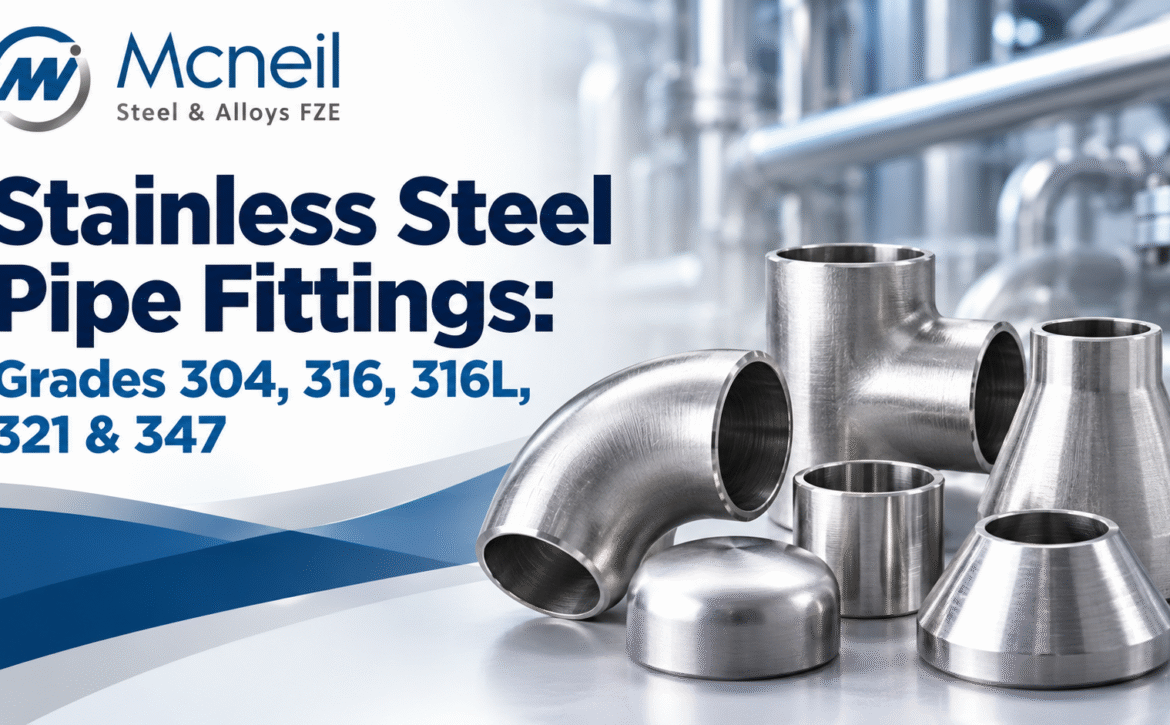
Stainless Steel Pipe Fittings: Grades 304, 316, 316L, 321 & 347

Introduction

Stainless steel pipe fittings are essential components in industrial piping systems, helping connect pipes, change flow direction, reduce pipe sizes, and create secure pipeline connections. These fittings are widely used in industries such as oil and gas, petrochemicals, chemical processing, power generation, pharmaceuticals, and food processing because of their corrosion resistance, durability, and dependable performance.

However, not all stainless steel grades offer the same properties. Grades 304, 316, 316L, 321, and 347 have different chemical compositions and performance characteristics, making each suitable for specific operating conditions. Selecting the right grade is important for achieving long-term reliability, minimizing maintenance requirements, and meeting project specifications.

At Mcneil Alloys, we understand the importance of choosing suitable stainless steel materials for industrial applications. This guide explains the key features, differences, and applications of these five stainless steel grades to help you make an informed decision.

What Are Stainless Steel Pipe Fittings?

Stainless steel pipe fittings are components used to connect, redirect, branch, or modify piping systems. They are available in different shapes, sizes, pressure classes, and material grades to accommodate various industrial requirements.

Common types of stainless steel pipe fittings include elbows, tees, reducers, caps, crosses, and stub ends. Depending on the application, fittings may be manufactured as butt-weld, socket-weld, or threaded fittings.

The appropriate fitting depends on factors such as operating pressure, temperature, fluid composition, corrosion exposure, installation method, and applicable industry standards.

Stainless Steel Grade 304 Pipe Fittings

Grade 304 is one of the most widely used austenitic stainless steel grades. It contains chromium and nickel, providing good corrosion resistance in many general industrial and commercial environments.

Key Features of Grade 304
Good corrosion resistance in many atmospheric and industrial environments.
Good formability and weldability.
Suitable for a wide range of general-purpose applications.
Available in various fitting configurations and dimensions.
Applications of Grade 304 Pipe Fittings

Grade 304 stainless steel pipe fittings are commonly used in food processing equipment, water systems, general industrial pipelines, architectural applications, and manufacturing facilities.

However, Grade 304 may not be the best choice for environments with significant chloride exposure, where localized corrosion can become a concern.

Stainless Steel Grade 316 Pipe Fittings

Grade 316 stainless steel contains molybdenum, which improves its resistance to pitting and crevice corrosion in many chloride-containing environments compared with Grade 304.

Key Features of Grade 316
Improved resistance to chloride-related corrosion compared with Grade 304.
Good mechanical properties across a range of operating conditions.
Suitable for many chemical processing and marine-related applications.
Good weldability using appropriate procedures.
Applications of Grade 316 Pipe Fittings

Grade 316 pipe fittings are widely used in chemical processing plants, marine equipment, pharmaceutical manufacturing, coastal industrial facilities, and selected oil and gas applications.

Although Grade 316 offers improved corrosion resistance, it is not immune to corrosion in every chloride-containing environment. The concentration, temperature, and exposure conditions must be considered when selecting the material.

Stainless Steel Grade 316L Pipe Fittings

Grade 316L is the low-carbon version of Grade 316. Its reduced carbon content helps minimize the risk of sensitization and associated intergranular corrosion during welding, particularly in applications where post-weld heat treatment is not performed.

Key Features of Grade 316L
Lower carbon content than standard Grade 316.
Reduced susceptibility to sensitization during welding.
Good corrosion resistance in many industrial environments.
Suitable for fabricated and welded piping systems.

Applications of Grade 316L Pipe Fittings

Grade 316L fittings are commonly used in pharmaceutical facilities, chemical processing plants, food and beverage production, water treatment systems, and industrial piping networks requiring welded stainless steel components.

For projects involving extensive welding or exposure to corrosive process media, Grade 316L may be preferred over Grade 316, subject to the design requirements.

Stainless Steel Grade 321 Pipe Fittings

Grade 321 is a titanium-stabilized austenitic stainless steel. Titanium helps stabilize the material against chromium carbide precipitation during exposure to certain elevated-temperature conditions.

Key Features of Grade 321
Titanium stabilization helps reduce sensitization-related concerns.
Suitable for selected elevated-temperature applications.
Good oxidation resistance under appropriate service conditions.
Good weldability when suitable fabrication procedures are followed.

Applications of Grade 321 Pipe Fittings

Grade 321 stainless steel pipe fittings are used in selected high-temperature process piping systems, exhaust systems, thermal processing equipment, chemical processing facilities, and aerospace-related applications.

The suitability of Grade 321 depends on the actual operating temperature, thermal cycling, corrosive environment, and applicable engineering standards.

Stainless Steel Grade 347 Pipe Fittings

Grade 347 is a niobium-stabilized austenitic stainless steel. Niobium, also known as columbium, helps reduce the risk of chromium carbide precipitation during exposure to certain temperature ranges.

Key Features of Grade 347
Niobium stabilization supports resistance to sensitization.
Suitable for selected elevated-temperature applications.
Good oxidation resistance under appropriate operating conditions.
Useful in welded components exposed to demanding thermal conditions.

Applications of Grade 347 Pipe Fittings

Grade 347 fittings are used in selected power generation systems, refinery equipment, chemical processing plants, heat exchangers, and elevated-temperature piping applications.

The final grade selection should account for service temperature, corrosion conditions, mechanical requirements, fabrication methods, and project specifications.

Difference Between Stainless Steel Grades 304, 316, 316L, 321, and 347

Each stainless steel grade offers distinct advantages depending on the operating environment.

Grade 304: A versatile choice for general-purpose applications requiring good corrosion resistance and fabrication characteristics.

Grade 316: Contains molybdenum, improving resistance to pitting and crevice corrosion in many chloride-containing environments.

Grade 316L: A low-carbon version of Grade 316, often preferred for welded components where reducing sensitization risk is important.

Grade 321: A titanium-stabilized grade used in selected applications involving elevated temperatures and thermal exposure.

Grade 347: A niobium-stabilized grade suitable for selected elevated-temperature applications where stabilization is beneficial.

The most suitable grade cannot be determined by price or alloy composition alone. Engineers should evaluate the complete operating environment, applicable standards, and material requirements before making a final selection.

How to Choose the Right Stainless Steel Pipe Fittings

Selecting the correct stainless steel pipe fittings requires careful consideration of several factors.

1. Corrosion Resistance
Evaluate the chemicals, moisture, chlorides, and other substances that the piping system will encounter. Grade 316 and 316L may provide advantages over Grade 304 in many chloride-containing environments, but severe conditions may require a different alloy.

2. Operating Temperature
Determine the normal operating temperature, maximum temperature, and any thermal cycling. Grades 321 and 347 may be suitable for certain elevated-temperature applications, depending on the engineering design.

3. Welding Requirements
Consider the fabrication method and extent of welding. Grade 316L is often preferred where its lower carbon content offers an advantage. Stabilized grades such as 321 and 347 may also be appropriate for particular thermal and fabrication conditions.

4. Pressure and Dimensions
Confirm the required fitting type, nominal pipe size, wall thickness, pressure rating, end connection, and dimensional standard.

5. Industry Standards
Check the applicable material specification, fitting standard, inspection requirements, and project documentation. Material grade alone does not establish suitability for a particular pressure or temperature.

6. Supplier Reliability
Choose a supplier that can support your procurement requirements with appropriate material identification, traceability, inspection records, and material test certificates.

Why Choose Mcneil Alloys for Stainless Steel Pipe Fittings?

Finding the right stainless steel pipe fittings involves matching material properties with project specifications, service conditions, and quality requirements.

Mcneil Alloys supports industrial buyers looking for alloy and stainless steel products for demanding applications. When sourcing Grades 304, 316, 316L, 321, or 347, buyers should confirm the available product forms, dimensions, specifications, documentation, and delivery requirements.

Whether your project involves chemical processing, oil and gas, power generation, marine applications, or general industrial piping, selecting the correct stainless steel grade can help support reliable system performance.

Contact Mcneil Alloys to discuss your stainless steel pipe fitting requirements and request information about suitable material options.

Conclusion

Stainless steel pipe fittings play an important role in maintaining the reliability and efficiency of industrial piping systems. Grades 304, 316, 316L, 321, and 347 each offer different advantages, from general corrosion resistance to improved resistance to chloride-related corrosion and stabilization for selected elevated-temperature applications.

Choosing the right grade requires evaluating corrosion exposure, temperature, welding requirements, pressure conditions, and applicable standards. By understanding these differences and working with a reliable supplier, businesses can make better material selection decisions for their industrial projects.

Need High-Quality Stainless Steel Pipe Fittings for Your Industrial Project?

Mcneil Alloys can help you explore stainless steel material options for your piping requirements. Contact our team to discuss Grades 304, 316, 316L, 321, and 347, along with your required dimensions, specifications, and documentation.

Website: https://mcneilalloys.ae/
Phone: +91 98708 83613
Email: info@mcneilalloys.ae

Get in touch with Mcneil Alloys to discuss your requirements and request a quotation.

Frequently Asked Questions (FAQs)

1. What are stainless steel pipe fittings used for?
Stainless steel pipe fittings connect pipes, change flow direction, create branches, and modify pipe sizes. They are widely used in oil and gas, chemical processing, power generation, pharmaceuticals, food processing, and other industries.

2. What is the difference between stainless steel Grades 304 and 316?
Grade 316 contains molybdenum, which improves resistance to pitting and crevice corrosion in many chloride-containing environments compared with Grade 304. The best choice depends on the actual service conditions.

3. What is the difference between Grade 316 and Grade 316L?
Grade 316L has a lower carbon content than Grade 316. This reduces the risk of sensitization during welding and can make Grade 316L preferable for certain welded piping applications.

4. Why are Grade 321 stainless steel pipe fittings used at elevated temperatures?
Grade 321 contains titanium, which stabilizes the steel and helps reduce chromium carbide precipitation under certain thermal exposure conditions. Its suitability depends on the application and operating temperature.

5. What makes Grade 347 stainless steel different?
Grade 347 is stabilized with niobium, which helps reduce sensitization-related concerns during exposure to certain temperature ranges. It is used in selected welded and elevated-temperature applications.

6. Which stainless steel grade is best for chemical processing?
Grades 316 and 316L are often considered for chemical processing because of their corrosion resistance. However, the appropriate grade depends on the specific chemical, concentration, temperature, and operating conditions.

7. Are stainless steel pipe fittings available in different types?
Yes. Common types include elbows, tees, reducers, caps, crosses, and stub ends. They may also be available in butt-weld, socket-weld, and threaded configurations, depending on the product range.

8. How can I verify the quality of stainless steel pipe fittings?
Review the applicable material specification, material test certificate, chemical composition, mechanical test results where required, dimensional inspection records, and traceability documentation.

9. How do I select the right stainless steel pipe fitting grade?
Consider corrosion resistance, operating temperature, pressure, welding requirements, fitting dimensions, applicable standards, and the process medium before selecting a grade.

10. How can I enquire about stainless steel pipe fittings from Mcneil Alloys?
Visit the official Mcneil Alloys website to contact the team, discuss your project specifications, confirm product availability, and request a quotation.

Read More
admin October 23, 2026 0 Comments

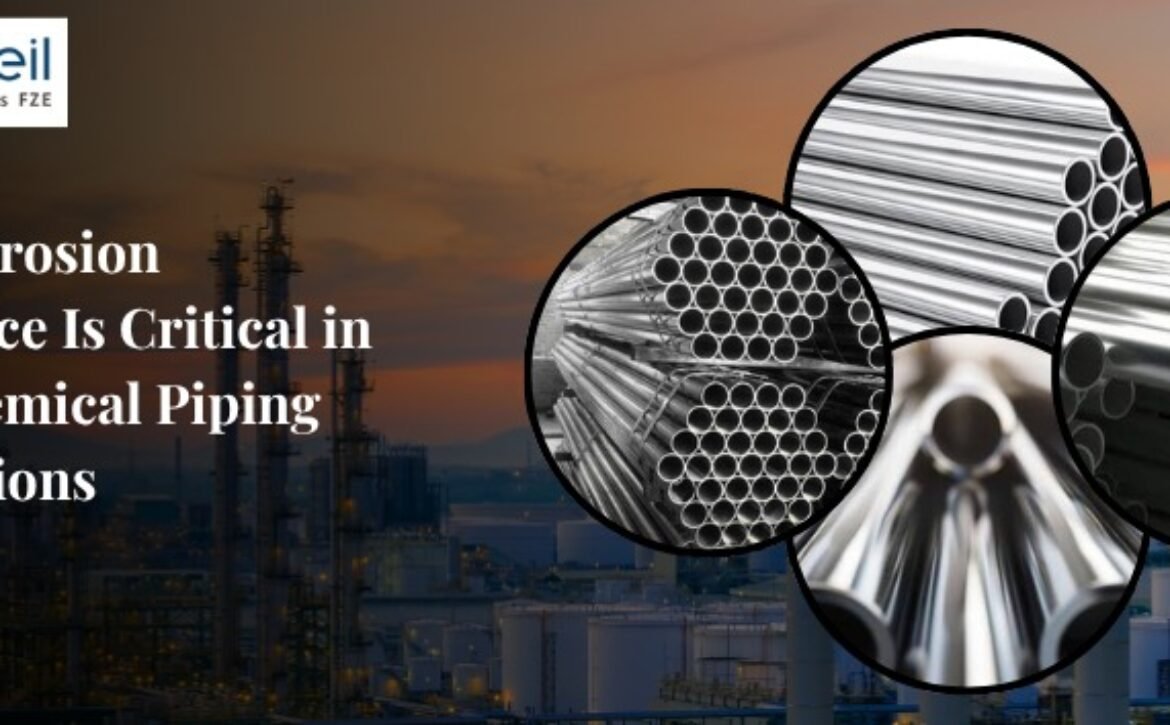
Why Corrosion Resistance Is Critical in Petrochemical Piping Applications

Petrochemical piping systems operate under some of the most demanding conditions in industrial processing. High temperatures, pressure fluctuations, hydrocarbons, acids, chlorides, moisture, sulfur-containing compounds and other aggressive process media can gradually attack piping materials and reduce their service life.

For this reason, corrosion resistance is a critical consideration when selecting pipes, flanges, pipe fittings, valves and other pressure-containing components for petrochemical applications.

Corrosion does more than affect the appearance of a metal surface. Depending on the mechanism and operating conditions, it can cause wall thinning, pitting, cracking, leakage, loss of mechanical integrity and unplanned shutdowns.

Material selection therefore needs to consider the complete service environment rather than simply choosing a material based on pressure or temperature.

Mcneil Alloys supplies industrial piping products in carbon steel, stainless steel, alloy steel, duplex, super duplex and nickel-based alloys for demanding applications across oil & gas, petrochemical, chemical processing, power and other industries.

What Is Corrosion in Petrochemical Piping?

Corrosion is the deterioration of a material caused by interaction with its surrounding environment.
In petrochemical piping, corrosion can occur internally, externally, or at localized areas such as welds, joints and crevices.
Common factors that contribute to corrosion include:
Water and moisture
Chlorides
Acids
Sulfur-containing compounds
Oxygen
Carbon dioxide
High temperatures
Contaminants
Chemical process fluids
Marine or coastal environments
Poor material compatibility
Incorrect fabrication or surface treatment

The specific corrosion mechanism depends on the process chemistry, temperature, pressure, material and operating conditions.
ASME’s technical literature on corrosion and materials in hydrocarbon production identifies corrosion threats, material selection and corrosion mitigation as important parts of hydrocarbon facility engineering and integrity management.

Why Corrosion Resistance Matters in Petrochemical Piping

A petrochemical plant can contain hundreds or thousands of metres of interconnected piping.
If the selected material has inadequate corrosion resistance, degradation can progressively affect:
Pipe walls
Elbows
Tees
Reducers
Flanges
Valves
Welded joints
Instrumentation connections
Pumps and equipment connections
The resulting problems can include:
Reduced wall thickness
Localized holes or pits
Leakage
Loss of pressure containment
Contamination
Reduced flow capacity
Increased maintenance requirements
Unplanned shutdowns
Replacement costs
Safety and environmental risks
Corrosion-resistant material selection is therefore closely connected to piping reliability and long-term plant operation.

Common Types of Corrosion in Petrochemical Piping

Different environments can produce different corrosion mechanisms.
1. General Corrosion
General corrosion occurs relatively uniformly across a metal surface.
Over time, continuous metal loss can reduce the wall thickness of a pipe or fitting.
This can become particularly important in systems where the component is expected to remain in service for many years.
2. Pitting Corrosion
Pitting is a localized form of corrosion that produces small cavities or pits in the metal.
The visible affected area can be relatively small, but individual pits can penetrate deeply into the material.
Pitting resistance is particularly important in environments containing chlorides.
Mcneil Alloys identifies stainless steel 316 pipe fittings as suitable for demanding environments involving saltwater, chemicals and industrial fluids, with corrosion and pitting resistance among their relevant properties.
3. Crevice Corrosion
Crevice corrosion can occur in confined areas where stagnant fluid or deposits develop.
Potential locations include:
Flange interfaces
Gasket areas
Bolted connections
Lap joints
Under deposits
Fitting connections
Material selection and good system design can help reduce susceptibility to localized corrosion.
4. Stress Corrosion Cracking
Stress corrosion cracking can occur when a susceptible material is exposed to a specific corrosive environment while subjected to tensile stress.
Chloride-containing environments are an important consideration for susceptible stainless steels.
Duplex and super duplex stainless steels are often considered where resistance to chloride-related corrosion mechanisms is required.
Mcneil Alloys states that Duplex 2205 and Super Duplex 2507 provide resistance to chloride stress corrosion cracking, pitting and crevice corrosion.
5. Erosion-Corrosion
High-velocity fluids, turbulence and suspended particles can accelerate material degradation.
Areas around:
Elbows
Tees
Reducers
Control valves
Flow restrictions
may experience increased turbulence.
The material must therefore be capable of handling both the chemical environment and the mechanical effects of fluid flow.
6. Corrosion Under Insulation
External corrosion can develop beneath insulation when moisture enters and remains trapped against the pipe surface.
This can be difficult to detect because the affected area is hidden beneath the insulation.
Proper insulation design, inspection and maintenance are therefore important parts of piping integrity management.

How Petrochemical Conditions Affect Material Selection

There is no single corrosion-resistant material that is suitable for every petrochemical application.
Material selection should consider:
Operating Factor Why It Matters
Process fluid Determines chemical compatibility
Chloride level Influences pitting and localized corrosion
Temperature Can accelerate corrosion and affect material strength
Pressure Determines mechanical requirements
Water content Can promote several corrosion mechanisms
Sulfur/H₂S Important for sour-service material selection
Flow velocity Can influence erosion-corrosion
pH Affects chemical attack
Marine exposure Increases chloride exposure
Welded construction Requires consideration of weld metallurgy and heat effects
Service life Influences lifecycle material selection
The objective is not simply to choose the most corrosion-resistant alloy available. The objective is to select a material that provides the required combination of corrosion resistance, mechanical strength, temperature capability, fabrication suitability and lifecycle value.

Stainless Steel in Petrochemical Piping

Stainless steel is widely used when corrosion resistance is required alongside mechanical performance and fabrication practicality.
Common grades include:
304
304L
316
316L
321
347
Mcneil Alloys supplies these stainless-steel grades in pipe fittings for applications including petrochemical plants, refineries, chemical processing, marine systems and other demanding industrial environments.

Stainless Steel 304
SS 304 provides general corrosion resistance and is widely used for industrial piping and process applications where the environment is not excessively aggressive.

Stainless Steel 316
SS 316 contains molybdenum, which improves resistance to localized corrosion compared with conventional 304 stainless steel.
It can be considered for applications involving:
Chloride exposure
Saltwater
Chemical processing
Petrochemical fluids
Marine environments
Stainless Steel 316L
316L is the low-carbon version of 316.
The lower carbon content can be beneficial for welded construction because it reduces the potential for sensitization associated with welding under applicable conditions.
Mcneil Alloys specifically positions 316L fittings for corrosive environments including chemical, petrochemical, marine and offshore applications.

Stainless Steel 321 and 347
High-temperature petrochemical systems may require stabilized stainless-steel grades.
321 uses titanium stabilization, while 347 uses niobium stabilization.

Mcneil Alloys describes 321 and 347 pipe fittings for high-temperature applications including petrochemical plants, chemical processing, refineries and heat exchangers.

Duplex Stainless Steel for Corrosion and Strength

Duplex stainless steels combine austenitic and ferritic metallurgical structures.
This combination provides a useful balance of:
High mechanical strength
Corrosion resistance
Resistance to chloride-related degradation
Pressure capability
Long service life
Duplex 2205
Duplex 2205 is commonly considered for demanding process environments where conventional austenitic stainless steels may not provide the required combination of strength and corrosion resistance.
Mcneil Alloys lists Duplex 2205 with approximately:
Chromium: 21–23%
Nickel: 4.5–6.5%
Molybdenum: 2.5–3.5%
Tensile strength: ≥620 MPa
Yield strength: ≥450 MPa
Temperature range listed by Mcneil Alloys: −50°C to +300°C
The listed standards include ASTM A182, ASTM A789 and ASME SA182.

Super Duplex 2507 for More Aggressive Environments

Super Duplex 2507 provides higher alloy content and higher mechanical strength than Duplex 2205.
Mcneil Alloys lists approximately:
Chromium: 24–26%
Nickel: 6–8%
Molybdenum: 3–5%
Nitrogen: 0.24–0.32%
Tensile strength: ≥800 MPa
Yield strength: ≥550 MPa
Temperature range listed: −50°C to +300°C
The material is positioned for aggressive, high-pressure and high-chloride applications where corrosion resistance and mechanical strength are both important.
Applications can include:
Offshore oil & gas
Seawater systems
Desalination
Petrochemical processing
Chemical plants
High-pressure process piping

Nickel Alloys for Severe Corrosion Service

Some petrochemical environments are too aggressive for conventional stainless steels.
In such situations, nickel-based alloys may be considered.
Examples include:
Inconel
Hastelloy
Monel
Incoloy
These materials can provide specialized combinations of corrosion resistance, high-temperature capability and mechanical performance.
Material selection must nevertheless be based on the actual process chemistry rather than simply selecting a nickel alloy because the service is classified as “corrosive.”

Corrosion Resistance and Flange Selection

Flanges are critical connection points in petrochemical piping.
A corrosion-resistant pipe connected to an unsuitable flange can still create a reliability problem.
Flange selection should consider:
Flange material
Process fluid
Pressure
Temperature
Corrosion environment
Flange facing
Gasket material
Bolting
Welding requirements
Applicable standard

Mcneil Alloys supplies flanges in materials including carbon steel, alloy steel, stainless steel, duplex, super duplex and nickel alloys for demanding energy and petrochemical applications. Its current project-focused flange information also highlights the importance of material condition, facing accuracy, traceability and documentation.

Corrosion Resistance of Pipe Fittings

Pipe fittings are particularly important because changes in flow direction can increase turbulence and localized stresses.
Common fittings include:
45° elbows
90° elbows
180° elbows
Equal tees
Reducing tees
Concentric reducers
Eccentric reducers
Crosses
Caps
Stub ends
Couplings

The fitting material should be compatible with the pipe and process environment.
Mcneil Alloys supplies stainless steel, duplex, super duplex, alloy steel and other piping materials for industrial applications.

Why Material Traceability Matters

Corrosion-resistant alloys only provide their expected performance when the supplied material actually meets the specified chemistry and mechanical requirements.

Material traceability can therefore be important for critical petrochemical projects.
Documentation may include:
Material Test Certificates
Heat numbers
Chemical composition
Mechanical test results
PMI reports
Dimensional inspection
NDT reports
Hydrostatic testing
Third-party inspection records

Mcneil Alloys’ project-oriented supply information emphasizes heat-number traceability, inspection and documentation for demanding piping applications.

The Role of PMI in Corrosion-Resistant Piping

Positive Material Identification, or PMI, is used to verify the alloy composition of materials.
This can be particularly important when multiple stainless steel, duplex or nickel alloy grades are present on a project site.
PMI can help verify that:
The correct material was supplied
Materials have not been incorrectly mixed
Specified alloying elements are present
Components can be traced to project documentation

For critical petrochemical piping, material verification can form an important part of quality assurance.

Welding and Corrosion Resistance

Welding can influence the corrosion performance of piping materials.

Important considerations include:
Welding procedure
Filler metal
Heat input
Interpass temperature
Post-weld treatment where required
Weld inspection
Heat-affected zone behavior
This is especially relevant for stainless steel and duplex stainless steel.

For example, duplex stainless steel requires appropriate control of welding parameters because the resulting metallurgical balance can influence mechanical and corrosion properties.

The material’s corrosion resistance therefore needs to be considered not only in its base-metal condition but also after fabrication.

Corrosion Resistance vs Initial Cost

A common misconception is that the least expensive material always provides the lowest project cost.

A lower-cost material can become more expensive over the complete service life if it requires:
Frequent replacement
Corrosion monitoring
Repairs
Coating maintenance
Additional inspection
Production shutdowns
Emergency intervention

A higher-alloy material may have a greater initial purchase price while providing a longer service life or reduced maintenance requirement in the right application.

The appropriate comparison should therefore consider total lifecycle cost, not only initial material price.

How Corrosion Can Affect Petrochemical Plant Reliability

Corrosion can gradually reduce the reliability of a piping network.
A simplified chain can look like:
Aggressive Environment → Material Degradation → Wall Loss/Pitting → Reduced Integrity → Leakage or Failure → Maintenance/Downtime
Preventing this progression requires a combination of:
Correct material selection
Corrosion assessment
Appropriate fabrication
Inspection
Monitoring
Maintenance
Operating control
Material selection is one part of a broader corrosion-management strategy.

How to Select Corrosion-Resistant Piping Materials

A practical material-selection process can include the following steps.
Step 1: Identify the Process Medium
Determine whether the piping carries:
Hydrocarbons
Water
Steam
Acids
Alkaline chemicals
Sour gas
Chloride-containing fluids
Seawater
Mixed-phase fluids
Step 2: Establish Operating Conditions
Document:
Pressure
Temperature
Flow velocity
Temperature cycling
Pressure cycling
Normal and upset conditions
Step 3: Identify Corrosion Threats
Consider:
General corrosion
Pitting
Crevice corrosion
Stress corrosion cracking
Erosion-corrosion
Sulfide-related damage
Corrosion under insulation
Galvanic corrosion
Step 4: Compare Candidate Materials
Depending on the application, candidates may include:
Carbon steel
304/304L stainless steel
316/316L stainless steel
321/347 stainless steel
Duplex 2205
Super Duplex 2507
Monel
Inconel
Hastelloy
Other specialized alloys
Step 5: Verify Fabrication Requirements
Check:
Welding
Heat treatment
Forming
Machining
Surface finish
Inspection requirements
Step 6: Establish Inspection and Documentation
Define requirements for:
PMI
MTCs
NDT
Hydrotesting
Dimensional inspection
Traceability
Third-party inspection

Carbon Steel vs Corrosion-Resistant Alloys

Carbon steel remains widely used in petrochemical infrastructure because it can provide useful mechanical performance and cost advantages.
However, it may require additional corrosion-management measures depending on the environment.
Corrosion-resistant alloys may provide advantages where the process environment creates a greater corrosion threat.
Material General Characteristics Typical Considerations
Carbon Steel Strength and cost efficiency May require corrosion-control measures
SS 304/304L General corrosion resistance Moderate industrial environments
SS 316/316L Improved localized corrosion resistance Chlorides, chemicals, marine environments
SS 321/347 High-temperature stainless grades Elevated-temperature process service
Duplex 2205 High strength + corrosion resistance Chloride and demanding process environments
Super Duplex 2507 Very high strength + aggressive corrosion resistance High-chloride and severe service
Nickel Alloys Specialized corrosion/high-temperature performance Highly demanding chemical environments
This comparison is a general material-selection guide. Actual suitability must be determined from the process chemistry, operating conditions and applicable engineering requirements.

Petrochemical Applications Where Corrosion Resistance Is Important

Corrosion-resistant piping materials may be required in:
Refineries
Refinery systems can expose piping to hydrocarbons, chemicals, sulfur-containing compounds and elevated temperatures.
Petrochemical Processing Plants
Chemical processing streams may contain aggressive fluids that require carefully selected piping materials.
Oil & Gas Processing
Produced fluids and process streams can contain water, salts, gases and other corrosive constituents.
Offshore Facilities
Offshore piping is exposed to marine atmospheres and potentially chloride-rich environments.
Desalination and Water Treatment
High-chloride water and seawater can create significant corrosion challenges.
Chemical Plants
Chemical composition, concentration and temperature can strongly influence material compatibility.

Mcneil Alloys for Corrosion-Resistant Petrochemical Piping

Mcneil Alloys provides piping products across several material categories to address different industrial service requirements.

Its current portfolio includes:
Stainless steel pipe fittings
Duplex 2205 fittings
Super Duplex 2507 fittings
Alloy steel fittings
Stainless steel flanges
Duplex and super duplex components
Nickel-alloy products
Industrial pipes and related piping components

Mcneil Alloys’ published product information positions Duplex 2205 and Super Duplex 2507 for demanding corrosive and high-pressure environments, while its stainless-steel fittings include grades such as 316L, 321 and 347 for chemical, petrochemical and high-temperature applications.
The company also supplies piping materials for oil & gas, petrochemical, chemical, power, marine and offshore applications.

Best Practices for Reducing Corrosion in Petrochemical Piping

A reliable corrosion-control strategy can include:
Select materials based on actual process chemistry.
Consider temperature and pressure alongside corrosion exposure.
Evaluate chloride and sour-service conditions.
Use appropriate corrosion-resistant alloys where required.
Verify material identity through documentation and PMI.
Use qualified welding procedures.
Control fluid velocity where erosion-corrosion is a concern.
Inspect high-risk areas regularly.
Monitor wall thickness where applicable.
Maintain insulation and external protective systems.
Avoid incompatible material combinations where galvanic corrosion may occur.
Maintain complete material traceability.

Frequently Asked Questions

Why is corrosion resistance important in petrochemical piping?
Corrosion can cause wall thinning, pitting, cracking and leakage, potentially reducing piping integrity and increasing maintenance and downtime. Selecting materials with appropriate corrosion resistance helps address the specific threats presented by the process environment.
Which stainless steel is commonly considered for corrosive petrochemical service?
Grades such as 316 and 316L may be considered where improved localized corrosion resistance is required compared with 304 grades. The correct material depends on the actual process chemistry and operating conditions.
Is Duplex 2205 suitable for petrochemical piping?
Duplex 2205 combines high mechanical strength with corrosion resistance and is used for demanding applications. Mcneil Alloys lists it for high-pressure and corrosive environments and identifies resistance to chloride stress corrosion cracking, pitting and crevice corrosion.
When is Super Duplex 2507 considered?
Super Duplex 2507 can be considered for aggressive environments requiring a combination of high strength and strong resistance to localized and chloride-related corrosion.
Is stainless steel always better than carbon steel for petrochemical piping?
Not necessarily. Material selection depends on the specific process environment, mechanical requirements, temperature, corrosion mechanism, fabrication requirements and lifecycle economics. Carbon steel can remain appropriate for many services when the overall corrosion-control strategy supports its use.
What is PMI in petrochemical piping?
PMI, or Positive Material Identification, is a method used to verify the alloy composition of a material. It can help confirm that the supplied piping component corresponds to the specified material grade.
How does temperature affect corrosion?
Temperature can influence the rate and mechanism of corrosion and can also affect the mechanical properties and allowable service conditions of piping materials. Therefore, corrosion assessment should consider both process chemistry and temperature.
What documentation is important for corrosion-resistant piping?
Depending on project requirements, documentation can include Material Test Certificates, heat-number traceability, chemical and mechanical test results, PMI, dimensional inspection, NDT and pressure-test records.

Conclusion

Corrosion resistance is critical in petrochemical piping because the process environment can continuously challenge the material’s mechanical integrity and service life.

The correct material cannot be selected by looking at pressure or temperature alone. Engineers must consider the process fluid, chloride exposure, chemical composition, temperature, flow conditions, corrosion mechanisms, welding requirements and expected service life.

Stainless steel grades such as 316L, stabilized grades such as 321 and 347, Duplex 2205, Super Duplex 2507 and nickel-based alloys each provide different combinations of corrosion resistance and mechanical performance. Mcneil Alloys’ current product portfolio covers several of these material families for demanding petrochemical, oil & gas, chemical, offshore and industrial applications.

The most effective approach is therefore to treat material selection as part of the overall piping integrity and corrosion-management strategy. When the correct alloy is combined with appropriate fabrication, inspection, traceability and maintenance practices, petrochemical piping systems can achieve the reliability required for demanding continuous-service operations.

Read More
admin October 3, 2026 0 Comments