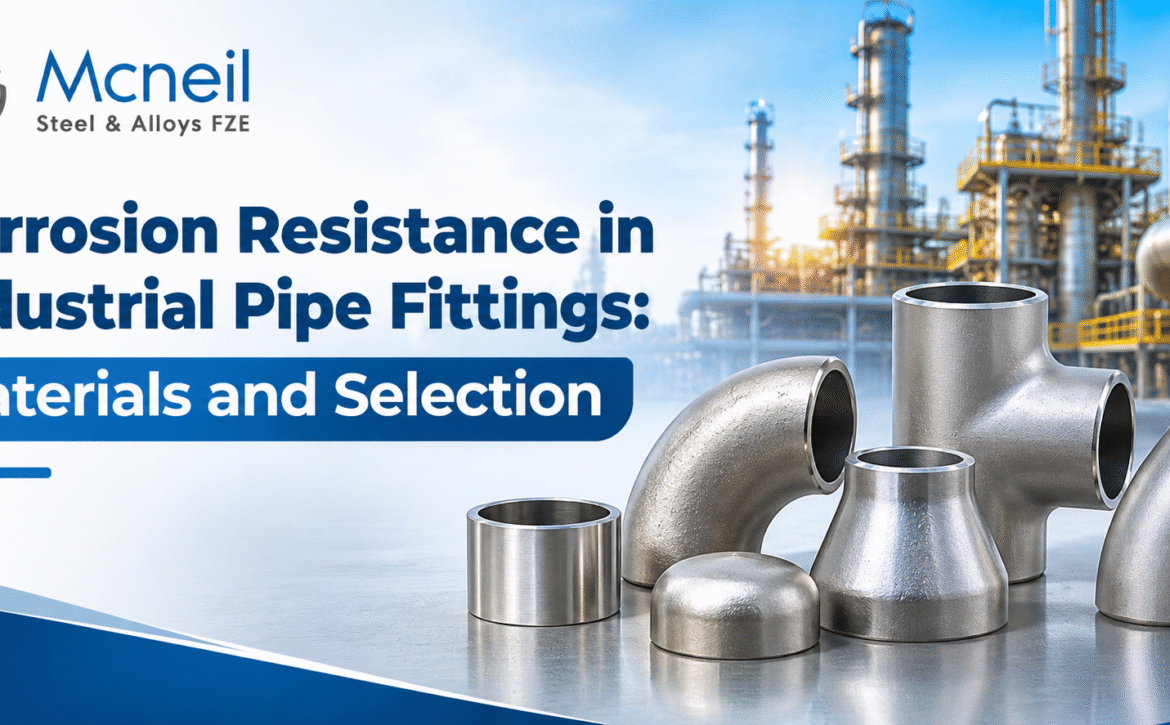
Corrosion Resistance in Industrial Pipe Fittings: Materials and Selection
Introduction
Corrosion is one of the major challenges faced by industries that operate with chemicals, high temperatures, moisture, seawater and aggressive operating environments. Industrial pipe fittings are continuously exposed to different process conditions, making material selection an important factor in maintaining piping system reliability, safety and long-term performance.
Choosing corrosion-resistant pipe fittings helps reduce leakage risks, equipment damage, unexpected maintenance and operational downtime. At Mcneil Alloys, we understand the importance of selecting suitable materials for industrial piping applications, particularly in oil and gas, petrochemical, marine, power generation and chemical processing industries.
In this article, we explore the common causes of corrosion, different corrosion-resistant materials used in industrial pipe fittings and the important factors to consider when selecting the right material for your application.
1. What Causes Corrosion in Industrial Pipe Fittings?
Corrosion occurs when metals react with their surrounding environment, gradually affecting their surface, strength and performance. Depending on the operating conditions, industrial pipe fittings can experience different forms of corrosion.
Some common causes include:
Chemical Exposure: Acids, alkalis and aggressive chemicals can damage metal surfaces.
Moisture and Humidity: Continuous exposure to water and humid environments can accelerate corrosion.
High Temperatures: Elevated temperatures can increase oxidation and affect material performance.
Saltwater Exposure: Chlorides present in seawater can cause pitting and crevice corrosion.
Dissimilar Metal Contact: Connecting different metals under certain conditions can lead to galvanic corrosion.
Improper Material Selection: Using materials that are unsuitable for the process environment can result in premature failure.
Understanding these factors helps engineers and procurement teams select appropriate pipe fittings for their industrial requirements.
2. Common Types of Corrosion in Industrial Pipe Fittings
Different operating environments can produce different corrosion mechanisms.
Uniform Corrosion: This occurs evenly across the exposed metal surface, gradually reducing material thickness.
Pitting Corrosion: Localised corrosion creates small holes or cavities on the metal surface. It is particularly important to consider in chloride-containing environments.
Crevice Corrosion: This develops in confined spaces, such as gaps between connected components, where stagnant solutions can accumulate.
Galvanic Corrosion: This occurs when dissimilar metals are electrically connected in the presence of an electrolyte.
Stress Corrosion Cracking: A combination of tensile stress and a corrosive environment can cause cracks to develop in susceptible materials.
Intergranular Corrosion: This affects the grain boundaries of certain alloys and can compromise material integrity.
Understanding the corrosion mechanism is essential before selecting a pipe fitting material.
3. Materials Used for Corrosion-Resistant Industrial Pipe Fittings
Selecting the right material is essential for improving the service life and reliability of industrial piping systems. Different alloys offer different levels of corrosion resistance depending on their chemical composition and operating conditions.
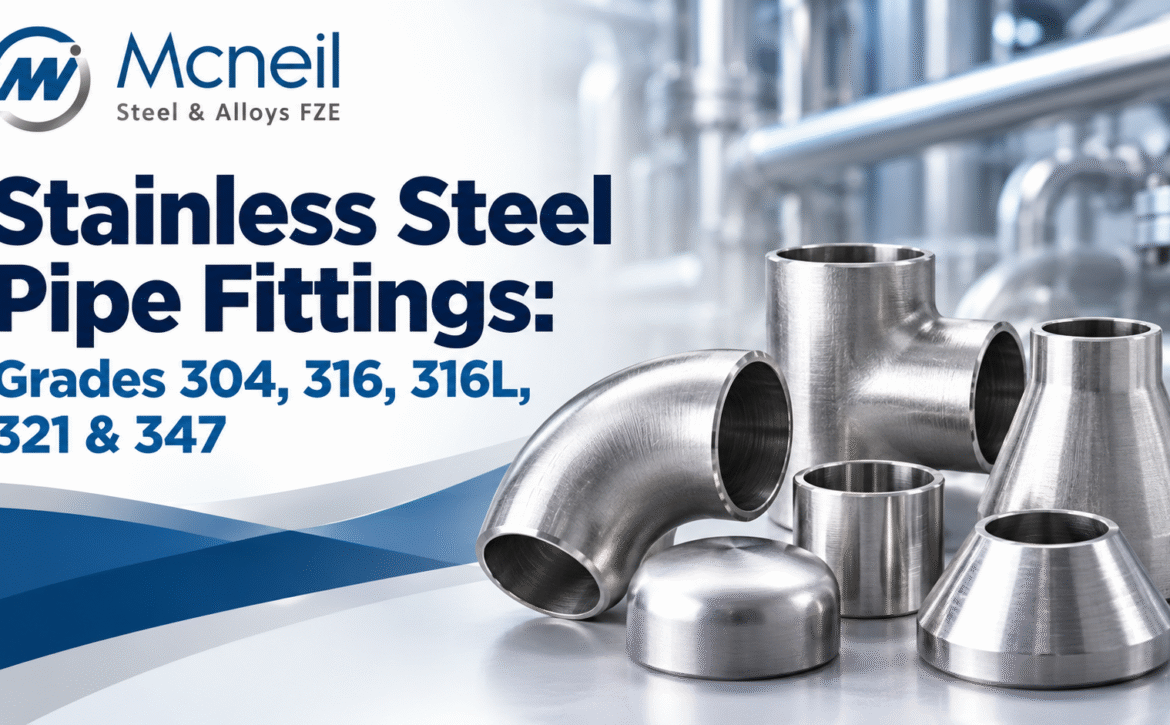
Stainless Steel Pipe Fittings
Stainless steel is widely used in industrial piping applications because of its corrosion resistance, mechanical strength and durability.
SS 304: Commonly used in general industrial applications and environments with moderate corrosion exposure.
SS 316: Contains molybdenum, which improves resistance to pitting and crevice corrosion in chloride-containing environments compared with SS 304.
SS 316L: A low-carbon grade commonly selected for applications where improved resistance to sensitisation after welding is important.
Duplex and Super Duplex Stainless Steel Pipe Fittings
Duplex stainless steels combine austenitic and ferritic microstructures, offering a balance of strength and corrosion resistance.
Super Duplex grades provide enhanced resistance to pitting, crevice corrosion and chloride stress corrosion cracking. These materials are commonly considered for offshore, marine, desalination and demanding oil and gas applications.
Hastelloy Pipe Fittings
Hastelloy alloys are nickel-based materials developed for demanding corrosive environments. Depending on the grade, they offer resistance to various acids, chemicals and aggressive process media.
They are used in chemical processing, pollution control and specialised industrial applications where conventional stainless steel may not provide sufficient resistance.
Inconel Pipe Fittings
Inconel is a family of nickel-chromium-based alloys known for their high-temperature strength and resistance to oxidation and certain corrosive environments.
Inconel 625, for example, is considered for applications involving seawater, chemical processing and demanding industrial operating conditions.
Monel Pipe Fittings
Monel alloys, primarily based on nickel and copper, are used in applications requiring resistance to seawater and selected corrosive chemical environments.
Monel 400 is commonly used in marine equipment, chemical processing and offshore applications.
Incoloy Pipe Fittings
Incoloy alloys are nickel-iron-chromium-based materials designed for applications requiring a combination of corrosion resistance and high-temperature performance.
Their applications include heat exchangers, chemical processing equipment and industrial heating systems.
Titanium Pipe Fittings
Titanium offers excellent resistance to seawater and several oxidising environments. It is particularly useful in marine engineering, desalination plants, chemical processing and specialised industrial applications.
The correct titanium grade must be selected according to the process chemistry and operating conditions.
4. Important Factors to Consider When Selecting Corrosion-Resistant Pipe Fittings
Selecting the correct pipe fitting material requires evaluating the complete operating environment rather than considering corrosion resistance alone.
1. Chemical Composition of the Process Fluid
Identify the chemicals, acids, alkalis, chlorides and other substances that will come into contact with the fitting. Different alloys offer different resistance levels against specific chemicals.
2. Operating Temperature
Temperature can significantly influence corrosion rates and material performance. Select a material that can withstand both normal operating temperatures and foreseeable temperature variations.
3. Operating Pressure
Pipe fittings must meet the pressure requirements of the piping system. Material strength, wall thickness, fitting design and applicable pressure ratings should all be considered.
4. Chloride Concentration
Chloride exposure is an important consideration for marine, offshore and desalination applications. Stainless steel grades should be evaluated carefully for pitting, crevice corrosion and stress corrosion cracking.
5. Welding and Fabrication Requirements
Welding can influence corrosion performance in certain stainless steel grades. Low-carbon grades such as 304L and 316L are often considered where welded fabrication is required.
6. Applicable Industry Standards
Always verify the applicable ASTM, ASME and project-specific requirements for material composition, dimensions, manufacturing and inspection.
5. Comparison of Common Materials Used in Industrial Pipe Fittings
The following table provides a general overview of commonly selected materials and their typical industrial applications.
Material Key Characteristics Typical Applications
SS 304 General corrosion resistance Industrial process piping, water systems
SS 316 Improved resistance to chloride-related localized corrosion compared with 304 Marine, chemical and offshore
SS 316L Low carbon, suitable for welded fabrication Chemical and process piping
Duplex Steel High strength and good resistance to localized corrosion Offshore and marine
Super Duplex Enhanced strength and localized corrosion resistance Seawater and demanding offshore systems
Inconel High-temperature strength and oxidation resistance, depending on grade Chemical and high-temperature systems
Monel Nickel-copper alloy with good resistance in selected marine environments Marine and chemical processing
Hastelloy Resistance to various aggressive chemical environments, depending on grade Chemical processing
Titanium Excellent resistance in seawater and selected chemical environments Desalination and marine
The final material selection should always be based on the actual service conditions, material grade and engineering specifications.
6. Industrial Applications of Corrosion-Resistant Pipe Fittings
Corrosion-resistant pipe fittings are essential in industries where piping components are exposed to demanding operating conditions.
Oil and Gas Industry
Oil and gas facilities require pipe fittings capable of handling hydrocarbons, process chemicals, pressure variations and corrosive environments. Stainless steel, duplex and nickel alloy fittings may be selected depending on the application.
Petrochemical Industry
Petrochemical plants handle different chemicals and process fluids. Suitable corrosion-resistant fittings help maintain the reliability of pipelines, processing equipment and transfer systems.
Marine and Offshore Industry
Seawater and chloride exposure can create challenging corrosion conditions. Duplex, super duplex, titanium, Monel and suitable stainless steel grades are considered for different marine applications.
Chemical Processing Industry
Chemical plants require materials compatible with the specific acids, alkalis and process chemicals being handled. Nickel-based alloys and specialised stainless steel grades may be suitable depending on chemical concentration and temperature.
Power Generation Industry
Power plants use piping systems for steam, cooling water and other process applications. Material selection must account for operating temperature, pressure, oxidation and corrosion conditions.
Water Treatment and Desalination
Water treatment and desalination facilities require materials that can withstand the chemistry of the water being processed. Titanium, duplex and suitable stainless steel grades are commonly evaluated for these environments.
7. How Proper Material Selection Reduces Maintenance and Operational Costs
Selecting the right corrosion-resistant pipe fittings can contribute to better equipment reliability and reduced maintenance requirements.
Some important benefits include:
Reduced Corrosion Damage: Suitable materials help minimise deterioration caused by process fluids and environmental exposure.
Improved System Reliability: Correct material selection helps maintain the integrity of piping connections.
Lower Maintenance Requirements: Reducing corrosion-related damage can help limit unexpected repairs and replacements.
Improved Operational Safety: Properly specified fittings help reduce the risk of leakage and component failure.
Longer Service Life: Materials selected for the actual operating environment can provide more dependable long-term performance.
However, corrosion resistance alone does not guarantee a particular service life. Installation quality, inspection, operating conditions and maintenance practices also play important roles.
8. Why Choose Mcneil Alloys for Industrial Pipe Fittings?
At Mcneil Alloys, we supply a wide range of industrial pipe fittings designed to meet the requirements of demanding industrial applications.
Our product range includes stainless steel, duplex, super duplex, Inconel, Monel, Hastelloy, Incoloy, carbon steel, alloy steel, copper nickel and titanium pipe fittings.
We support industrial requirements across oil and gas, petrochemical, marine, chemical processing, power generation and other engineering sectors.
Our product selection includes:
Stainless Steel Pipe Fittings
Duplex and Super Duplex Pipe Fittings
Inconel Pipe Fittings
Monel Pipe Fittings
Hastelloy Pipe Fittings
Incoloy Pipe Fittings
Carbon Steel Pipe Fittings
Alloy Steel Pipe Fittings
Copper Nickel Pipe Fittings
Titanium Pipe Fittings
We focus on supplying products according to customer specifications, applicable material standards and project requirements. Our range supports industrial buyers, EPC contractors, engineering companies and procurement teams across Dubai, Abu Dhabi, Sharjah and other UAE locations.
Explore our Industrial Pipe Fittings Range to find suitable material options for your project.
Conclusion
Corrosion resistance is an important consideration when selecting industrial pipe fittings for demanding operating environments. Factors such as chemical composition, chloride exposure, operating temperature, pressure and fabrication requirements all influence the suitability of a material.
Stainless steel, duplex, super duplex, Inconel, Monel, Hastelloy, Incoloy and titanium offer different performance characteristics for specific industrial applications.
At Mcneil Alloys, we understand the importance of selecting appropriate materials for industrial piping systems. Our range of industrial pipe fittings supports the requirements of oil and gas, petrochemical, marine, chemical processing and power generation industries.
Choosing the right pipe fitting material helps improve piping system reliability, minimise corrosion-related maintenance and support long-term industrial performance.
Looking for Reliable Corrosion-Resistant Industrial Pipe Fittings?
Choose the right material for your industrial piping requirements with Mcneil Alloys. Explore our extensive range of stainless steel, duplex, Inconel, Monel, Hastelloy, Incoloy and titanium pipe fittings for demanding industrial applications.
Contact our team to discuss your material specifications and project requirements.
Mcneil Alloys – Your Industrial Piping Solutions Partner
Request a Quote
Website: mcneilalloys.ae
Email: sales@mcneilalloys.ae
Phone: +91 987 088 3613
Frequently Asked Questions (FAQs)
1. What are the most corrosion-resistant materials used in industrial pipe fittings?
Stainless steel 316, duplex, super duplex, Inconel, Monel, Hastelloy and titanium are commonly considered for corrosion-resistant industrial applications. The appropriate material depends on the process environment and operating conditions.
2. What is the difference between SS 304 and SS 316 pipe fittings?
SS 304 is commonly used for general industrial applications, while SS 316 contains molybdenum, which improves resistance to pitting and crevice corrosion in many chloride-containing environments.
3. Which pipe fitting material is suitable for marine applications?
Duplex, super duplex, titanium, Monel and SS 316 are among the materials considered for marine applications. The final choice depends on seawater exposure, temperature, pressure and other service conditions.
4. Why are Hastelloy pipe fittings used in chemical processing industries?
Hastelloy alloys offer resistance to various aggressive chemicals and corrosive environments. Different Hastelloy grades are designed for different chemical conditions.
5. Are Inconel pipe fittings suitable for high-temperature applications?
Yes. Several Inconel grades provide excellent high-temperature strength and oxidation resistance. Their suitability depends on the specific grade and operating environment.
6. What causes pitting corrosion in stainless steel pipe fittings?
Pitting corrosion is commonly associated with chloride exposure. It causes localised damage to the metal surface and can eventually lead to leakage or component failure.
7. How can corrosion in industrial pipe fittings be prevented?
Corrosion can be managed through proper material selection, compatible fabrication methods, suitable installation practices, regular inspection and appropriate maintenance.
8. What factors should be considered when purchasing industrial pipe fittings?
Important factors include material grade, chemical compatibility, operating temperature, pressure rating, dimensions, connection type, applicable ASTM and ASME standards and project specifications.
9. Which industries require corrosion-resistant pipe fittings?
Oil and gas, petrochemical, marine, offshore, chemical processing, power generation, desalination and water treatment industries commonly require corrosion-resistant pipe fittings.
10. Where can I source corrosion-resistant industrial pipe fittings in UAE?
Mcneil Alloys supplies industrial pipe fittings in stainless steel, duplex, nickel alloys, carbon steel, alloy steel, copper nickel and titanium for industrial applications in the UAE and international markets.