Manufacturer & Exporters of:
Instrumentation Pipe Fittings & Valves

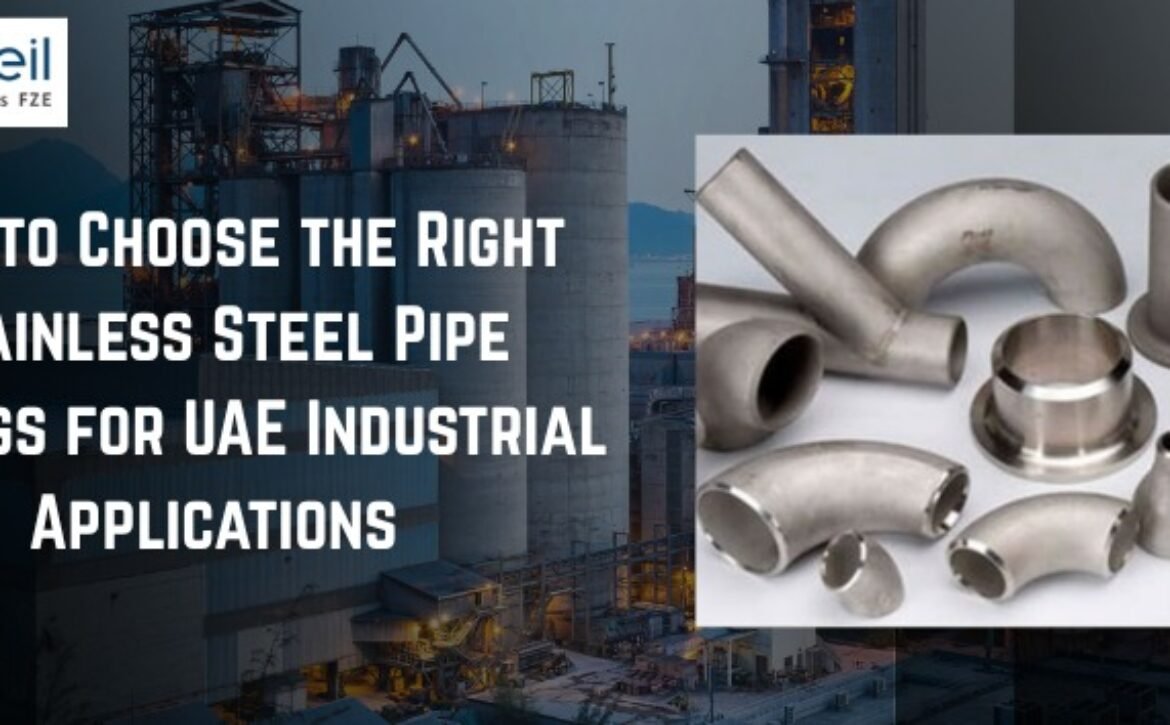
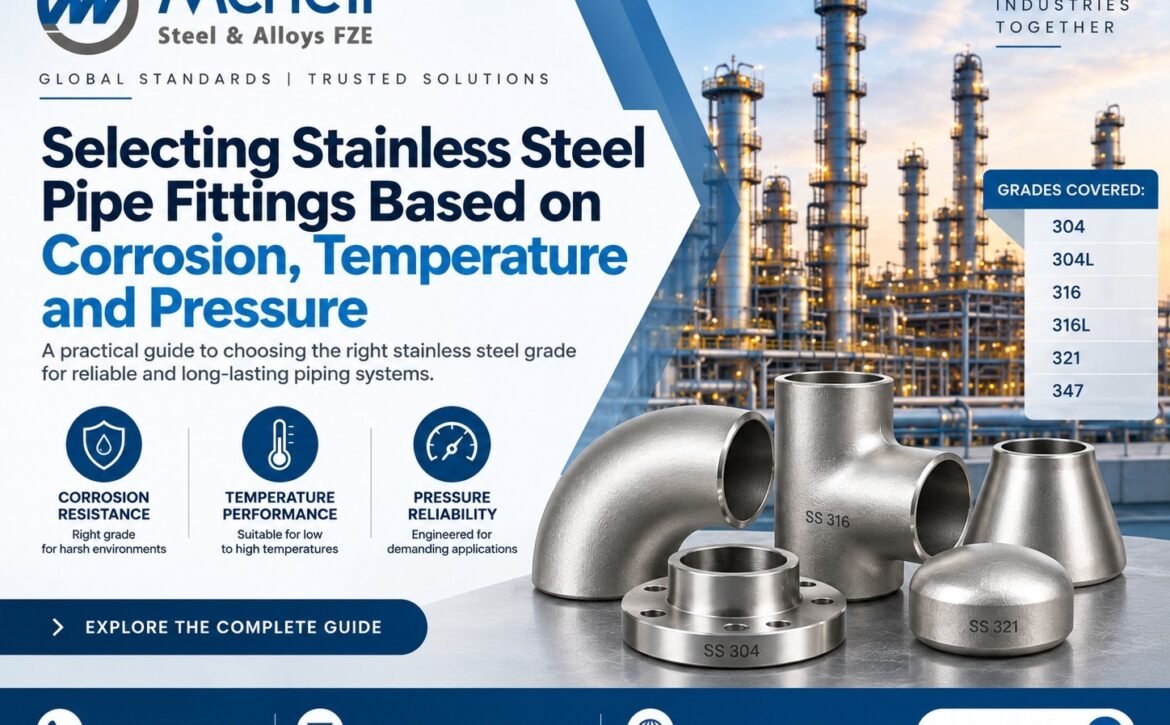
Selecting Stainless Steel Pipe Fittings Based on Corrosion, Temperature and Pressure: Mcneil Alloys

Industrial piping systems in the UAE can operate under a combination of corrosive chemicals, elevated temperatures, high pressure, chlorides, seawater and continuous operating cycles. Selecting stainless steel pipe fittings only by size or availability can result in material mismatch and premature deterioration.

The correct fitting grade should be selected according to the actual corrosion environment, operating temperature, pressure, fluid chemistry, welding requirements and applicable piping standards.

Mcneil Alloys supplies stainless steel pipe fittings in grades including 304, 304L, 316, 316L, 321 and 347, with applications across oil & gas, petrochemical, offshore, desalination, power generation, marine and industrial processing sectors in the UAE. Its published range includes elbows, tees, reducers, caps, stub ends and crosses, with specifications including ASTM A403 / ASME SA403 and ASME dimensional standards. 

Why Proper Stainless Steel Pipe Fitting Selection Matters

Pipe fittings are critical connection components in a piping system. They must maintain dimensional integrity and provide reliable connections while exposed to the same service conditions as the pipe.

Incorrect material selection can contribute to:

  • Corrosion and pitting
  • Crevice corrosion
  • Intergranular corrosion
  • Loss of mechanical strength
  • Weld-related sensitization
  • Premature leakage
  • Increased maintenance requirements
  • Reduced service life

The fitting material should therefore be selected based on the complete operating environment, rather than simply choosing the most commonly used stainless steel grade.

Three Primary Factors for Selecting Stainless Steel Pipe Fittings

A practical selection process should begin with three fundamental parameters:

  1. Corrosion resistance
  2. Operating temperature
  3. Operating pressure

Other factors such as welding, fluid velocity, chloride concentration, cyclic loading and project standards should then be incorporated into the final material selection.

1. Selecting Stainless Steel Pipe Fittings Based on Corrosion

Corrosion resistance is often the first consideration when selecting stainless steel fittings.

Different stainless steel grades provide different levels of resistance depending on the process environment.

Important factors include:

  • Chloride concentration
  • Seawater exposure
  • Acidic chemicals
  • Alkaline solutions
  • Hydrocarbons
  • Process gases
  • Humidity
  • Chemical concentration
  • Temperature
  • Fluid velocity
  • Exposure duration

Stainless Steel 304 for General Corrosion Resistance

SS 304 is widely used where general corrosion resistance and mechanical performance are required.

Mcneil Alloys describes its 304 fittings for applications including oil & gas, petrochemical, water treatment, food processing, HVAC and marine systems. The published range includes ASTM A403 / ASME SA403 fittings from 1/2″ NB to 48″ NB. 

Typical applications include:

  • General process piping
  • Water systems
  • Food-processing facilities
  • HVAC
  • Industrial piping
  • Selected oil & gas applications

However, 304 should not automatically be selected for every corrosive environment. Chloride-rich and marine applications may require consideration of 316 or 316L.

2. When to Select Stainless Steel 304L

SS 304L is the low-carbon version of 304.

Its lower carbon content makes it particularly useful where welding is an important part of fabrication. Mcneil Alloys describes 304L fittings as suitable for corrosive and high-temperature industrial environments and identifies their low-carbon construction as helping resist carbide precipitation during welding. 

304L can be considered for:

  • Welded process piping
  • Petrochemical systems
  • Oil & gas facilities
  • Water treatment
  • Food and beverage systems
  • HVAC
  • Industrial process equipment

304 vs 304L

Factor SS 304 SS 304L
Basic alloy family Austenitic stainless steel Austenitic stainless steel
Carbon Standard 304 carbon level Lower carbon
Corrosion resistance Good general resistance Similar general resistance
Welding Good Particularly suitable for welded construction
Sensitization consideration Requires attention during certain welding conditions Lower carbon helps reduce sensitization risk
Typical focus General industrial service Welded fabrication

3. Selecting Stainless Steel 316 for Chloride and Marine Environments

SS 316 contains molybdenum, which improves resistance to localized corrosion compared with 304 in many chloride-containing environments.

This makes 316 relevant to applications involving:

  • Seawater
  • Saltwater
  • Chlorides
  • Chemical processing
  • Marine environments
  • Offshore facilities
  • Water treatment

Mcneil Alloys specifically positions SS 316 pipe fittings for applications involving saltwater, chemicals and industrial fluids, including marine, oil & gas, petrochemical and water-treatment systems. 

For UAE projects exposed to seawater or significant chloride conditions, 316 may be evaluated where its corrosion-resistance characteristics meet the project requirements.

4. When to Select Stainless Steel 316L

SS 316L combines the corrosion-resistance characteristics of 316 with a lower carbon content.

This makes it particularly relevant when fittings are welded and corrosion resistance in the welded area is important.

Mcneil Alloys identifies 316L applications including:

  • Marine systems
  • Chemical plants
  • Petrochemical facilities
  • Offshore oil & gas
  • Water-treatment systems
  • Food-processing pipelines

The company describes its 316L fittings as low-carbon products designed to help prevent carbide precipitation during welding. 

316 vs 316L

Factor SS 316 SS 316L
Corrosion resistance High High
Molybdenum Yes Yes
Carbon Standard 316 level Lower carbon
Welding Suitable with proper procedures Particularly suitable for welded construction
Chloride service Commonly considered Commonly considered
Marine applications Yes Yes
Chemical processing Yes Yes

5. Selecting Stainless Steel 321 for Elevated Temperature

When temperature becomes a major design factor, conventional stainless steel grades may not always be the most appropriate choice.

SS 321 is a titanium-stabilized austenitic stainless steel. The stabilization is intended to reduce sensitization concerns during elevated-temperature exposure.

Mcneil Alloys positions 321 pipe fittings for:

  • Power plants
  • Petrochemical plants
  • Chemical-processing units
  • Refineries
  • Industrial heat exchangers

The company’s product information identifies high-temperature corrosion and oxidation resistance as key characteristics. 

SS 321 may therefore be evaluated when a piping system combines:

  • Elevated temperature
  • Thermal cycling
  • Corrosive service
  • Welding
  • Long operating periods

6. Selecting Stainless Steel 347 for High-Temperature Service

SS 347 is another stabilized austenitic stainless steel, using niobium for stabilization.

It is associated with applications where fittings must withstand elevated temperatures while maintaining resistance to sensitization.

Mcneil Alloys identifies applications including:

  • Power generation
  • Petrochemical processing
  • Chemical plants
  • Refineries
  • Industrial heat exchangers

The company’s published information describes SS 347 fittings as suitable for high-temperature corrosion and oxidation resistance and demanding industrial applications. 

Stainless Steel Grade Selection Based on Corrosion and Temperature

Grade Primary Selection Consideration Typical Applications
304 General corrosion resistance Industrial, water, food, HVAC
304L General corrosion resistance + welded fabrication Process and welded systems
316 Chloride and localized corrosion resistance Marine, offshore, chemical
316L Chloride resistance + welded fabrication Marine, chemical, petrochemical
321 Elevated-temperature service Heat exchangers, refinery, power
347 Elevated-temperature service + stabilization Power, refinery, petrochemical

This table is a material-selection framework rather than a universal grade-selection rule. Actual service conditions must be evaluated before specifying the fitting material.

7. Selecting Stainless Steel Pipe Fittings Based on Pressure

Temperature and corrosion are only part of the selection process. Operating pressure must also be evaluated.

Pressure affects:

  • Fitting wall thickness
  • Schedule
  • Connection configuration
  • Design class
  • Fitting dimensions
  • Welding requirements
  • Material strength
  • Applicable piping code

Mcneil Alloys’ published stainless steel fitting range includes SCH 10 through SCH XXS, with sizes from 1/2″ NB to 48″ NB. 

The fitting should therefore be selected according to the piping system’s design pressure, not merely its normal operating pressure.

Operating Pressure vs Design Pressure

These should not be treated as identical.

Operating pressure is the pressure normally experienced during operation.

Design pressure is the pressure used for engineering and component selection under the applicable design code.

The fitting must be suitable for the applicable design conditions.

8. Consider Temperature and Pressure Together

Temperature can affect the mechanical performance of stainless steel.

A fitting operating at ambient temperature may have different allowable conditions from the same fitting operating at an elevated temperature.

For this reason, material selection should consider:

Temperature + Pressure + Material Grade + Fitting Geometry + Applicable Code

For example, an application involving high temperature and high pressure may require a different material and fitting specification from a low-temperature, low-pressure water line.

9. Consider the Process Fluid

The fluid inside the piping system can significantly influence material selection.

Before selecting a stainless steel fitting, identify:

  • Fluid composition
  • Chloride concentration
  • Acid concentration
  • Alkalinity
  • Sulfur compounds
  • Hydrocarbon content
  • Water content
  • Operating temperature
  • Operating pressure
  • Flow velocity

A fitting suitable for clean water may not be appropriate for an aggressive chemical process.

10. Consider Chloride Exposure

Chlorides are particularly important for stainless steel selection.

UAE industrial facilities may encounter chloride exposure through:

  • Seawater
  • Brackish water
  • Marine environments
  • Desalination processes
  • Coastal atmospheres
  • Chemical solutions

Where chloride-induced pitting or crevice corrosion is a concern, 316 and 316L may be evaluated instead of 304-family grades, depending on the actual chloride concentration and service conditions.

Material selection should also consider temperature and concentration because corrosion behavior can change significantly with service conditions.

11. Consider Welding Requirements

Welding can influence stainless steel material selection.

During certain welding operations, chromium carbide precipitation can occur in susceptible stainless steel grades, potentially reducing corrosion resistance near the weld.

Low-carbon grades such as:

  • 304L
  • 316L

are commonly considered for welded applications where reduced sensitization risk is important.

For elevated-temperature applications, stabilized grades such as 321 and 347 can also be evaluated according to the applicable design and fabrication requirements.

12. Select the Correct Fitting Configuration

Material grade alone does not determine whether a fitting is suitable.

The correct configuration must also be selected.

Common stainless steel pipe fittings include:

Stainless Steel Elbows

Used to change piping direction.

Common configurations include:

  • 45° elbows
  • 90° elbows
  • Long-radius elbows
  • Short-radius elbows

Stainless Steel Tees

Used to create branch connections.

They can be:

  • Equal tees
  • Reducing tees

Stainless Steel Reducers

Used to connect pipes with different nominal diameters.

Common configurations include:

  • Concentric reducers
  • Eccentric reducers

Stainless Steel Caps

Used to close the end of a piping system.

Stainless Steel Stub Ends

Used with compatible flange arrangements where a removable flange connection is required.

Stainless Steel Crosses

Used where four-way branching is required.

Mcneil Alloys’ published stainless steel fitting range includes elbows, tees, reducers, caps, stub ends and crosses. 

13. Confirm the Applicable Standards

The fitting should comply with the standards specified by the project.

Mcneil Alloys’ published stainless steel pipe fitting specifications include:

  • ASTM A403 / ASME SA403
  • ASME B16.9
  • ASME B16.11
  • ASME B16.28
  • MSS-SP-43

The company’s published range includes seamless, welded and fabricated forms, with bevelled, plain or threaded ends and schedules ranging from SCH 10 to SCH XXS. 

Project-specific requirements may require additional inspection, testing, certification or dimensional standards.

14. Consider the UAE Operating Environment

Stainless steel fittings used in UAE projects may face a combination of:

  • High ambient temperatures
  • Coastal humidity
  • Chloride exposure
  • Seawater
  • Industrial chemicals
  • High operating pressure
  • Thermal cycling
  • Continuous operation

Therefore, a fitting selected for an indoor utility system may not be suitable for an offshore or desalination application.

The selection process should always start with the actual service environment.

Stainless Steel Pipe Fittings for Oil & Gas Applications

Oil & gas facilities require piping components capable of handling hydrocarbons, pressure, temperature and potentially corrosive fluids.

Potential applications include:

  • Process piping
  • Refinery systems
  • Petrochemical plants
  • Offshore platforms
  • Instrumentation systems
  • Chemical transfer
  • Utility piping
  • High-pressure process systems

304 and 304L can be considered for suitable general applications, while 316 and 316L may be evaluated for chloride-rich or more corrosive service.

For high-temperature refinery and thermal applications, 321 and 347 may be considered when their characteristics match the operating conditions. Mcneil Alloys identifies all six grades across its UAE stainless steel fitting range. 

Stainless Steel Pipe Fittings for Petrochemical Plants

Petrochemical systems can combine:

  • High temperature
  • High pressure
  • Hydrocarbons
  • Chemicals
  • Thermal cycling
  • Corrosive environments

This makes material selection particularly important.

Engineers should evaluate the process fluid, temperature, pressure and corrosion mechanism before choosing between 304, 304L, 316, 316L, 321 and 347.

Stainless Steel Pipe Fittings for Marine and Offshore Applications

Marine and offshore installations can involve continuous exposure to seawater and chloride-containing environments.

316 and 316L are commonly evaluated for such applications because molybdenum improves resistance to localized corrosion compared with 304 in many chloride environments.

Potential applications include:

  • Offshore platforms
  • Marine process systems
  • Seawater systems
  • Shipbuilding
  • Marine instrumentation
  • Offshore oil & gas

Stainless Steel Pipe Fittings for Desalination

Desalination systems can expose components to seawater, concentrated brines, chlorides and treatment chemicals.

Material selection should consider:

  • Chloride concentration
  • Temperature
  • Pressure
  • Water chemistry
  • Flow velocity
  • Cleaning chemicals
  • Corrosion mechanism

316 or 316L may be considered for selected applications, but the actual water chemistry and design conditions must determine whether the grade is adequate.

Stainless Steel Pipe Fittings for Power Generation

Power-generation facilities can involve elevated temperatures, pressure and thermal cycling.

For higher-temperature systems, stabilized grades such as 321 and 347 can be evaluated.

Typical applications include:

  • Heat exchangers
  • Thermal systems
  • Process piping
  • Power-generation equipment
  • Steam-related systems
  • High-temperature auxiliary piping

Mcneil Alloys identifies power generation and industrial heat exchangers among the applications for its stainless steel 321 and 347 fittings. 

Practical Stainless Steel Pipe Fitting Selection Checklist

Before purchasing stainless steel pipe fittings, verify the following:

Material

  • Required stainless steel grade
  • Applicable material specification
  • Heat number and traceability

Corrosion

  • Process fluid
  • Chloride concentration
  • Seawater exposure
  • Acid or alkaline exposure
  • Expected corrosion mechanism

Temperature

  • Minimum design temperature
  • Normal operating temperature
  • Maximum design temperature
  • Thermal cycling

Pressure

  • Normal operating pressure
  • Design pressure
  • Pressure class where applicable
  • Required schedule

Dimensions

  • Nominal pipe size
  • Outside diameter
  • Wall thickness
  • Fitting geometry
  • End preparation

Fabrication

  • Seamless or welded construction
  • Welding requirements
  • Heat treatment
  • Inspection requirements

Standards

  • ASTM specification
  • ASME specification
  • Dimensional standard
  • Project-specific requirements

Common Mistakes When Selecting Stainless Steel Pipe Fittings

Choosing 304 for Every Application

304 is versatile, but it is not universally appropriate for chloride-rich or highly corrosive environments.

Choosing 316 Without Evaluating the Actual Chemistry

316 offers enhanced resistance in many chloride environments, but the specific concentration, temperature and exposure conditions still need to be assessed.

Ignoring Welding Requirements

The difference between standard and low-carbon grades can become important in welded construction.

Selecting Based Only on Temperature

A fitting may withstand the temperature but still be unsuitable for the process chemistry.

Selecting Based Only on Pressure

Pressure capability cannot be considered independently of material, temperature, dimensions and applicable design code.

Ignoring the Fitting Standard

A material grade alone does not establish dimensional compatibility or pressure suitability.

Why Choose Mcneil Alloys for Stainless Steel Pipe Fittings in UAE?

Mcneil Alloys identifies itself as a manufacturer, supplier and exporter of stainless steel pipe fittings in the UAE, with grades including 304, 304L, 316, 316L, 321 and 347. Its published range covers applications in oil & gas, petrochemical, offshore, desalination, power, marine and industrial processing. 

The published product range includes:

  • Stainless Steel 304 Pipe Fittings
  • Stainless Steel 304L Pipe Fittings
  • Stainless Steel 316 Pipe Fittings
  • Stainless Steel 316L Pipe Fittings
  • Stainless Steel 321 Pipe Fittings
  • Stainless Steel 347 Pipe Fittings
  • Elbows
  • Tees
  • Reducers
  • Caps
  • Stub ends
  • Crosses
  • Seamless fittings
  • Welded fittings
  • Fabricated fittings

Mcneil Alloys states that it supplies stainless steel pipe fittings across Abu Dhabi, Dubai, Sharjah, Fujairah and Ras Al Khaimah. 

Stainless Steel Pipe Fittings Supplier in Dubai, Abu Dhabi & UAE

Dubai

Stainless steel fittings can support Dubai’s industrial, petrochemical, infrastructure, marine and process-sector requirements.

Abu Dhabi

Oil & gas, refinery and petrochemical facilities can require corrosion-resistant fittings designed for demanding pressure and temperature conditions.

Sharjah

Stainless steel pipe fittings can support manufacturing, industrial processing and infrastructure projects.

Fujairah

Marine, oil-storage, terminal and energy-related facilities can require stainless steel fittings capable of operating in chloride and coastal environments.

Ras Al Khaimah

Industrial and manufacturing facilities can use stainless steel fittings for process, utility and fluid-handling applications.

Frequently Asked Questions

How do I select stainless steel pipe fittings?

Start by identifying the fluid chemistry, corrosion conditions, operating temperature, design pressure, pipe dimensions, welding requirements and applicable standards. Then select the stainless steel grade and fitting configuration that meet those conditions.

Which stainless steel grade is best for corrosion resistance?

There is no single grade that is best for every corrosive environment. 304 provides general corrosion resistance, while 316 and 316L offer enhanced resistance to many chloride-containing environments. The actual process chemistry must determine the selection.

Is 316 better than 304 for marine applications?

316 contains molybdenum and generally provides better resistance to localized corrosion in many chloride environments than 304. However, actual seawater chemistry, temperature and service conditions should be evaluated before specifying the grade.

When should 304L or 316L be selected?

The low-carbon grades can be considered when welding is significant and reducing the risk of weld-related sensitization is important.

Which stainless steel grades are suitable for high-temperature applications?

321 and 347 are stabilized austenitic stainless steel grades associated with elevated-temperature applications. Actual operating conditions and engineering requirements should determine the final selection.

What standards are used for stainless steel pipe fittings?

Mcneil Alloys’ published range specifies ASTM A403 / ASME SA403, along with dimensional standards including ASME B16.9, ASME B16.11, ASME B16.28 and MSS-SP-43. 

What sizes are available?

Mcneil Alloys’ published stainless steel pipe fitting range covers 1/2″ NB to 48″ NB, with schedules from SCH 10 to SCH XXS. Exact availability should be confirmed for the required grade and configuration. 

Conclusion

Selecting stainless steel pipe fittings requires more than choosing a material based on price or availability. The correct selection should consider corrosion, temperature, pressure, process chemistry, welding, dimensions and applicable standards together.

SS 304 and 304L can be considered for many general industrial and welded applications, while 316 and 316L are relevant to many chloride, marine, offshore and chemical environments. For elevated-temperature service, 321 and 347 can be evaluated because of their stabilized metallurgy and suitability for demanding thermal applications. 

For UAE oil & gas, petrochemical, chemical, marine, desalination, power-generation and industrial projects, engineers should establish the complete operating envelope before specifying a stainless steel pipe fitting.

Mcneil Alloys supplies 304, 304L, 316, 316L, 321 and 347 stainless steel pipe fittings in configurations including elbows, tees, reducers, caps, stub ends and crosses, with published specifications covering ASTM A403 / ASME SA403 and relevant ASME/MSS dimensional standards. 

Read More
admin September 19, 2026 0 Comments

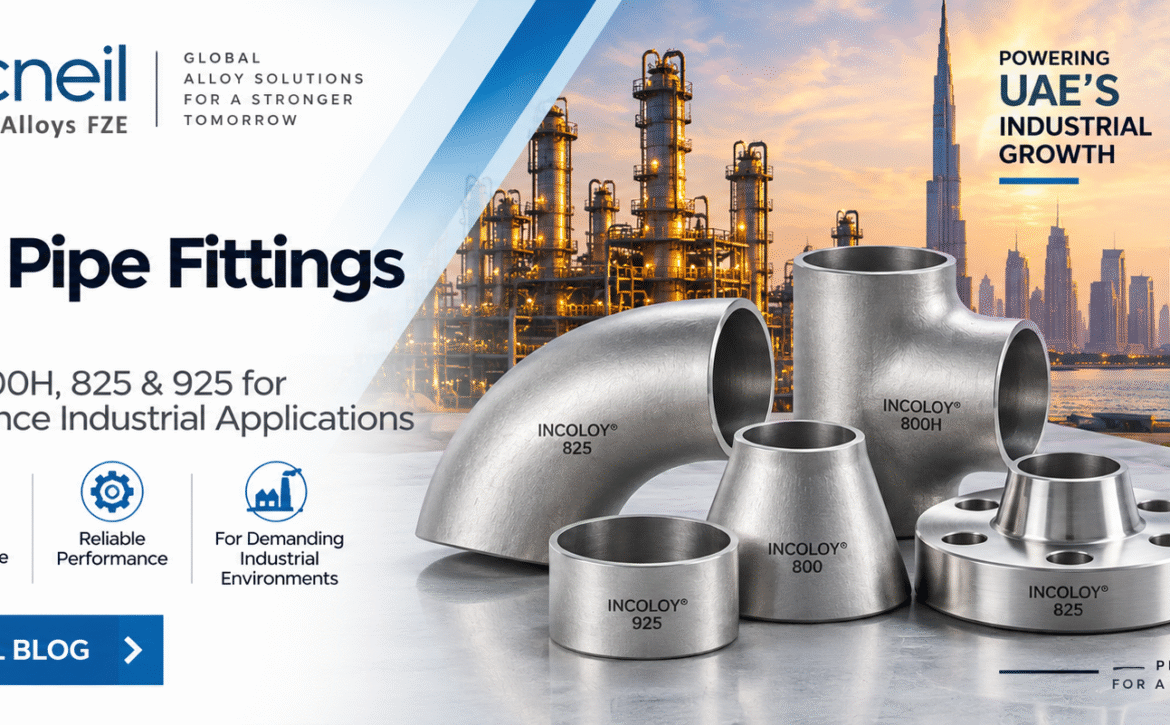
Incoloy Pipe Fittings in UAE: Grades 800, 800H, 825 & 925 for High-Performance Industrial Applications

Industrial facilities in the UAE operate in demanding environments where piping components may be exposed to high temperatures, aggressive chemicals, pressure, chlorides, seawater and long operating cycles. For these applications, conventional materials may not always provide the required combination of corrosion resistance, thermal stability and mechanical strength.

Incoloy Pipe Fittings are nickel-based alloy fittings developed for demanding industrial service. They are used to connect, redirect, branch, reduce and terminate piping systems in applications where high-temperature performance, corrosion resistance and long-term reliability are important.

Mcneil Alloys manufactures, supplies and exports Incoloy Pipe Fittings in the UAE in Incoloy 800, 800H, 825 and 925 grades. The company’s published range includes precision-manufactured butt-weld fittings for oil & gas, petrochemical, chemical processing, power generation, offshore, marine and other critical industrial applications.

What Are Incoloy Pipe Fittings?

Incoloy Pipe Fittings are fittings manufactured from nickel-based alloys containing combinations of nickel, iron, chromium and other alloying elements depending on the grade.

These fittings are designed for piping systems where material performance is important under conditions such as:

  • Elevated temperatures
  • High pressure
  • Corrosive process fluids
  • Chloride-containing environments
  • Marine exposure
  • Acidic environments
  • Sour-service conditions
  • Continuous thermal cycling

Common Incoloy fitting configurations include elbows, tees, reducers, caps and stub ends. Mcneil Alloys’ UAE product page specifically describes its range as butt-welding pipe fittings manufactured to ASTM B366 / ASME SB366.

Why Are Incoloy Pipe Fittings Important for UAE Industries?

The UAE has a large industrial base covering oil & gas, refining, petrochemical processing, power generation, desalination, marine operations and chemical manufacturing.

These facilities can expose piping components to combinations of heat, pressure and corrosive media. Material selection therefore has a direct impact on reliability, maintenance requirements and operating life.

Incoloy grades provide different performance characteristics, allowing engineers to select a suitable alloy according to the application’s temperature, corrosion and mechanical requirements.

Mcneil Alloys supplies Incoloy pipe fittings throughout key UAE industrial locations including Dubai, Abu Dhabi, Sharjah, Fujairah and Ras Al Khaimah, with supply extending across the wider GCC.

Incoloy Pipe Fitting Grades Available from Mcneil Alloys

Mcneil Alloys’ UAE range includes four major grades:

  1. Incoloy 800
  2. Incoloy 800H
  3. Incoloy 825
  4. Incoloy 925

Each grade is suited to different combinations of temperature, corrosion and mechanical requirements.


Incoloy 800 Pipe Fittings

Incoloy 800, identified as UNS N08800, is a nickel-iron-chromium alloy used for high-temperature industrial applications.

Mcneil Alloys specifies ASTM B366 / ASME SB366 for its Incoloy 800 fittings, with a published size range of ½ inch to 24 inches and a maximum operating temperature listed up to 1100°F (593°C).

Key Characteristics of Incoloy 800

  • High-temperature performance
  • Good thermal stability
  • Resistance to surface degradation during prolonged heat exposure
  • Mechanical integrity during thermal cycling
  • Suitability for corrosive industrial atmospheres
  • Compatibility with butt-weld piping systems

Applications of Incoloy 800 Pipe Fittings

Mcneil Alloys identifies applications including:

  • Heat exchangers
  • Nuclear power plants
  • Furnace components
  • Oil & gas processing
  • Petrochemical facilities
  • Chemical manufacturing
  • Thermal power facilities
  • Industrial furnace systems

For UAE projects involving sustained thermal exposure, Incoloy 800 can be considered where the operating conditions match the grade’s capabilities.


Incoloy 800H Pipe Fittings

Incoloy 800H, identified by Mcneil Alloys as UNS N08810, is intended for sustained high-temperature applications where creep and rupture resistance are important.

The company’s product information describes 800H as a controlled-carbon version of Incoloy 800 developed for improved creep resistance and strength during prolonged exposure to elevated temperatures.

Technical Specifications

Parameter Incoloy 800H
UNS N08810
Standard ASTM B366 / ASME SB366
Size Range ½” to 24″
Maximum Temperature Listed Up to 1000°C
Carbon Content 0.05%–0.10%
Construction Butt-weld fittings

Applications

Incoloy 800H pipe fittings are suitable for applications such as:

  • Reformer systems
  • Pressure vessels
  • Heat-treatment equipment
  • Power generation
  • Petrochemical facilities
  • Oil & gas processing
  • Chemical processing
  • Furnace and thermal systems

The grade is particularly relevant where piping components experience prolonged high-temperature exposure and maintaining strength over time is important.


Incoloy 825 Pipe Fittings

Incoloy 825, or UNS N08825, is a nickel-iron-chromium alloy with additions of molybdenum and copper. It is intended for applications where corrosion resistance is a major consideration.

Mcneil Alloys lists ASTM B366 / ASME SB366 as the manufacturing standard and a size range of ½ inch to 24 inches for its Incoloy 825 pipe fittings.

Key Characteristics of Incoloy 825

  • Strong resistance to acidic corrosion
  • Resistance to chloride-containing environments
  • Suitable for marine exposure
  • Resistance to sulfuric and phosphoric acid environments
  • Good mechanical stability at elevated temperatures
  • Suitability for butt-weld piping systems

Applications of Incoloy 825 Pipe Fittings

Incoloy 825 can be considered for:

  • Chemical processing plants
  • Acid production facilities
  • Desalination plants
  • Offshore platforms
  • Marine systems
  • Oil & gas processing
  • Petrochemical facilities
  • Pollution-control equipment
  • Power-generation facilities

Mcneil Alloys specifically identifies marine exhaust systems, acid production plants and pollution-control equipment among its applications.

For the UAE, this makes Incoloy 825 particularly relevant to applications involving chemical processing, marine exposure and desalination-related environments.


Incoloy 925 Pipe Fittings

Incoloy 925, identified as UNS N09925, is a precipitation-hardened nickel alloy designed for applications requiring a combination of high strength and corrosion resistance.

Mcneil Alloys lists ASTM B366 / ASME SB366 and a size range of ½ inch to 12 inches for its Incoloy 925 pipe fittings.

Technical Specifications

Parameter Incoloy 925
UNS N09925
Standard ASTM B366 / ASME SB366
Size Range ½” to 12″
Hardening Precipitation-hardened
Corrosion Resistance Sulfide stress corrosion and seawater exposure
Typical Applications Oilfield piping, valve components, industrial fasteners

Applications of Incoloy 925

Incoloy 925 pipe fittings can be considered for:

  • Oilfield piping
  • Offshore installations
  • Upstream oil & gas
  • Downstream oil & gas
  • Petrochemical processing
  • Chemical transfer systems
  • Marine equipment
  • High-pressure industrial applications

Its combination of strength and corrosion resistance makes it particularly relevant to demanding oilfield and offshore environments.

Incoloy 800 vs 800H vs 825 vs 925

Grade Primary Strength Typical Applications
Incoloy 800 High-temperature stability Heat exchangers, furnaces, power systems
Incoloy 800H Long-term high-temperature creep resistance Reformers, pressure vessels, thermal systems
Incoloy 825 Corrosion and acid resistance Chemical, marine, desalination, pollution control
Incoloy 925 High strength + corrosion resistance Oilfield, offshore and pressure-intensive applications

The correct grade should be selected according to the actual operating temperature, pressure, process chemistry, corrosion mechanism and applicable project specifications.

Types of Incoloy Pipe Fittings

Incoloy fittings are available in different configurations to accommodate piping layouts and connection requirements.

Incoloy Elbows

Elbows change the direction of piping while maintaining the flow path.

Common configurations include:

  • 45° elbows
  • 90° elbows
  • Long-radius elbows
  • Short-radius elbows

Incoloy Tees

Tees create branch connections in piping systems.

They may be selected as:

  • Equal tees
  • Reducing tees

Incoloy Reducers

Reducers connect pipes with different nominal diameters.

Common configurations include:

  • Concentric reducers
  • Eccentric reducers

Incoloy Caps

Caps close the end of piping systems and can be used for permanent or project-specific termination.

Incoloy Stub Ends

Stub ends are used with compatible flange arrangements and can be useful where piping systems require specific dismantling or connection arrangements.

Mcneil Alloys’ product information specifically identifies butt-weld fittings such as elbows, tees, reducers, caps and stub ends in its Incoloy range.

Incoloy Pipe Fittings for Oil & Gas in UAE

The UAE’s oil and gas industry requires piping components capable of operating under demanding process conditions.

Incoloy fittings can be considered for applications involving:

  • Process piping
  • Oilfield systems
  • Refinery equipment
  • Offshore platforms
  • Chemical transfer lines
  • High-temperature process systems
  • Sour-service applications
  • Corrosive environments

Incoloy 925 is particularly positioned by Mcneil Alloys for oilfield and offshore applications requiring high strength and corrosion resistance, while Incoloy 800 and 800H are positioned toward high-temperature industrial service.

Incoloy Pipe Fittings for Petrochemical Plants

Petrochemical facilities combine high temperatures with chemically aggressive process environments.

Incoloy fittings can be used in selected applications such as:

  • Process piping
  • Heat exchangers
  • Furnace systems
  • Chemical transfer lines
  • Thermal processing equipment
  • Process-control systems
  • High-temperature piping

The specific Incoloy grade should be matched to the process fluid and operating conditions rather than selected solely by industry or application name.

Incoloy Pipe Fittings for Chemical Processing

Chemical plants may expose piping systems to acids, chlorides and other aggressive chemicals.

Incoloy 825 is particularly relevant to applications where resistance to acidic and chloride-containing environments is important. Mcneil Alloys identifies sulfuric and phosphoric acid resistance, marine environments and pollution-control applications among its characteristics and uses.

Incoloy Pipe Fittings for Desalination and Marine Applications

Desalination and marine facilities can involve chloride-rich environments and continuous exposure to water and process chemicals.

Incoloy 825 can be considered for selected applications involving:

  • Desalination systems
  • Marine equipment
  • Marine exhaust systems
  • Offshore platforms
  • Corrosive process piping

For particularly demanding offshore and seawater applications, Incoloy 925 is also positioned by Mcneil Alloys for resistance to sulfide stress corrosion and seawater exposure.

Incoloy Pipe Fitting Specifications

Mcneil Alloys’ UAE product page identifies ASTM B366 / ASME SB366 as the manufacturing standard for the four grades.

Grade UNS Standard Published Size Range
Incoloy 800 N08800 ASTM B366 / ASME SB366 ½”–24″
Incoloy 800H N08810 ASTM B366 / ASME SB366 ½”–24″
Incoloy 825 N08825 ASTM B366 / ASME SB366 ½”–24″
Incoloy 925 N09925 ASTM B366 / ASME SB366 ½”–12″

Actual dimensions, wall thickness, fitting geometry, end preparation and project requirements should be confirmed before procurement.

How to Select Incoloy Pipe Fittings in UAE

Selecting the correct Incoloy grade requires an engineering assessment of the service environment.

1. Identify the Operating Temperature

For high-temperature systems, determine both normal operating and design temperatures.

Incoloy 800 and 800H are particularly associated with elevated-temperature applications.

2. Determine Operating Pressure

Pressure requirements influence fitting dimensions, wall thickness, configuration and material selection.

3. Understand the Process Chemistry

Identify:

  • Acids
  • Chlorides
  • Sulfur compounds
  • Seawater
  • Hydrocarbons
  • Other aggressive chemicals

4. Select the Correct Alloy

Use the actual service conditions to determine whether 800, 800H, 825 or 925 is appropriate.

5. Select Fitting Configuration

Specify whether the piping design requires:

  • Elbows
  • Tees
  • Reducers
  • Caps
  • Stub ends
  • Other butt-weld configurations

6. Confirm Applicable Standards

For Mcneil Alloys’ published Incoloy range, ASTM B366 / ASME SB366 is specified. Project-specific standards may require additional documentation or inspection.

7. Confirm Traceability and Inspection Requirements

For critical UAE oil & gas and petrochemical projects, material certificates, inspection requirements and traceability should be established before ordering.

Why Choose Mcneil Alloys for Incoloy Pipe Fittings in UAE?

Mcneil Alloys positions itself as a manufacturer, supplier and exporter of Incoloy pipe fittings in the UAE, offering 800, 800H, 825 and 925 grades for high-temperature and corrosive industrial applications.

Key advantages include:

  • Complete Incoloy 800, 800H, 825 and 925 range
  • Precision-manufactured butt-weld fittings
  • ASTM B366 / ASME SB366 manufacturing standard
  • Applications across oil & gas and petrochemical industries
  • Solutions for high-temperature service
  • Corrosion-resistant alloy options
  • UAE-wide supply coverage
  • GCC export capabilities
  • Technical support for project requirements

Mcneil Alloys’ broader UAE operations identify supply coverage across Dubai, Abu Dhabi, Sharjah, Fujairah and Ras Al Khaimah, while its wider business serves GCC markets.

Incoloy Pipe Fittings Supplier in Dubai, Abu Dhabi & UAE

For UAE industrial projects, Mcneil Alloys supplies Incoloy pipe fittings across major industrial locations.

Dubai

Suitable for petrochemical, industrial, infrastructure and process-industry requirements.

Abu Dhabi

Relevant to oil & gas, energy and petrochemical projects.

Sharjah

Supports manufacturing and industrial piping requirements.

Fujairah

Relevant to marine, oil storage, terminal and energy-related applications.

Ras Al Khaimah

Supports industrial and manufacturing applications requiring high-performance piping materials.

Mcneil Alloys specifically identifies these UAE locations in its Incoloy pipe fitting supply coverage.

Frequently Asked Questions

What are Incoloy Pipe Fittings?

Incoloy Pipe Fittings are nickel-based alloy fittings designed for demanding high-temperature, corrosive and pressure-intensive industrial piping applications.

Which Incoloy grades does Mcneil Alloys supply?

Mcneil Alloys’ UAE product page lists Incoloy 800, 800H, 825 and 925.

What standard is used for these Incoloy fittings?

The product page specifies ASTM B366 / ASME SB366 for the listed Incoloy pipe fitting grades.

What is Incoloy 800 used for?

Incoloy 800 fittings are used for high-temperature applications including heat exchangers, furnace components, power-generation systems and other thermal industrial equipment.

What is the difference between Incoloy 800 and 800H?

In the Mcneil Alloys product description, 800H is positioned for sustained high-temperature service with enhanced creep and rupture resistance compared with standard 800.

What is Incoloy 825 used for?

Incoloy 825 is suited to applications requiring corrosion resistance in aggressive chemical and marine environments, including chemical processing, acid production, desalination and pollution-control systems.

What is Incoloy 925 used for?

Incoloy 925 is a precipitation-hardened alloy used for applications requiring high strength and corrosion resistance, including oilfield piping and offshore systems.

What sizes are available?

Mcneil Alloys lists ½” to 24″ for Incoloy 800, 800H and 825, while Incoloy 925 is listed from ½” to 12″.

Does Mcneil Alloys supply butt-weld Incoloy fittings?

Yes. The company’s product page describes its Incoloy range as precision-manufactured butt-weld pipe fittings, including elbows, tees, reducers, caps and stub ends.

Conclusion

Incoloy Pipe Fittings in UAE provide high-performance material options for industrial piping systems exposed to elevated temperatures, aggressive chemicals, pressure and corrosive environments.

Mcneil Alloys supplies Incoloy 800, 800H, 825 and 925 Pipe Fittings according to the requirements described on its UAE product page. The grades address different service priorities: 800 and 800H for high-temperature applications, 825 for demanding corrosion and chemical environments, and 925 for applications requiring a combination of high strength and corrosion resistance.

For UAE oil & gas, petrochemical, chemical, power, marine and offshore projects, the correct fitting should be selected according to the actual operating temperature, pressure, process chemistry, corrosion mechanism, dimensions and applicable standards.

With its range of Incoloy grades and butt-weld fitting configurations, Mcneil Alloys provides Incoloy Pipe Fittings for industrial applications across Dubai, Abu Dhabi, Sharjah, Fujairah, Ras Al Khaimah and the wider UAE/GCC market.

Read More
admin September 7, 2026 0 Comments

Stainless Steel Pipe Fittings in UAE: Grades 304, 316, 316L, 321 & 347

Stainless Steel Pipe Fittings in UAE are widely used in industrial piping systems where corrosion resistance, strength, durability, and reliable connections are essential. Mcneil Alloys supplies stainless steel pipe fittings in grades 304, 316, 316L, 321, and 347 for industrial applications across the UAE.
These stainless steel fittings are suitable for applications where piping systems must withstand moisture, elevated temperatures, chemicals, and demanding operating conditions.

Stainless Steel 304 Pipe Fittings in UAE

Stainless Steel 304 Pipe Fittings are among the most widely used stainless steel fittings for general industrial applications.
They offer good corrosion resistance, strength, formability, and durability, making them suitable for:
Industrial piping
Chemical processing
Food processing
Water systems
General engineering
Process industries
Petrochemical applications
SS 304 pipe fittings in UAE are commonly selected when a combination of corrosion resistance, mechanical performance, and cost effectiveness is required.

Stainless Steel 316 Pipe Fittings in UAE

Stainless Steel 316 Pipe Fittings offer improved corrosion resistance compared with SS 304, particularly in environments where chlorides and corrosive chemicals are present.
They are suitable for applications such as:
Chemical processing
Marine environments
Petrochemical plants
Oil & gas facilities
Pharmaceutical industries
Water treatment
Process piping
For demanding industrial environments in the UAE, SS 316 pipe fittings can be considered where enhanced corrosion resistance is required.

Stainless Steel 316L Pipe Fittings in UAE

Stainless Steel 316L Pipe Fittings are the low-carbon version of 316 stainless steel.
The reduced carbon content makes 316L particularly useful for welded piping systems where resistance to sensitization and intergranular corrosion is important.
Common applications include:
Chemical plants
Pharmaceutical plants
Food processing
Petrochemical facilities
Process piping
Marine applications
Water treatment systems
Mcneil Alloys supplies SS 316L pipe fittings in UAE for industrial piping and process applications.

Stainless Steel 321 Pipe Fittings in UAE

Stainless Steel 321 Pipe Fittings are stabilized with titanium and are designed for applications involving elevated temperatures.
They can be considered for:
High-temperature piping
Heat exchangers
Petrochemical plants
Chemical processing
Thermal processing equipment
Furnace components
Industrial process systems
The titanium stabilization helps improve resistance to intergranular corrosion after exposure to elevated temperatures.

Stainless Steel 347 Pipe Fittings in UAE

Stainless Steel 347 Pipe Fittings are stabilized with niobium and are designed for elevated-temperature applications.
Typical applications include:
High-temperature piping
Heat exchangers
Petrochemical processing
Chemical plants
Refinery applications
Power-generation equipment
Thermal processing systems
SS 347 pipe fittings in UAE can be selected for applications where high-temperature performance and resistance to intergranular corrosion are important.

304 vs 316 vs 316L vs 321 vs 347 Pipe Fittings

Grade Key Characteristic Typical Applications
SS 304 General corrosion resistance Industrial, food, water systems
SS 316 Enhanced corrosion resistance Marine, chemical, oil & gas
SS 316L Low carbon, welding-friendly Pharmaceutical, chemical, process piping
SS 321 Titanium stabilized High-temperature applications
SS 347 Niobium stabilized High-temperature process systems
The appropriate grade depends on the process medium, temperature, pressure, corrosion environment, welding requirements, and applicable project specifications.

Stainless Steel Pipe Fittings Applications in UAE

Stainless steel pipe fittings are used across numerous UAE industries, including:
Oil & Gas
Stainless steel fittings can be used in process piping, instrumentation systems, hydrocarbon processing, and other suitable oil & gas applications.
Petrochemical Industry
Grades such as 316, 316L, 321, and 347 can be considered for applications involving corrosive chemicals and elevated temperatures.
Chemical Processing
Stainless steel pipe fittings provide corrosion resistance for suitable chemical processing systems.
Power Generation
High-temperature grades such as SS 321 and SS 347 can be used in appropriate high-temperature piping and equipment.
Water Treatment
SS 304, 316, and 316L fittings are used in suitable water and process-fluid systems where corrosion resistance is required.
Pharmaceutical Industry
SS 316L pipe fittings are commonly considered for hygienic and corrosion-sensitive process applications.

Types of Stainless Steel Pipe Fittings

Depending on the piping configuration, stainless steel fittings are available in various forms, including:
Stainless Steel Elbows
Stainless Steel Tees
Stainless Steel Crosses
Stainless Steel Reducers
Stainless Steel Couplings
Stainless Steel Unions
Stainless Steel Caps
Stainless Steel Nipples
Stainless Steel Stub Ends
Stainless Steel Pipe Bends
The exact fitting configuration, dimensions, wall thickness, connection type, and standards should be specified according to the project requirement.

How to Select Stainless Steel Pipe Fittings in UAE

Before purchasing stainless steel pipe fittings in UAE, consider:
1. Stainless Steel Grade
Select 304, 316, 316L, 321, or 347 according to the service conditions.
2. Operating Temperature
For elevated-temperature applications, grades such as 321 and 347 may be considered.
3. Corrosion Environment
Consider exposure to:
Chlorides
Seawater
Chemicals
Moisture
Hydrocarbons
Process fluids
4. Pressure Rating
Confirm the required pressure class or rating for the piping system.
5. Dimensions
Specify nominal pipe size, wall thickness, schedule, and fitting dimensions.
6. Connection Type
Determine whether the project requires butt-weld, socket-weld, threaded, or another connection configuration.
7. Applicable Standards
Confirm the required ASTM, ASME, ANSI, or project-specific specifications.

Why Choose Mcneil Alloys for Stainless Steel Pipe Fittings in UAE?

Mcneil Alloys offers stainless steel pipe fittings in 304, 316, 316L, 321, and 347 grades for industrial applications in the UAE.
The range can support requirements involving:
Corrosion-resistant piping
High-temperature service
Chemical processing
Oil & gas
Petrochemical applications
Power generation
Water treatment
Industrial process systems
For project procurement, customers should provide the required grade, fitting type, size, schedule, pressure rating, connection, quantity, and applicable standard to determine the appropriate product.

Conclusion

Stainless Steel Pipe Fittings in UAE are essential components for industrial piping systems requiring corrosion resistance, mechanical strength, and dependable performance.
SS 304 and 316 pipe fittings are widely considered for general and corrosion-sensitive applications, while 316L is particularly useful for welded and hygienic process systems. SS 321 and SS 347 pipe fittings are better suited to selected elevated-temperature applications.
Mcneil Alloys supplies Stainless Steel 304, 316, 316L, 321, and 347 Pipe Fittings in UAE for industrial, chemical, petrochemical, oil & gas, power, water treatment, and process applications.

Read More
admin August 31, 2026 0 Comments

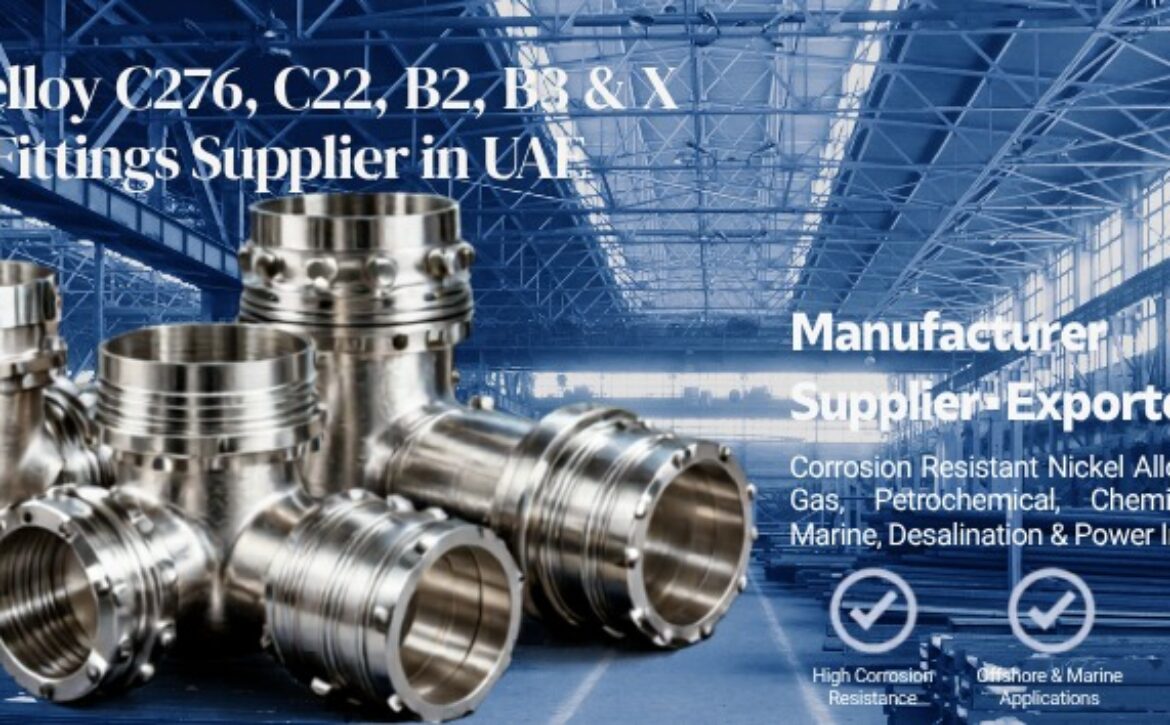
Hastelloy C276, C22, B2, B3 & X Pipe Fittings Suppliers in UAE – High Corrosion Resistant Nickel Alloy Solutions

Introduction

The UAE is home to some of the world’s largest petrochemical plants, refineries, offshore oil platforms, desalination facilities, LNG terminals, chemical processing plants, and power generation projects. These industries require materials capable of withstanding highly aggressive chemicals, corrosive media, extreme temperatures, and challenging operating environments.

Hastelloy Pipe Fittings are among the most trusted nickel alloy piping components for critical industrial applications where corrosion resistance and reliability are essential.

Mcneil Alloys is a leading manufacturer, supplier, stockist, and exporter of Hastelloy C276 Pipe Fittings, Hastelloy C22 Pipe Fittings, Hastelloy B2 Pipe Fittings, Hastelloy B3 Pipe Fittings, and Hastelloy X Pipe Fittings throughout the UAE and GCC region.

We supply premium-quality Hastelloy fittings to Dubai, Abu Dhabi, Sharjah, Fujairah, Ras Al Khaimah, Ajman, Al Ain, Jebel Ali Free Zone (JAFZA), Khalifa Industrial Zone Abu Dhabi (KIZAD), Ruwais Industrial Complex, and major industrial projects across the Middle East.

Why Hastelloy Pipe Fittings Are Used Across UAE Industries

Industrial facilities throughout the UAE often handle:

✔ Sulfuric acid

✔ Hydrochloric acid

✔ Chloride-containing environments

✔ High-temperature process fluids

✔ Sour gas processing

✔ Aggressive chemical media

✔ Offshore seawater exposure

Hastelloy alloys offer exceptional corrosion resistance, making them ideal for applications where conventional stainless steel materials may fail.

Hastelloy C276 Pipe Fittings Suppliers in UAE

What is Hastelloy C276?

Hastelloy C276 Pipe Fittings are among the most widely used corrosion-resistant nickel alloy fittings. They provide outstanding resistance against oxidizing and reducing chemicals.

Available Products

Benefits

✔ Exceptional corrosion resistance

✔ Excellent resistance to pitting and crevice corrosion

✔ Suitable for chloride-rich environments

✔ Long service life

Industries Served

  • Petrochemical Plants
  • Chemical Processing Facilities
  • Offshore Oil Platforms
  • Refineries
  • Desalination Plants

Hastelloy C22 Pipe Fittings Suppliers in UAE

High Performance Corrosion Resistant Alloy

Hastelloy C22 Pipe Fittings offer superior protection against both oxidizing and reducing environments.

Applications

  • Chemical Manufacturing
  • Pharmaceutical Plants
  • Specialty Chemical Processing
  • Waste Treatment Facilities
  • Marine Systems

Advantages

✔ Outstanding resistance to wet chlorine

✔ Superior oxidation resistance

✔ Excellent fabrication properties

✔ Enhanced durability in harsh environments

Hastelloy B2 Pipe Fittings Suppliers in UAE

Designed for Hydrochloric Acid Applications

Hastelloy B2 Pipe Fittings provide exceptional resistance to hydrochloric acid across a wide range of temperatures and concentrations.

Industries

  • Acid Production Plants
  • Chemical Processing
  • Fertilizer Manufacturing
  • Pharmaceutical Facilities

Key Features

✔ Excellent resistance to hydrochloric acid

✔ High thermal stability

✔ Superior corrosion performance

Hastelloy B3 Pipe Fittings Suppliers in UAE

Advanced Corrosion Resistant Alloy

Hastelloy B3 Pipe Fittings improve upon the performance of B2 alloy by offering enhanced thermal stability and fabrication characteristics.

Applications

  • Chemical Processing Plants
  • Acid Handling Systems
  • Industrial Manufacturing
  • Specialty Chemical Production

Benefits

✔ Improved mechanical properties

✔ Better fabrication performance

✔ Excellent resistance to chemical attack

Hastelloy X Pipe Fittings Suppliers in UAE

High Temperature Alloy Pipe Fittings

Hastelloy X Pipe Fittings are widely used where exceptional heat resistance and oxidation resistance are required.

Industries

  • Aerospace
  • Gas Turbines
  • Industrial Furnaces
  • Power Generation
  • Thermal Processing Plants

Advantages

✔ Excellent high-temperature strength

✔ Superior oxidation resistance

✔ Long-term thermal stability

✔ Reliable performance under extreme conditions

UAE Cities We Supply Hastelloy Pipe Fittings To

Abu Dhabi – Oil & Gas & Petrochemical Capital

Major Industrial Areas

  • Mussafah Industrial Area
  • KIZAD
  • Ruwais Industrial Complex
  • ADNOC Facilities

Industries

  • Oil & Gas
  • LNG Processing
  • Petrochemicals
  • Refineries
  • Offshore Projects

Dubai – EPC & Industrial Trading Hub

Major Industrial Zones

  • Jebel Ali Free Zone (JAFZA)
  • Dubai Industrial City
  • Dubai Maritime City
  • Al Quoz Industrial Area

Industries

  • EPC Contracting
  • Marine Engineering
  • Industrial Infrastructure
  • Energy Projects

Sharjah – Engineering & Manufacturing Center

Industrial Areas

  • Sharjah Industrial Area
  • Hamriyah Free Zone

Industries

  • Heavy Fabrication
  • Manufacturing
  • Process Engineering
  • Industrial Equipment Production

Fujairah – Marine & Energy Hub

Industries

  • Oil Storage Terminals
  • Marine Engineering
  • Shipping
  • Offshore Services
  • Petrochemical Facilities

Ras Al Khaimah – Heavy Industry Hub

Industries

  • Cement Manufacturing
  • Industrial Utilities
  • Engineering Projects
  • Process Industries

Ajman – Fabrication & Industrial Services

Industries

  • Mechanical Engineering
  • Industrial Fabrication
  • Construction Projects

Al Ain – Utility & Processing Industries

Industries

  • Water Treatment
  • Food Processing
  • Agricultural Infrastructure
  • Utility Projects

Major UAE Industries Using Hastelloy Pipe Fittings

Oil & Gas Industry

Hastelloy Pipe Fittings are widely used in upstream, midstream, and downstream oil and gas facilities where corrosion resistance is critical.

Petrochemical Industry

Ideal for handling aggressive chemicals, hydrocarbons, and corrosive process fluids.

Chemical Processing Industry

Used extensively in reactors, pipelines, storage systems, and processing units.

Offshore & Marine Industry

Provides outstanding performance in seawater and chloride-rich environments.

LNG Industry

Suitable for extreme temperatures and highly demanding process conditions.

Desalination Industry

Used in systems exposed to saltwater and corrosive treatment chemicals.

Power Generation Industry

Applied in boilers, turbines, heat exchangers, and high-temperature piping systems.

Why Choose Mcneil Alloys UAE

✔ Complete range of Hastelloy Pipe Fittings

✔ International quality standards

✔ Competitive project pricing

✔ Fast UAE-wide delivery

✔ Large ready stock inventory

✔ Material test certificates available

✔ Technical engineering support

✔ Global export capabilities

✔ Custom manufacturing solutions

Benefits of Hastelloy Pipe Fittings

📈 Exceptional corrosion resistance

📈 Extended service life

📈 Reduced maintenance costs

📈 Improved operational safety

📈 High-temperature performance

📈 Resistance to aggressive chemicals

📈 Long-term reliability

Export Markets We Serve

Mcneil Alloys exports Hastelloy Pipe Fittings to:

  • UAE
  • Saudi Arabia
  • Qatar
  • Oman
  • Kuwait
  • Bahrain
  • Iraq
  • Egypt
  • South Africa
  • Europe
  • Southeast Asia

Contact Mcneil Alloys UAE

Website:

https://mcneilalloys.ae/hastelloy-c276-c22-b2-b3-x-pipe-fittings/

Contact our team today for technical specifications, project requirements, bulk orders, and competitive pricing on Hastelloy C276, C22, B2, B3, and Hastelloy X Pipe Fittings.

Frequently Asked Questions

What are the advantages of Hastelloy Pipe Fittings over stainless steel fittings?
Hastelloy Pipe Fittings offer superior resistance to corrosion, oxidation, pitting, and stress corrosion cracking, making them ideal for highly aggressive chemical environments where stainless steel may not perform effectively.

Can Hastelloy C276 Pipe Fittings handle acidic environments?
Yes, Hastelloy C276 Pipe Fittings are specifically designed to withstand a wide range of corrosive acids, including sulfuric acid, hydrochloric acid, and phosphoric acid, making them suitable for chemical processing plants.

Are Hastelloy C22 Pipe Fittings suitable for pharmaceutical applications?
Yes, Hastelloy C22 Pipe Fittings are commonly used in pharmaceutical and specialty chemical manufacturing due to their excellent corrosion resistance and ability to maintain product purity.

What temperature range can Hastelloy X Pipe Fittings withstand?
Hastelloy X Pipe Fittings are engineered for high-temperature service and can perform reliably in environments exceeding 1000°C, depending on operating conditions and system design.

Do Hastelloy Pipe Fittings require special maintenance?
Hastelloy fittings generally require minimal maintenance due to their exceptional corrosion resistance, helping reduce downtime and long-term operating costs.

Which industries commonly use Hastelloy Pipe Fittings?
Industries such as chemical processing, petrochemicals, marine engineering, power generation, aerospace, pollution control, and oil & gas rely on Hastelloy fittings for critical applications.

Are custom sizes available for Hastelloy Pipe Fittings?
Yes, custom dimensions, wall thicknesses, pressure ratings, and specialized configurations can be manufactured to meet project-specific requirements.

Can Hastelloy Pipe Fittings be used in high-pressure systems?
Yes, Hastelloy fittings are known for their excellent mechanical strength and are widely used in high-pressure pipelines, reactors, heat exchangers, and processing systems.

How do Hastelloy fittings perform in chloride-rich environments?
Hastelloy alloys offer exceptional resistance to chloride-induced pitting, crevice corrosion, and stress corrosion cracking, making them suitable for marine and desalination applications.

Why choose Mcneil Alloys for Hastelloy Pipe Fittings in the UAE?
Mcneil Alloys provides premium-quality Hastelloy fittings, competitive pricing, reliable delivery schedules, comprehensive documentation, and technical support for industrial projects across the UAE and international markets.


Read More
admin June 9, 2026 0 Comments

High-Performance Pipe Fittings Suppliers in UAE – Premium Industrial Solutions

Introduction

The United Arab Emirates is a global center for oil & gas production, petrochemical processing, LNG facilities, desalination plants, marine engineering, and power generation projects. These industries require piping components capable of performing under extreme temperatures, corrosive chemicals, chloride-rich environments, and high-pressure operating conditions.

Incoloy Pipe Fittings are widely used throughout the UAE because of their excellent resistance to oxidation, corrosion, stress corrosion cracking, and elevated temperatures. These Incoly-iron-chromium alloys deliver exceptional reliability in some of the world’s most demanding industrial environments. Incoloy 800 and 800H are especially valued for high-temperature service, while Incoloy 825 is preferred in highly corrosive chemical and offshore environments.

Mcneil Alloys is a trusted manufacturer, supplier, stockist, and exporter of Incoloy 800 Pipe Fittings, Incoloy 800H Pipe Fittings, Incoloy 825 Pipe Fittings, and Incoloy 925 Pipe Fittings across the UAE and GCC region.

Why Incoloy Pipe Fittings Are in Demand Across UAE Industries

Industrial facilities in the UAE commonly face:

✔ High-temperature processing

✔ Corrosive chemicals

✔ Offshore seawater exposure

✔ Chloride-rich environments

✔ Sour gas operations

✔ High-pressure applications

Incoloy alloys are engineered to maintain strength and corrosion resistance in these challenging environments, making them ideal for critical piping systems.

Incoloy 800 Pipe Fittings Suppliers in UAE

What is Incoloy 800?

Incoloy 800 Pipe Fittings are incoly-iron-chromium alloy fittings designed for elevated-temperature applications requiring oxidation and carburization resistance.

Common Products

  • Incoloy 800 Elbows
  • Incoloy 800 Tees
  • Incoloy 800 Reducers
  • Incoloy 800 Stub Ends
  • Incoloy 800 Pipe Caps
  • Incoloy 800 Pipe Bends

Benefits

✔ Excellent oxidation resistance

✔ High-temperature strength

✔ Resistance to scaling

✔ Long service life

Applications

  • Industrial Furnaces
  • Heat Exchangers
  • Petrochemical Plants
  • Thermal Processing Units
  • Power Generation Facilities

Incoloy 800 is commonly used where high-temperature performance is the primary requirement.

Incoloy 800H Pipe Fittings Suppliers in UAE

Enhanced High Temperature Performance

Incoloy 800H Pipe Fittings are a modified version of Incoloy 800 with enhanced creep strength and improved performance during long-term exposure to elevated temperatures.

Industries Served

  • Refineries
  • Ethylene Plants
  • Fertilizer Plants
  • Steam Generation Systems
  • Petrochemical Processing

Advantages

✔ Enhanced creep resistance

✔ Excellent metallurgical stability

✔ High-temperature durability

✔ Reliable long-term performance

Incoloy 800H is widely used for demanding thermal processing and high-temperature pipeline systems.

Incoloy 825 Pipe Fittings Suppliers in UAE

Corrosion Resistant Alloy for Aggressive Environments

Incoloy 825 Pipe Fittings contain incoly, chromium, molybdenum, and copper, providing exceptional resistance against acids, chlorides, pitting, crevice corrosion, and stress corrosion cracking.

Products Available

Industries

  • Chemical Processing
  • Petrochemical Plants
  • Offshore Oil & Gas
  • Marine Engineering
  • Desalination Plants
  • Power Plants

Key Benefits

✔ Outstanding corrosion resistance

✔ Resistance to oxidizing and reducing acids

✔ Superior chloride resistance

✔ Excellent mechanical strength

✔ Long operational life

Incoloy 825 is particularly suitable for petrochemical, offshore, marine, and chemical processing facilities operating in aggressive environments.

Incoloy 925 Pipe Fittings Suppliers in UAE

High Strength incoly Alloy Pipe Fittings

Incoloy 925 Pipe Fittings combine excellent corrosion resistance with enhanced mechanical strength, making them ideal for critical oilfield and offshore applications.

Applications

  • Offshore Platforms
  • Subsea Equipment
  • Oilfield Production Systems
  • Gas Processing Facilities
  • High-Pressure Process Lines

Features

✔ High tensile strength

✔ Excellent resistance to stress corrosion cracking

✔ Superior performance in sour gas environments

✔ Long-term reliability

UAE Cities We Supply Incoloy Pipe Fittings To

Abu Dhabi – Oil & Gas Capital of UAE

Major Areas

  • Mussafah Industrial Area
  • KIZAD
  • Ruwais Industrial Complex
  • ADNOC Facilities

Industries

  • Oil & Gas
  • LNG
  • Petrochemicals
  • Refineries
  • Offshore Energy Projects

Dubai – Industrial Trading & EPC Hub

Major Areas

  • Jebel Ali Free Zone (JAFZA)
  • Dubai Industrial City
  • Dubai Maritime City
  • Al Quoz Industrial Area

Industries

  • EPC Contracting
  • Industrial Construction
  • Marine Engineering
  • Energy Infrastructure

Sharjah – Manufacturing & Engineering Hub

Major Areas

  • Sharjah Industrial Area
  • Hamriyah Free Zone

Industries

  • Heavy Fabrication
  • Manufacturing
  • Process Engineering
  • Equipment Production

Fujairah – Marine & Energy Hub

Industries

  • Oil Storage Terminals
  • Marine Engineering
  • Shipping
  • Petrochemical Facilities
  • Offshore Services

Ras Al Khaimah – Industrial Manufacturing Center

Industries

  • Cement Plants
  • Industrial Utilities
  • Manufacturing Facilities
  • Engineering Projects

Ajman – Fabrication & Construction Hub

Industries

  • Fabrication Workshops
  • Mechanical Engineering
  • Industrial Construction

Al Ain – Utilities & Water Infrastructure Hub

Industries

  • Water Treatment
  • Food Processing
  • Utilities
  • Agricultural Projects

Major UAE Industries Using Incoloy Pipe Fittings

Oil & Gas Industry

Incoloy Pipe Fittings are extensively used in upstream, midstream, and downstream facilities due to their corrosion resistance and durability.

Petrochemical Industry

Suitable for handling aggressive chemicals, hydrocarbons, and high-temperature process streams.

Offshore & Marine Industry

Incoloy 825 and Incoloy 925 Pipe Fittings provide excellent resistance to seawater and chloride-rich environments.

LNG Industry

Used in critical piping systems operating under extreme temperatures and pressures.

Desalination Industry

Ideal for saltwater applications requiring long-term corrosion resistance.

Power Generation Industry

Applied in boilers, steam systems, heat exchangers, and thermal processing facilities.

Chemical Processing Industry

Widely used for handling acids, corrosive media, and specialty chemicals.

Why Choose Mcneil Alloys UAE

✔ Complete range of Incoloy Pipe Fittings

✔ International quality standards

✔ Competitive project pricing

✔ Large ready stock inventory

✔ Fast delivery throughout UAE

✔ Technical engineering support

✔ Material test certificates available

✔ Custom manufacturing capabilities

✔ Global export network

Benefits of Incoloy Pipe Fittings

📈 Superior corrosion resistance

📈 Excellent high-temperature performance

📈 Long service life

📈 Reduced maintenance costs

📈 Enhanced plant reliability

📈 High-pressure capability

📈 Improved operational safety

Export Markets We Serve

Mcneil Alloys exports Incoloy Pipe Fittings to:

  • UAE
  • Saudi Arabia
  • Qatar
  • Oman
  • Kuwait
  • Bahrain
  • Iraq
  • Egypt
  • South Africa
  • Europe
  • Southeast Asia

Contact Mcneil Alloys UAE

Website:

https://mcneilalloys.ae/incoloy-800-800h-825-925-pipe-fittings-2/

Contact our team today for technical specifications, project requirements, bulk orders, and competitive pricing on Incoloy 800 Pipe Fittings, Incoloy 800H Pipe Fittings, Incoloy 825 Pipe Fittings, and Incoloy 925 Pipe Fittings.

Frequently Asked Questions

What is the difference between heat-resistant and corrosion-resistant fittings?

Heat-resistant fittings are optimized for high-temperature oxidation and strength, whereas corrosion-resistant types are formulated to withstand aggressive chemicals, acids, and seawater.

Which industries require high-performance alloy fittings?

Chemical processing, petrochemical plants, marine engineering, offshore oil & gas, power generation, and desalination industries utilize these advanced components.

Are these pipe fittings suitable for offshore projects?

Yes, our high-performance fittings are engineereNId for marine environments, offering superior resistance to chloride-induced corrosion.

Do you supply industrial fittings throughout UAE?

Yes, we supply across Dubai, Abu Dhabi, Sharjah, Fujairah, Ajman, Ras Al Khaimah, Al Ain, KIZAD, JAFZA, and Ruwais.

What types of specialty fittings are available?

We provide Elbows, Tees, Reducers, Stub Ends, End Caps, Pipe Bends, Crosses, Couplings, and custom-engineered industrial solutions.

Do you export industrial pipe fittings globally?

Yes, Mcneil Alloys exports worldwide including GCC countries, Africa, Europe, and Asia, ensuring international quality compliance.

Read More
admin June 9, 2026 0 Comments