Manufacturer & Exporters of:
Instrumentation Pipe Fittings & Valves

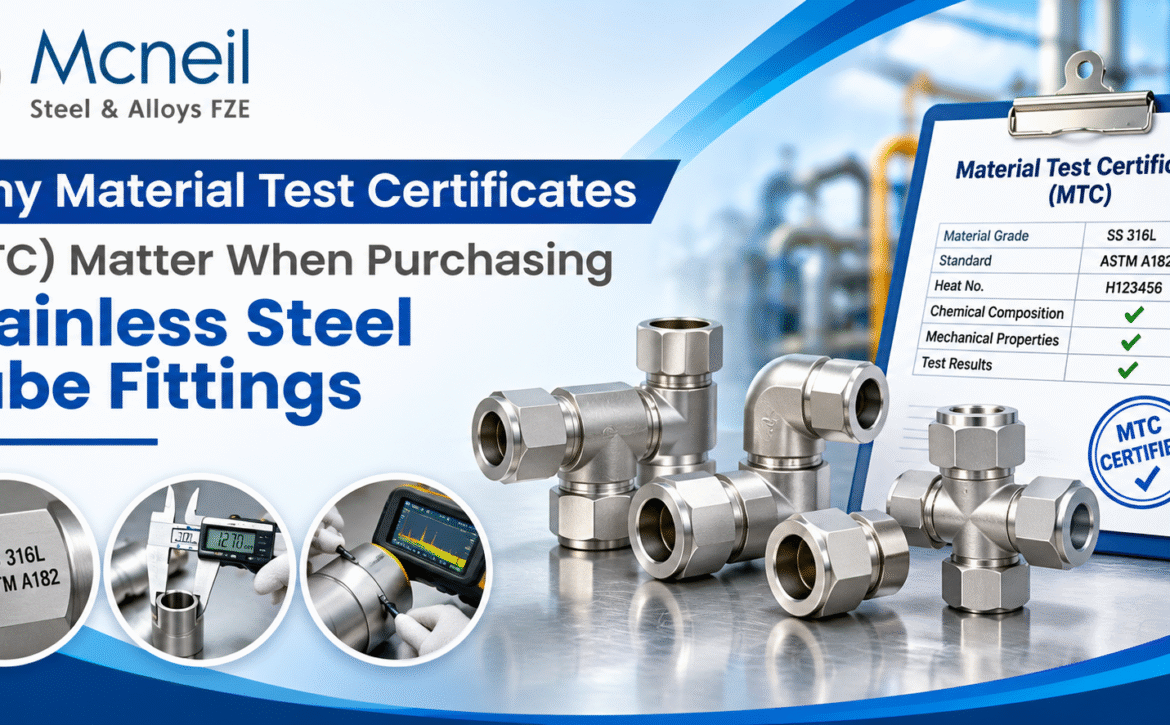
Why Material Test Certificates (MTC) Matter When Purchasing Stainless Steel Tube Fittings

Introduction

When purchasing stainless steel tube fittings for industrial applications, quality, reliability, and material traceability are essential considerations. These fittings are widely used in industries such as oil and gas, petrochemicals, chemical processing, power generation, pharmaceuticals, and marine engineering, where even a minor material failure can lead to leakage, equipment damage, production downtime, or safety risks.

One of the most important documents buyers should request when purchasing stainless steel tube fittings is a Material Test Certificate (MTC). An MTC provides documented evidence of the material’s chemical composition, mechanical properties, manufacturing standards, and quality inspection results.

At Mcneil Alloys, we understand that selecting the right stainless steel tube fittings involves more than checking dimensions and appearance. Verifying material quality through proper documentation helps buyers make informed purchasing decisions and ensures that the supplied products meet the required technical specifications.

What Is a Material Test Certificate (MTC)?

A Material Test Certificate (MTC), also known as a Mill Test Certificate, is an official quality document issued by the manufacturer or material producer. It confirms that the supplied material has been tested and complies with the specified material grade and applicable standards.
For stainless steel tube fittings, an MTC generally includes details such as:
Material Grade: Specifies the stainless steel grade, such as SS 304, SS 304L, SS 316, or SS 316L.
Chemical Composition: Provides details of elements such as chromium, nickel, molybdenum, carbon, and manganese.
Mechanical Properties: Includes tensile strength, yield strength, elongation, and hardness test results, as applicable.
Applicable Standards: Identifies the relevant ASTM, ASME, or other material specifications.
Heat Number: A unique identification number used to trace the material back to its original production batch.
Manufacturer Details: Includes the name and identification details of the material manufacturer.
Inspection and Testing Details: Records relevant quality inspection and testing results.
These details help purchasers verify whether stainless steel tube fittings meet the technical requirements of their intended application.

7 Reasons Why MTC Matters When Purchasing Stainless Steel Tube Fittings

1. Ensures Correct Material Grade
Not all stainless steel grades offer the same performance. For example, SS 304 and SS 316 tube fittings have different chemical compositions and corrosion resistance properties.
SS 316 contains molybdenum, which improves its resistance to chloride-related corrosion compared with SS 304 in many environments.
An MTC helps buyers verify that the supplied stainless steel tube fittings match the specified grade. This is particularly important for chemical processing, offshore installations, marine applications, and oil and gas projects.
2. Verifies Chemical Composition
The chemical composition of stainless steel directly affects its corrosion resistance, strength, and durability.
An MTC provides laboratory test results showing the percentage of different alloying elements present in the material. Buyers can compare these values against the applicable ASTM or ASME material specifications.
This verification reduces the risk of receiving incorrectly graded or substituted materials.
3. Confirms Mechanical Properties
Stainless steel tube fittings must withstand the pressure, temperature, vibration, and operating conditions of industrial systems.
An MTC provides relevant mechanical test results, including tensile strength, yield strength, elongation, and hardness, depending on the product specification and certification requirements.
These properties help engineers assess whether the selected material is suitable for the intended application.
4. Provides Material Traceability
Traceability is especially important in industries where quality documentation and inspection records are mandatory.
Every properly documented material batch can be linked to its heat number. This allows purchasers, inspectors, and quality control teams to trace the supplied stainless steel tube fittings back to the original material manufacturer and associated test records.
Heat number identification also helps during quality audits, project inspections, and future maintenance activities.
5. Supports Industry Standards and Project Compliance
Industrial projects often specify particular material grades, manufacturing standards, and inspection requirements.
For example, stainless steel tube fittings may need to comply with applicable ASTM specifications and relevant dimensional or manufacturing standards, such as ASTM A269 for certain tubing applications and ASME B16.11 for applicable forged fittings.
An MTC helps demonstrate material compliance with the specified requirements. However, buyers should also verify product-specific manufacturing, dimensional, and inspection documentation because an MTC alone does not establish complete product compliance.
6. Reduces the Risk of Material Failure
Using the wrong material in an industrial installation can result in corrosion, cracking, leakage, and premature equipment failure.
An MTC helps reduce this risk by providing documented evidence of material composition and tested properties. It also gives quality teams a reliable reference when evaluating incoming stainless steel tube fittings.
For critical applications, buyers should combine MTC verification with appropriate dimensional inspections, pressure testing, and other specified quality checks.
7. Improves Purchasing Confidence and Quality Assurance
Purchasing industrial components requires confidence in both the supplier and the material being delivered.
An MTC provides buyers with documented quality information that supports supplier evaluation, incoming material inspection, and project documentation.
It is particularly valuable for EPC contractors, procurement managers, project engineers, distributors, and industrial maintenance teams handling quality-sensitive projects.

Understanding Different Types of Material Test Certificates

When purchasing stainless steel tube fittings, buyers may come across different inspection document categories.
The EN 10204 standard defines different types of inspection documents commonly used for metallic products.
EN 10204 Type 2.1: A declaration of compliance with the order, without test results.
EN 10204 Type 2.2: A test report containing results based on non-specific inspection.
EN 10204 Type 3.1: An inspection certificate containing specific inspection results, validated by the manufacturer’s authorised inspection representative who is independent of the manufacturing department.
EN 10204 Type 3.2: An inspection certificate containing specific inspection results, validated by both the manufacturer’s authorised inspection representative and an authorised inspector representing the purchaser or an independent inspection body.
For critical industrial projects, purchasers should confirm the required certificate type in the purchase order and project specifications before placing an order.

What Should Buyers Check in an MTC Before Purchasing Stainless Steel Tube Fittings?

Receiving an MTC is important, but reviewing its details is equally essential.
Here are some important points buyers should verify:
Material Grade: Ensure the grade mentioned in the certificate matches the purchase order.
Chemical Composition: Check that the chemical analysis complies with the relevant material specification.
Mechanical Test Results: Verify that the recorded values meet the specified requirements.
Heat Number: Confirm that the heat number on the MTC matches the material identification or product traceability records.
Applicable Standards: Check the ASTM, ASME, or other specified standards.
Manufacturer Information: Verify the certificate issuer and material manufacturer’s details.
Certificate Authenticity: Ensure the document is genuine and can be verified with the issuing manufacturer when necessary.
These checks help procurement teams avoid documentation gaps and reduce the risk of accepting non-compliant materials.

Why Choose Mcneil Alloys for Stainless Steel Tube Fittings?

At Mcneil Alloys, we understand the importance of material quality, product reliability, and documentation in industrial procurement. We focus on supplying industrial piping components that meet the technical and quality requirements of demanding applications.

Our product range includes stainless steel tube fittings in different grades, including SS 304, SS 304L, SS 316, and SS 316L, subject to availability and project requirements.

We support customers with product specifications and relevant material documentation as required by the order.

Whether you are sourcing stainless steel tube fittings for oil and gas, petrochemical, chemical processing, power generation, or other industrial applications, our team can assist you in identifying suitable products for your requirements.

We serve customers across India and international markets, including the UAE, Saudi Arabia, and other GCC countries.

Conclusion

Material Test Certificates play an important role in ensuring the quality, traceability, and specification compliance of stainless steel tube fittings. They provide essential information about material composition, mechanical properties, manufacturing origin, and inspection results.

For buyers, checking an MTC before accepting materials is an important step towards reducing procurement risks and maintaining industrial quality standards.

At Mcneil Alloys, we believe that reliable industrial components begin with proper material selection and quality verification. Always request and review the appropriate material documentation before purchasing stainless steel tube fittings for critical applications.

Looking for Quality Stainless Steel Tube Fittings with Material Test Certificates?

Choose Mcneil Alloys for stainless steel tube fittings in SS 304, SS 304L, SS 316, and SS 316L grades.
We support industrial buyers with quality-focused product sourcing, technical specifications, and relevant material documentation for demanding applications.

Contact Mcneil Alloys today to discuss your stainless steel tube fitting requirements and request a quotation.
Website:

Frequently Asked Questions (FAQs)

1. What is an MTC in stainless steel tube fittings?
An MTC (Material Test Certificate) is an official document that provides details about the chemical composition, mechanical properties, material grade, heat number, and relevant test results of stainless steel materials.
2. Is an MTC necessary when purchasing stainless steel tube fittings?
An MTC is important for verifying material quality, traceability, and compliance with purchase specifications. It is particularly important for oil and gas, petrochemical, chemical, and other quality-sensitive industrial applications.
3. What is the difference between SS 304 and SS 316 MTC?
The primary difference is their chemical composition. SS 316 contains molybdenum, which provides improved resistance to chloride-related corrosion compared with SS 304 in many environments. Their MTCs show the respective chemical composition and mechanical test results.
4. What is a Heat Number in an MTC?
A heat number is a unique identification number assigned to a particular batch of material during production. It helps trace the material to its original manufacturing and testing records.
5. What is an EN 10204 Type 3.1 certificate?
An EN 10204 Type 3.1 certificate is an inspection document containing specific test results, validated by the manufacturer’s authorised inspection representative who is independent of the manufacturing department.
6. Can stainless steel tube fittings be supplied without an MTC?
Some standard applications may not require an MTC, depending on the purchase specifications. However, for critical industrial projects, buyers should clearly specify the required material certification before placing an order.
7. Which standards are important for stainless steel tube fittings?
Applicable standards depend on the product type. ASTM A269 covers certain stainless steel tubing applications, ASTM A182 covers specified forged or rolled alloy and stainless steel piping components, and ASME B16.11 covers applicable forged fittings.
8. How can buyers verify an MTC?
Buyers should check the manufacturer’s details, material grade, chemical composition, mechanical properties, heat number, and applicable standards. They can also contact the issuing manufacturer to confirm the certificate’s authenticity.
9. Why is material traceability important in oil and gas projects?
Material traceability helps identify the manufacturing origin and testing history of supplied components. It supports quality audits, inspection procedures, maintenance activities, and project documentation requirements.
10. Does Mcneil Alloys provide stainless steel tube fittings with MTC?
Mcneil Alloys can assist buyers with stainless steel tube fitting requirements and relevant material documentation, subject to the agreed product specifications and purchase order requirements.

Read More
admin November 23, 2026 0 Comments

The Hidden Supply Chain Impact of Gulf Infrastructure Damage on Monel Tube Fitting Procurement

Introduction

When industrial infrastructure is damaged, the immediate focus is usually on repairing equipment, restoring production, and bringing affected facilities back into operation. But there is another challenge that can take longer to become visible: the impact on industrial procurement and supply chains.

Across the Gulf region, oil & gas facilities, refineries, petrochemical plants, power stations, marine infrastructure, and processing facilities depend on thousands of specialized components. A damaged pipeline or process system may require far more than replacement pipe. It can also require instrumentation tubing, valves, adapters, connectors, and Monel Tube Fittings that match the existing system and its operating conditions.

The scale of recent infrastructure and energy-sector disruption demonstrates why industrial procurement resilience matters. Rystad Energy has estimated that damage to Middle Eastern energy infrastructure has created a major repair and restoration requirement, with spending extending beyond construction into equipment and materials.

For procurement teams, this creates a less obvious problem:

A facility may be ready to repair, but the required specialty fitting may not be immediately available.

This is where dependable sourcing of Monel Tube Fittings becomes important.

Why Infrastructure Damage Creates a Procurement Chain Reaction

An industrial facility does not operate as a collection of independent components. Piping, instrumentation, valves, pressure systems, process equipment, and control systems are interconnected.

When one part of the system is damaged, several supporting components may need to be inspected or replaced.

A typical repair sequence can look like:

Infrastructure Damage → Inspection → Engineering Assessment → Material Identification → Component Specification → Procurement → Manufacturing → Testing → Delivery → Installation → Commissioning

The procurement stage can become a bottleneck when the required component is made from a specialized alloy.

Unlike standard carbon steel or commonly stocked stainless steel fittings, specialty nickel-alloy components may require specific grades, dimensions, connection types, pressure ratings, testing, and documentation.

Why Monel Tube Fittings Matter in Industrial Systems

Monel is a family of nickel-copper alloys known for strong corrosion resistance and mechanical performance in demanding environments.

Monel 400, for example, is a nickel-copper alloy recognized for resistance to seawater, steam, salt, and caustic solutions. It is used in marine, chemical, oil, and hydrocarbon-processing applications, including valves, pumps, fittings, and related equipment.

This makes Monel an important material option for tubing systems exposed to challenging operating environments.

Depending on the application, Monel Tube Fittings may be used for:

  • Instrumentation tubing
  • Process control systems
  • Hydraulic systems
  • Marine systems
  • Chemical processing
  • Oil & gas equipment
  • Seawater-related applications
  • Pressure measurement systems
  • Process fluid connections

The material must always be selected according to the actual process conditions and engineering specification.

How Gulf Infrastructure Damage Can Affect Monel Fitting Procurement

The supply-chain impact is not necessarily limited to physical damage at a plant.

Several indirect effects can occur.

1. Increased Demand for Replacement Components

When multiple industrial facilities require repair simultaneously, demand for specialized components can increase.

This can affect:

  • Manufacturing capacity
  • Supplier inventories
  • Production schedules
  • Inspection availability
  • Freight capacity

A component that normally has a predictable lead time may therefore become more difficult to source during periods of elevated industrial demand.

2. Longer Procurement Cycles

Specialty fittings can involve several steps before reaching a project site.

For example:

Material sourcing → Forging or machining → Heat treatment → Finishing → Inspection → Certification → Packing → Shipping

If the fitting is not already available, the buyer may have to wait for several of these stages.

For an emergency maintenance project, even a relatively small delay can affect installation and commissioning schedules.

3. Transportation Disruptions

The Gulf’s position within global energy and maritime trade networks makes logistics an important part of industrial procurement.

Recent disruptions around the Strait of Hormuz have demonstrated how geopolitical conditions can affect shipping and energy operations. Reuters reported that ADNOC Gas experienced significant effects from the closure of the Strait of Hormuz, while regional energy operations were affected by infrastructure attacks and shipping restrictions.

S&P Global has also noted that damage and continuing risks to shipping and infrastructure assets around the Gulf have broadened supply-chain risks beyond crude oil and LNG into other industrial inputs.

For procurement teams, this means delivery schedules for specialized components should not always be treated as fixed.

4. Higher Pressure on Critical Maintenance Inventory

A facility that normally operates with minimal spare inventory may face a different situation after unexpected infrastructure damage.

Maintenance teams may suddenly need:

  • Replacement tube fittings
  • Instrumentation components
  • Valves
  • Flanges
  • Adapters
  • Connectors
  • Replacement tubing
  • Specialty alloy components

If these materials are not available locally or through an established supplier, procurement teams may need to begin sourcing from international markets during an already disrupted logistics environment.

5. Documentation Can Become a Hidden Bottleneck

Having a Monel Tube Fitting physically available does not necessarily mean it can immediately be installed.

Industrial projects may require documentation such as:

  • Material Test Certificates
  • Heat number traceability
  • Chemical composition
  • Mechanical test results
  • PMI reports
  • Dimensional inspection reports
  • Pressure testing records
  • Third-party inspection documentation
  • Certificate of conformity

Mcneil Instrument highlights material testing, PMI traceability, dimensional inspection, hydrostatic testing, and third-party certification within its broader approved-fittings quality process.

This is why procurement planning needs to consider documentation availability alongside physical stock.

Choosing the Right Monel Tube Fitting

When replacing a damaged fitting, selecting a component based only on its nominal size is not enough.

Procurement and engineering teams should verify several parameters.

Material Grade

Determine whether the system requires:

  • Monel 400
  • Monel K500
  • Another specified nickel alloy

Mcneil Instrument’s product portfolio includes Monel 400 and Monel K500 among its nickel-alloy products.

The replacement grade should match the original engineering requirement or an approved alternative.

Tube Size

The fitting must match the actual tubing dimensions.

Even a small dimensional mismatch can prevent proper installation or compromise the connection.

Connection Type

Depending on the system, requirements may include:

  • Compression connections
  • Threaded connections
  • Tube unions
  • Male connectors
  • Female connectors
  • Elbows
  • Tees
  • Bulkhead fittings
  • Adapters

The correct configuration should be confirmed against the piping or instrumentation drawing.

Pressure Rating

The fitting must be capable of safely handling the system’s operating and design pressure.

This is particularly important in high-pressure instrumentation and process systems.

Temperature

Operating temperature affects both material performance and sealing arrangements.

The selected fitting must be appropriate for the actual process temperature.

Fluid Compatibility

The chemical composition of the process medium should be reviewed before selecting the alloy.

Monel is valued for corrosion resistance in several aggressive environments, but material suitability should always be evaluated for the specific medium and operating conditions.

Monel 400 vs Monel K500 Tube Fittings

Two commonly encountered Monel grades are Monel 400 and Monel K500.

Monel 400

Monel 400 provides excellent corrosion resistance and good mechanical properties across a broad range of environments.

It is particularly associated with:

  • Marine applications
  • Chemical processing
  • Hydrocarbon processing
  • Seawater systems
  • Valves
  • Pumps
  • Fittings

Parker’s instrumentation materials guide describes Alloy 400 as a nickel-copper alloy with resistance to seawater, steam, salt, caustic solutions, and a range of corrosive media.

Monel K500

Monel K500 is a precipitation-hardenable nickel-copper alloy designed to provide higher strength than Monel 400 while retaining useful corrosion resistance.

It can be considered for applications where both corrosion resistance and increased mechanical strength are required.

The correct grade should always be determined from the project specification and operating conditions.

Types of Monel Tube Fittings

Depending on the instrumentation system, common fitting configurations can include:

Monel Tube Unions

Used to connect two sections of tubing.

Monel Union Elbows

Used where tubing needs to change direction.

Monel Tube Tees

Used to create a branch connection.

Monel Reducing Unions

Used when connecting tubing of different sizes.

Monel Bulkhead Unions

Used for tubing connections through panels or barriers.

Monel Male Connectors

Used to connect tubing to threaded components.

Monel Female Connectors

Used for compatible threaded connections.

Monel Adapters

Used to connect different connection standards or component types.

The correct configuration depends on the system design and instrumentation requirements.

Why Ready Stock Can Be Valuable

Ready stock can become particularly useful when infrastructure damage creates an unexpected requirement.

Consider two procurement scenarios.

Without Ready Stock

Damage → Engineering Review → RFQ → Material Procurement → Manufacturing → Testing → Shipping → Delivery → Installation

With Strategic Stock

Damage → Engineering Review → Stock Verification → Inspection/Documentation → Dispatch → Installation

Ready stock does not eliminate every procurement requirement, but it can remove several lead-time variables.

For critical maintenance components, this can make a significant difference.

Strategic Inventory for Gulf Industrial Projects

Industrial operators do not necessarily need to maintain large quantities of every Monel fitting.

A more practical approach is strategic inventory planning.

Identify Critical Components

Determine which fittings could stop a repair or commissioning activity if unavailable.

Identify Long-Lead Components

Specialty alloys and unusual configurations may require longer procurement periods.

Maintain Minimum Stock

Keep selected high-priority components available based on historical consumption and operational risk.

Track Material Documentation

Make sure inventory records include heat numbers, certificates, and other required documentation.

Review Inventory Periodically

Project requirements change. Stock should therefore be reviewed and updated rather than left untouched indefinitely.

Why Supplier Reliability Matters

During normal operations, procurement teams often compare suppliers primarily on price, lead time, and commercial terms.

During infrastructure recovery, other factors become equally important.

A dependable Monel Tube Fitting Supplier should be able to support:

  • Material identification
  • Grade selection
  • Dimensional requirements
  • Custom configurations
  • Testing
  • Documentation
  • Packaging
  • Export logistics
  • Technical communication

Mcneil Instrument describes itself as a manufacturer, supplier, and exporter of industrial fittings and materials, with international export coverage that includes Gulf markets such as UAE, Bahrain, Kuwait, Qatar, Saudi Arabia, Oman, and other destinations.

Mcneil Instrument and Monel Tube Fittings

Mcneil Instrument supplies nickel-alloy products including Monel 400 and Monel K500, alongside Inconel, Hastelloy, Incoloy, stainless steel, duplex, super duplex, chrome-moly, and other industrial materials.

Its broader fitting capabilities include forged, butt-weld, threaded, and other industrial fitting configurations, supported by quality inspection and documentation processes.

For Gulf industrial projects, this broader material and fitting capability can be useful when procurement teams need to source specialty components for maintenance, replacement, expansion, or infrastructure restoration.

Building a More Resilient Monel Fitting Procurement Strategy

Infrastructure damage cannot always be predicted. Procurement exposure can, however, be reduced.

Industrial operators can strengthen their supply strategy by:

  1. Maintaining an approved supplier network
  2. Identifying critical Monel fitting requirements in advance
  3. Maintaining strategic inventory for long-lead items
  4. Verifying material certificates before an emergency occurs
  5. Establishing alternative logistics routes
  6. Keeping accurate equipment and piping records
  7. Reviewing supplier manufacturing capabilities
  8. Pre-qualifying suppliers for critical projects
  9. Including inspection requirements in purchase specifications
  10. Avoiding dependence on a single supply route

The objective is simple:

Make the replacement component easier to procure before it becomes an emergency requirement.

The Hidden Cost of Waiting

The cost of a Monel Tube Fitting is only one part of the equation.

If a fitting is unavailable, the actual cost can include:

  • Additional equipment downtime
  • Extended maintenance periods
  • Delayed commissioning
  • Emergency freight
  • Additional engineering hours
  • Contractor standby costs
  • Production losses
  • Expedited manufacturing charges

This is why procurement teams should evaluate specialty fittings based on their total operational impact, rather than purchase price alone.

Conclusion

Infrastructure damage creates more than a physical repair requirement. It can trigger a wider chain of procurement, manufacturing, inspection, logistics, and commissioning challenges.

For Gulf industries, the impact can be particularly significant when the damaged system depends on specialized components such as Monel Tube Fittings.

Monel 400 and Monel K500 provide material options for demanding industrial environments where corrosion resistance and mechanical performance are important. Mcneil Instrument includes these grades within its nickel-alloy product portfolio and supports industrial customers with manufacturing, supply, testing, documentation, and export capabilities.

The most effective response is not simply to react faster after damage occurs. It is to build procurement resilience beforehand through strategic inventory, qualified suppliers, material traceability, accurate specifications, and dependable logistics.

For refineries, petrochemical facilities, oil & gas operators, power plants, marine facilities, and other critical industrial infrastructure, reliable access to the right Monel Tube Fitting can help turn an unexpected component shortage into a manageable maintenance requirement.

Frequently Asked Questions

Why are Monel Tube Fittings used in industrial applications?

Monel alloys are valued for their corrosion resistance and mechanical properties. Monel 400, for example, performs well in environments involving seawater, steam, salt, caustic solutions, and various chemical and hydrocarbon-processing conditions.

How can infrastructure damage affect Monel Tube Fitting procurement?

Damage can increase demand for replacement components while simultaneously creating logistics, manufacturing, inspection, and transportation challenges. This can make specialty fittings more difficult to source within normal lead times.

What should be checked before ordering replacement Monel Tube Fittings?

The material grade, tube size, connection configuration, pressure rating, temperature, process medium, applicable specification, and documentation requirements should all be verified.

Is Monel 400 the same as Monel K500?

No. Both are nickel-copper alloys, but Monel K500 is precipitation-hardenable and provides higher mechanical strength than Monel 400. The appropriate grade depends on the application.

Why is material traceability important?

Traceability helps verify that the supplied fitting matches the specified material and provides documentation needed for quality control, inspection, and project acceptance.

Read More
admin August 12, 2026 0 Comments

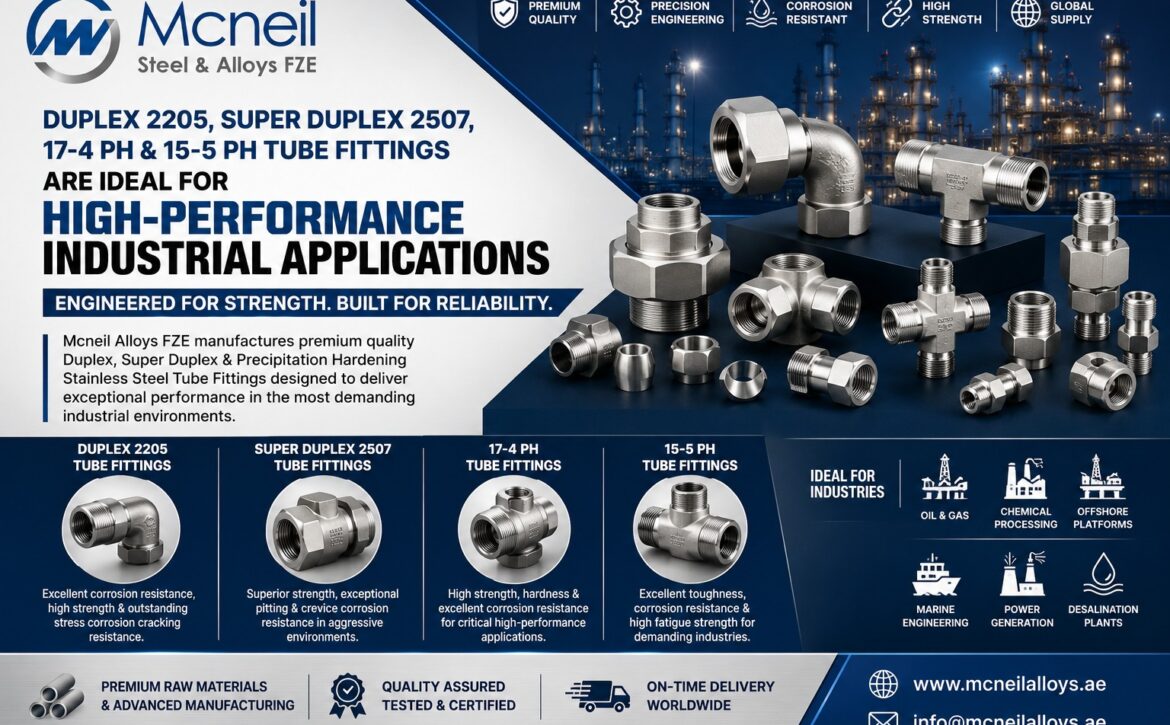
Why Duplex 2205, Super Duplex 2507, 17-4 PH & 15-5 PH Tube Fittings Are Ideal for High-Performance Industrial Applications

Introduction

Industrial piping and instrumentation systems operate under extreme pressure, corrosive environments, fluctuating temperatures, and continuous service conditions. Selecting the right tube fittings is essential for maintaining leak-proof connections, ensuring operational safety, and minimizing maintenance costs.

Duplex 2205 Tube Fittings, Super Duplex 2507 Tube Fittings, 17-4 PH Tube Fittings, and 15-5 PH Tube Fittings are among the most reliable solutions for industries requiring exceptional corrosion resistance, high mechanical strength, and superior durability. These advanced alloy tube fittings are widely used in oil & gas, offshore platforms, chemical processing, power generation, marine engineering, desalination, and instrumentation systems.

Mcneil Alloys FZE is a trusted manufacturer, supplier, and exporter of premium-quality Duplex, Super Duplex, and Precipitation Hardening Stainless Steel Tube Fittings, manufactured according to international standards for critical industrial applications worldwide.

Why Choose Mcneil Alloys FZE for Tube Fittings?

Selecting the right manufacturer ensures reliable performance, superior quality, and long service life.

Why Customers Trust Us

✔ Premium-grade raw materials

✔ Precision-manufactured tube fittings

✔ Excellent corrosion resistance

✔ High-pressure capability

✔ Leak-proof connections

✔ Competitive pricing

✔ Ready stock for quick delivery

✔ Custom sizes and configurations

✔ Worldwide exports

✔ Dedicated technical support

Our commitment to quality ensures dependable performance even in the most demanding industrial environments.

Our Tube Fitting Grades

1. Duplex 2205 Tube Fittings

Duplex 2205 is a nitrogen-enhanced duplex stainless steel offering an excellent combination of strength and corrosion resistance, making it one of the most widely used materials for industrial process piping.

Key Features

  • Excellent chloride corrosion resistance
  • High mechanical strength
  • Superior stress corrosion cracking resistance
  • Excellent weldability
  • Long operational life
  • Cost-effective performance

Typical Applications

  • Offshore platforms
  • Chemical processing
  • Oil & Gas pipelines
  • Heat exchangers
  • Marine systems
  • Pressure vessels
  • Water treatment plants

2. Super Duplex 2507 Tube Fittings

Super Duplex 2507 offers higher chromium, molybdenum, and nitrogen content, providing outstanding resistance to aggressive chemical environments and seawater corrosion.

Advantages

  • Exceptional pitting resistance
  • Outstanding crevice corrosion resistance
  • Superior chloride resistance
  • Excellent mechanical strength
  • High pressure capability
  • Extended service life

Common Applications

  • Offshore drilling
  • Desalination plants
  • Petrochemical plants
  • Marine engineering
  • Chemical processing
  • Seawater cooling systems
  • LNG facilities

3. 17-4 PH Tube Fittings

17-4 PH Stainless Steel is a precipitation-hardening alloy that combines high strength with excellent corrosion resistance.

Key Features

  • High tensile strength
  • Excellent hardness
  • Good corrosion resistance
  • Outstanding wear resistance
  • High fatigue strength
  • Excellent dimensional stability

Applications

  • Aerospace components
  • Oil & Gas equipment
  • Pump shafts
  • Valves
  • Instrumentation
  • Defense equipment

4. 15-5 PH Tube Fittings

15-5 PH Stainless Steel provides improved toughness and transverse strength while maintaining excellent corrosion resistance.

Advantages

  • High strength
  • Excellent toughness
  • Good corrosion resistance
  • Superior fatigue resistance
  • Excellent machinability
  • Reliable long-term performance

Applications

  • Aerospace
  • Nuclear industry
  • Marine engineering
  • Petrochemical plants
  • Process equipment
  • High-pressure instrumentation

Why Duplex & PH Stainless Steel Tube Fittings Are the Best Choice

Modern industrial plants demand tube fittings capable of performing reliably under extreme operating conditions.

Key Benefits

✔ Exceptional corrosion resistance

✔ High mechanical strength

✔ Excellent pressure handling

✔ Leak-proof performance

✔ Outstanding fatigue resistance

✔ Long operational lifespan

✔ Reduced maintenance costs

✔ Excellent temperature resistance

✔ Reliable performance in harsh environments

Types of Tube Fittings We Manufacture

Mcneil Alloys FZE offers a comprehensive range of precision-engineered tube fittings.

Product Range

  • Tube Elbows
  • Tube Tees
  • Tube Unions
  • Male Connectors
  • Female Connectors
  • Bulkhead Connectors
  • Tube Reducers
  • Tube Adapters
  • Tube Caps
  • Tube Plugs
  • Ferrule Fittings
  • Compression Tube Fittings
  • Instrumentation Tube Fittings
  • Hydraulic Tube Fittings
  • Custom Tube Fittings

Available in multiple sizes, pressure ratings, and customized configurations.

Duplex 2205 vs Super Duplex 2507 vs 17-4 PH vs 15-5 PH Tube Fittings

Feature Duplex 2205 Super Duplex 2507 17-4 PH 15-5 PH
Corrosion Resistance Excellent Outstanding Very Good Very Good
Chloride Resistance Excellent Superior Moderate Moderate
Mechanical Strength High Very High Very High High
Wear Resistance Good Excellent Excellent Excellent
Pressure Capability High Very High High High
Typical Applications Offshore & Chemical Marine & Desalination Aerospace & Valves Aerospace & Process Equipment

Each alloy provides unique advantages depending on the operating environment and application requirements.

Applications of Tube Fittings

Our Duplex and PH Stainless Steel Tube Fittings are widely used across numerous industrial sectors.

Major Industries

  • Oil & Gas
  • Offshore Platforms
  • Petrochemical Plants
  • Chemical Processing
  • Marine Engineering
  • Shipbuilding
  • Power Generation
  • Aerospace Industry
  • Pharmaceutical Plants
  • Water Treatment
  • Desalination Plants
  • LNG Plants
  • Fertilizer Industry
  • Industrial Automation
  • Instrumentation Systems

Why Duplex & PH Tube Fittings Perform Better

Compared to conventional stainless steel fittings, these advanced alloys offer superior performance by resisting:

  • Chloride attack
  • Pitting corrosion
  • Crevice corrosion
  • Stress corrosion cracking
  • High-pressure fatigue
  • Mechanical wear
  • Corrosive chemicals

This makes them ideal for long-term industrial service.

International Standards

Our Tube Fittings are manufactured according to internationally recognized specifications.

Available Standards

  • ASTM
  • ASME
  • ANSI
  • ISO
  • DIN
  • EN
  • MSS
  • NACE

Available in multiple sizes, pressure ratings, end connections, and custom specifications.

Why Industries Prefer Our Tube Fittings

Compared with conventional materials, our Duplex and PH Tube Fittings deliver exceptional reliability.

Business Advantages

🌍 Superior corrosion resistance

⚙ High-pressure performance

🛡 Leak-proof connections

📈 Longer equipment lifespan

💰 Reduced maintenance costs

🚀 Lower downtime

📊 Improved operational safety

Quality Assurance at Mcneil Alloys FZE

Every Tube Fitting undergoes rigorous inspection before shipment.

Our Inspection Process

  • Raw Material Testing
  • PMI Testing
  • Chemical Analysis
  • Mechanical Testing
  • Hydrostatic Testing
  • Pressure Testing
  • Dimensional Inspection
  • Surface Finish Verification
  • Visual Inspection
  • Material Traceability

Material Test Certificates (MTC) and inspection reports are available upon request.

Why Businesses Worldwide Choose Mcneil Alloys FZE

Industrial customers continue to rely on us because of our engineering excellence and commitment to quality.

Our Strengths

✔ Premium raw materials

✔ Advanced manufacturing facility

✔ Experienced engineering team

✔ Large inventory

✔ Fast global delivery

✔ Competitive pricing

✔ Customized production

✔ Reliable after-sales support

Benefits of Choosing Our Tube Fittings

Partnering with Mcneil Alloys FZE provides long-term industrial advantages.

📊 Reliable industrial performance

🌍 Worldwide supply capability

⚙ Precision-engineered fittings

🛠 Long-lasting durability

📈 Improved operational efficiency

💼 Trusted manufacturing expertise

📞 Get Premium Duplex & PH Tube Fittings Today

Looking for high-quality Duplex 2205 Tube Fittings, Super Duplex 2507 Tube Fittings, 17-4 PH Tube Fittings, or 15-5 PH Tube Fittings for your industrial applications?

Mcneil Alloys FZE

📞 +91 9870883613

📧 info@mcneilalloys.ae

Our experts are ready to assist you with product selection, technical specifications, pricing, and customized manufacturing solutions.

Frequently Asked Questions (FAQs)

1. Why are Duplex 2205 Tube Fittings widely used?

Duplex 2205 Tube Fittings provide an excellent combination of corrosion resistance, high strength, and resistance to chloride stress corrosion cracking, making them ideal for offshore and chemical industries.

2. What is the difference between Duplex 2205 and Super Duplex 2507 Tube Fittings?

Super Duplex 2507 offers higher chromium, molybdenum, and nitrogen content, resulting in better corrosion resistance and higher mechanical strength than Duplex 2205.

3. Where are 17-4 PH and 15-5 PH Tube Fittings commonly used?

These precipitation-hardening stainless steel tube fittings are widely used in aerospace, defense, instrumentation, oil & gas, valves, pumps, and high-pressure industrial systems.

4. What types of Tube Fittings do you manufacture?

We manufacture elbows, tees, unions, adapters, ferrule fittings, compression tube fittings, hydraulic fittings, instrumentation tube fittings, plugs, caps, reducers, and customized tube fittings.

5. Do your Tube Fittings comply with international standards?

Yes. Our products are manufactured according to ASTM, ASME, ANSI, ISO, DIN, EN, MSS, and NACE standards.

6. Why choose Mcneil Alloys FZE?

Mcneil Alloys FZE offers premium-quality tube fittings, advanced manufacturing, strict quality control, competitive pricing, customized solutions, technical expertise, and reliable worldwide delivery.

Read More
admin July 22, 2026 0 Comments