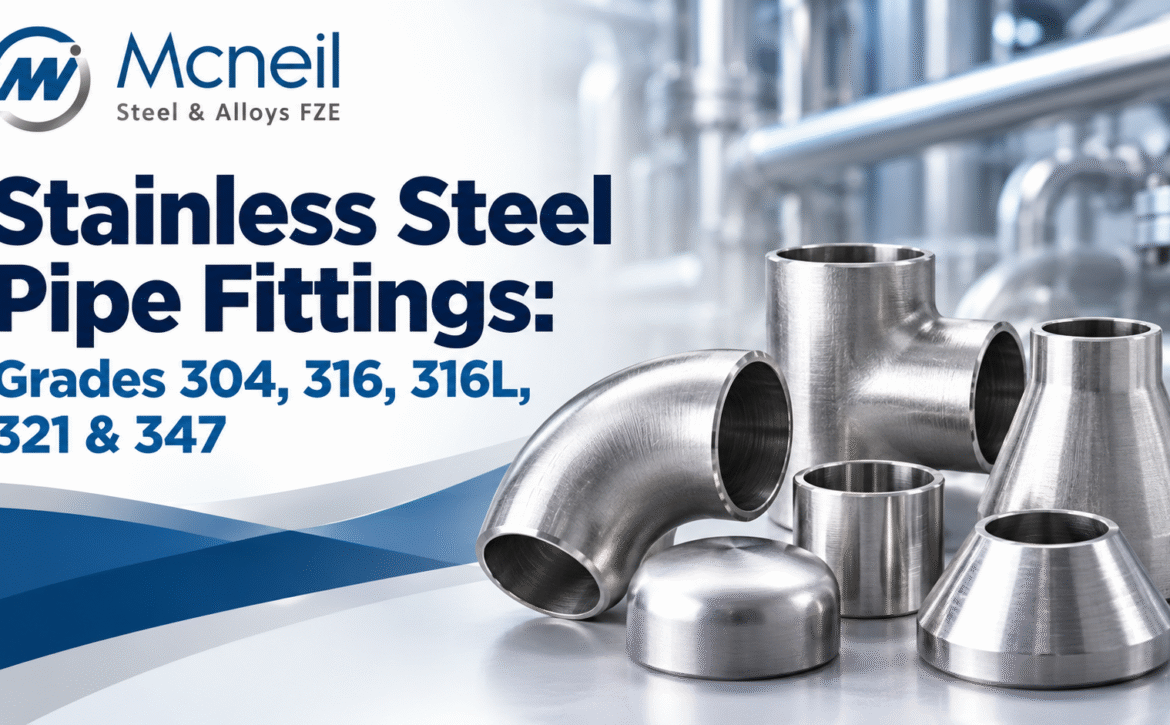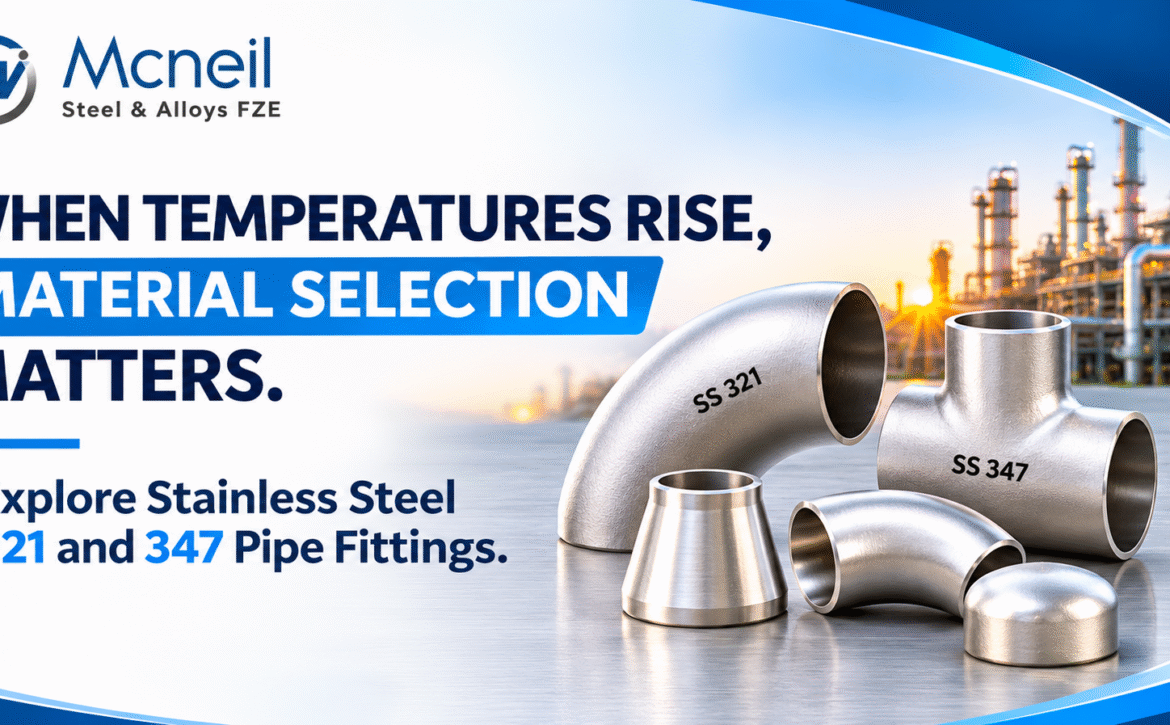
When Temperatures Rise, Material Selection Matters: Explore Stainless Steel 321 and 347 Pipe Fittings
Introduction
In high-temperature industrial applications, selecting the right material is essential for maintaining equipment reliability, safety, and long-term performance. Stainless steel 321 and 347 pipe fittings are widely used in industries where elevated temperatures, thermal cycling, and corrosive environments create demanding operating conditions.
Both grades belong to the austenitic stainless steel family and offer excellent resistance to oxidation and intergranular corrosion. Their titanium and niobium stabilization helps maintain their mechanical properties and corrosion resistance during exposure to elevated temperatures.
At Mcneil Alloys, we understand the importance of selecting suitable materials for demanding industrial applications. Stainless steel 321 and 347 pipe fittings are valuable solutions for industries requiring dependable performance under high-temperature conditions.
Understanding Stainless Steel 321 Pipe Fittings
Stainless steel 321 is a titanium-stabilized austenitic stainless steel designed to provide improved resistance to intergranular corrosion following exposure to elevated temperatures.
The addition of titanium helps prevent chromium carbide precipitation during welding and high-temperature service. This makes SS 321 pipe fittings suitable for applications involving repeated heating and cooling.
Key Features of Stainless Steel 321
High-Temperature Performance: SS 321 maintains good mechanical properties and oxidation resistance in elevated-temperature environments.
Excellent Corrosion Resistance: Its stabilized composition helps reduce the risk of intergranular corrosion.
Good Weldability: SS 321 is suitable for welded piping systems and industrial fabrication.
Thermal Stability: Its titanium stabilization makes it a reliable choice for applications involving thermal cycling.
Applications of SS 321 Pipe Fittings
Stainless steel 321 pipe fittings are commonly used in:
Chemical processing plants
Petroleum refining facilities
Aerospace and aircraft exhaust systems
Thermal processing equipment
Power generation plants
High-temperature industrial piping systems
Understanding Stainless Steel 347 Pipe Fittings
Stainless steel 347 is a niobium-stabilized austenitic stainless steel developed for applications involving elevated temperatures and welding.
The addition of niobium helps prevent chromium carbide precipitation, improving resistance to intergranular corrosion after exposure to high temperatures.
SS 347 pipe fittings are particularly suitable for applications where welding and prolonged high-temperature service are important considerations.
Key Features of Stainless Steel 347
Excellent High-Temperature Resistance: SS 347 offers dependable performance in elevated-temperature environments.
Improved Resistance to Intergranular Corrosion: Niobium stabilization helps maintain corrosion resistance after welding and high-temperature exposure.
Good Weldability: Its composition makes it suitable for welded piping systems.
Reliable Mechanical Properties: SS 347 maintains useful strength and stability under demanding operating conditions.
Applications of SS 347 Pipe Fittings
Stainless steel 347 pipe fittings are commonly used in:
Power generation facilities
Petrochemical processing plants
Chemical processing industries
High-temperature exhaust systems
Industrial furnace equipment
Refinery piping systems
Stainless Steel 321 vs. 347 Pipe Fittings: Key Differences
Although SS 321 and SS 347 offer similar performance characteristics, their stabilization methods differ.
Feature: Stainless Steel 321: Stainless Steel 347
Stabilizing element: Titanium: Niobium
Corrosion resistance: Excellent resistance to intergranular corrosion: Excellent resistance to intergranular corrosion
High-temperature performance: Suitable for elevated-temperature service: Suitable for elevated-temperature service
Welding applications: Suitable for welded piping systems: Particularly useful in welded systems
Common applications: Aerospace, chemical processing, thermal equipment: Power generation, petrochemical plants, refineries
The selection between these grades depends on operating temperature, fabrication requirements, corrosion conditions, and applicable industry standards.
Why Material Selection Matters in High-Temperature Applications
Choosing the correct stainless steel grade is essential for maintaining piping system performance and preventing premature material failure.
High temperatures can affect the mechanical properties of metals and increase the risk of oxidation, corrosion, and thermal fatigue.
Stainless steel 321 and 347 pipe fittings offer several advantages:
Improved Operational Reliability: Their stabilized compositions help maintain performance in demanding temperature conditions.
Reduced Corrosion Risk: Both grades provide improved resistance to intergranular corrosion.
Long-Term Durability: Their high-temperature properties support dependable performance in industrial environments.
Suitable for Critical Applications: They are widely used in piping systems where material reliability is essential.
Choosing the Right Stainless Steel Pipe Fittings
Before selecting stainless steel 321 or 347 pipe fittings, consider the following factors:
Operating temperature and pressure
Type of fluid or gas being transported
Corrosion and oxidation conditions
Welding and fabrication requirements
Applicable ASTM and ASME standards
Required dimensions, wall thickness, and fitting configuration
Selecting the appropriate material helps ensure compatibility with operating conditions and supports long-term piping system reliability.
Why Choose Mcneil Alloys?
Mcneil Alloys supplies stainless steel and specialty alloy products for demanding industrial applications.
Our product range supports industries requiring reliable materials for high-temperature service, corrosion resistance, and critical piping systems.
Whether your project requires stainless steel 321 or 347 pipe fittings, selecting the right grade is essential for achieving dependable performance.
Looking for reliable stainless steel 321 and 347 pipe fittings for high-temperature industrial applications?
Contact Mcneil Alloys today to discuss your requirements and find the right material for your project.
Frequently Asked Questions (FAQs)
1. What are stainless steel 321 pipe fittings?
Stainless steel 321 pipe fittings are titanium-stabilized stainless steel components designed for high-temperature applications. They offer excellent resistance to oxidation and intergranular corrosion.
2. What are stainless steel 347 pipe fittings used for?
SS 347 pipe fittings are used in power generation, petrochemical processing, chemical plants, refineries, and other industrial applications involving elevated temperatures.
3. What is the main difference between SS 321 and SS 347?
The primary difference is their stabilizing element. SS 321 uses titanium, while SS 347 uses niobium to improve resistance to intergranular corrosion.
4. Are stainless steel 321 and 347 suitable for high-temperature applications?
Yes. Both grades are designed for elevated-temperature service and offer good oxidation resistance and mechanical stability. The suitable grade depends on the specific operating conditions.
5. Are SS 321 and SS 347 pipe fittings weldable?
Yes. Both grades offer good weldability and are suitable for welded piping systems. Their stabilized compositions help reduce the risk of intergranular corrosion following welding.
6. Which is better for high-temperature applications: SS 321 or SS 347?
Both grades offer reliable high-temperature performance. The choice depends on operating conditions, fabrication requirements, and the applicable material specifications.
7. What industries use stainless steel 321 and 347 pipe fittings?
These fittings are commonly used in chemical processing, petrochemical, power generation, aerospace, oil and gas, and thermal processing industries.