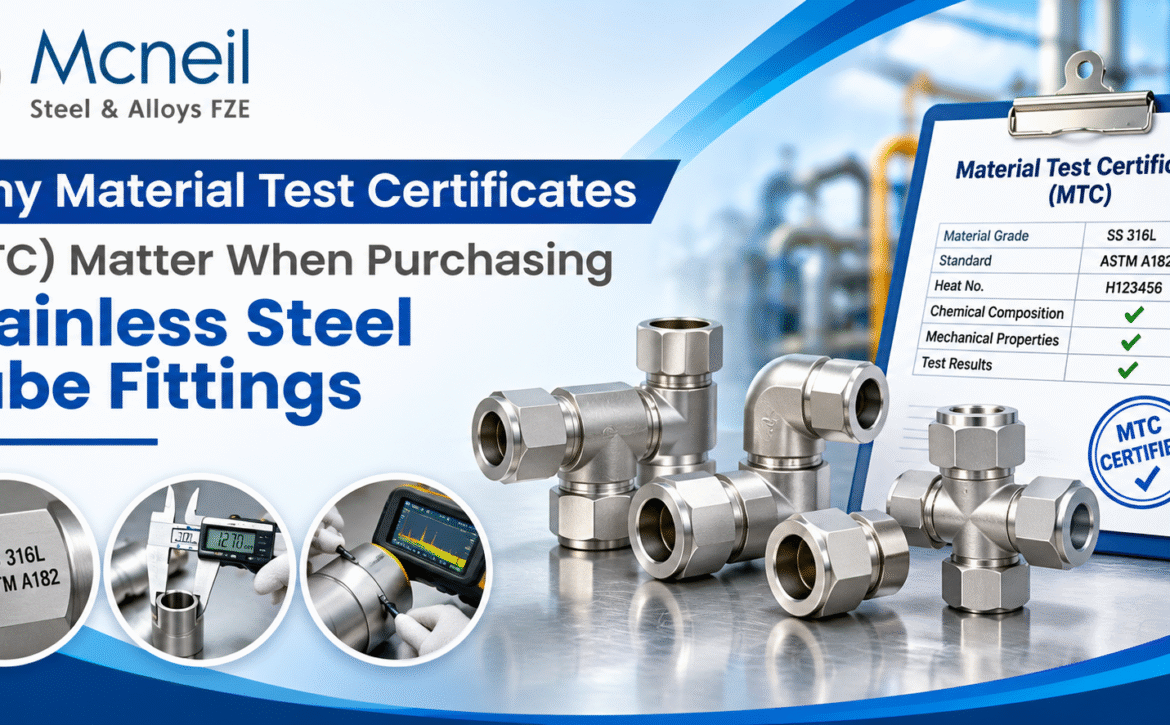
Why Material Test Certificates (MTC) Matter When Purchasing Stainless Steel Tube Fittings
Introduction
When purchasing stainless steel tube fittings for industrial applications, quality, reliability, and material traceability are essential considerations. These fittings are widely used in industries such as oil and gas, petrochemicals, chemical processing, power generation, pharmaceuticals, and marine engineering, where even a minor material failure can lead to leakage, equipment damage, production downtime, or safety risks.
One of the most important documents buyers should request when purchasing stainless steel tube fittings is a Material Test Certificate (MTC). An MTC provides documented evidence of the material’s chemical composition, mechanical properties, manufacturing standards, and quality inspection results.
At Mcneil Alloys, we understand that selecting the right stainless steel tube fittings involves more than checking dimensions and appearance. Verifying material quality through proper documentation helps buyers make informed purchasing decisions and ensures that the supplied products meet the required technical specifications.
What Is a Material Test Certificate (MTC)?
A Material Test Certificate (MTC), also known as a Mill Test Certificate, is an official quality document issued by the manufacturer or material producer. It confirms that the supplied material has been tested and complies with the specified material grade and applicable standards.
For stainless steel tube fittings, an MTC generally includes details such as:
Material Grade: Specifies the stainless steel grade, such as SS 304, SS 304L, SS 316, or SS 316L.
Chemical Composition: Provides details of elements such as chromium, nickel, molybdenum, carbon, and manganese.
Mechanical Properties: Includes tensile strength, yield strength, elongation, and hardness test results, as applicable.
Applicable Standards: Identifies the relevant ASTM, ASME, or other material specifications.
Heat Number: A unique identification number used to trace the material back to its original production batch.
Manufacturer Details: Includes the name and identification details of the material manufacturer.
Inspection and Testing Details: Records relevant quality inspection and testing results.
These details help purchasers verify whether stainless steel tube fittings meet the technical requirements of their intended application.
7 Reasons Why MTC Matters When Purchasing Stainless Steel Tube Fittings
1. Ensures Correct Material Grade
Not all stainless steel grades offer the same performance. For example, SS 304 and SS 316 tube fittings have different chemical compositions and corrosion resistance properties.
SS 316 contains molybdenum, which improves its resistance to chloride-related corrosion compared with SS 304 in many environments.
An MTC helps buyers verify that the supplied stainless steel tube fittings match the specified grade. This is particularly important for chemical processing, offshore installations, marine applications, and oil and gas projects.
2. Verifies Chemical Composition
The chemical composition of stainless steel directly affects its corrosion resistance, strength, and durability.
An MTC provides laboratory test results showing the percentage of different alloying elements present in the material. Buyers can compare these values against the applicable ASTM or ASME material specifications.
This verification reduces the risk of receiving incorrectly graded or substituted materials.
3. Confirms Mechanical Properties
Stainless steel tube fittings must withstand the pressure, temperature, vibration, and operating conditions of industrial systems.
An MTC provides relevant mechanical test results, including tensile strength, yield strength, elongation, and hardness, depending on the product specification and certification requirements.
These properties help engineers assess whether the selected material is suitable for the intended application.
4. Provides Material Traceability
Traceability is especially important in industries where quality documentation and inspection records are mandatory.
Every properly documented material batch can be linked to its heat number. This allows purchasers, inspectors, and quality control teams to trace the supplied stainless steel tube fittings back to the original material manufacturer and associated test records.
Heat number identification also helps during quality audits, project inspections, and future maintenance activities.
5. Supports Industry Standards and Project Compliance
Industrial projects often specify particular material grades, manufacturing standards, and inspection requirements.
For example, stainless steel tube fittings may need to comply with applicable ASTM specifications and relevant dimensional or manufacturing standards, such as ASTM A269 for certain tubing applications and ASME B16.11 for applicable forged fittings.
An MTC helps demonstrate material compliance with the specified requirements. However, buyers should also verify product-specific manufacturing, dimensional, and inspection documentation because an MTC alone does not establish complete product compliance.
6. Reduces the Risk of Material Failure
Using the wrong material in an industrial installation can result in corrosion, cracking, leakage, and premature equipment failure.
An MTC helps reduce this risk by providing documented evidence of material composition and tested properties. It also gives quality teams a reliable reference when evaluating incoming stainless steel tube fittings.
For critical applications, buyers should combine MTC verification with appropriate dimensional inspections, pressure testing, and other specified quality checks.
7. Improves Purchasing Confidence and Quality Assurance
Purchasing industrial components requires confidence in both the supplier and the material being delivered.
An MTC provides buyers with documented quality information that supports supplier evaluation, incoming material inspection, and project documentation.
It is particularly valuable for EPC contractors, procurement managers, project engineers, distributors, and industrial maintenance teams handling quality-sensitive projects.
Understanding Different Types of Material Test Certificates
When purchasing stainless steel tube fittings, buyers may come across different inspection document categories.
The EN 10204 standard defines different types of inspection documents commonly used for metallic products.
EN 10204 Type 2.1: A declaration of compliance with the order, without test results.
EN 10204 Type 2.2: A test report containing results based on non-specific inspection.
EN 10204 Type 3.1: An inspection certificate containing specific inspection results, validated by the manufacturer’s authorised inspection representative who is independent of the manufacturing department.
EN 10204 Type 3.2: An inspection certificate containing specific inspection results, validated by both the manufacturer’s authorised inspection representative and an authorised inspector representing the purchaser or an independent inspection body.
For critical industrial projects, purchasers should confirm the required certificate type in the purchase order and project specifications before placing an order.
What Should Buyers Check in an MTC Before Purchasing Stainless Steel Tube Fittings?
Receiving an MTC is important, but reviewing its details is equally essential.
Here are some important points buyers should verify:
Material Grade: Ensure the grade mentioned in the certificate matches the purchase order.
Chemical Composition: Check that the chemical analysis complies with the relevant material specification.
Mechanical Test Results: Verify that the recorded values meet the specified requirements.
Heat Number: Confirm that the heat number on the MTC matches the material identification or product traceability records.
Applicable Standards: Check the ASTM, ASME, or other specified standards.
Manufacturer Information: Verify the certificate issuer and material manufacturer’s details.
Certificate Authenticity: Ensure the document is genuine and can be verified with the issuing manufacturer when necessary.
These checks help procurement teams avoid documentation gaps and reduce the risk of accepting non-compliant materials.
Why Choose Mcneil Alloys for Stainless Steel Tube Fittings?
At Mcneil Alloys, we understand the importance of material quality, product reliability, and documentation in industrial procurement. We focus on supplying industrial piping components that meet the technical and quality requirements of demanding applications.
Our product range includes stainless steel tube fittings in different grades, including SS 304, SS 304L, SS 316, and SS 316L, subject to availability and project requirements.
We support customers with product specifications and relevant material documentation as required by the order.
Whether you are sourcing stainless steel tube fittings for oil and gas, petrochemical, chemical processing, power generation, or other industrial applications, our team can assist you in identifying suitable products for your requirements.
We serve customers across India and international markets, including the UAE, Saudi Arabia, and other GCC countries.
Conclusion
Material Test Certificates play an important role in ensuring the quality, traceability, and specification compliance of stainless steel tube fittings. They provide essential information about material composition, mechanical properties, manufacturing origin, and inspection results.
For buyers, checking an MTC before accepting materials is an important step towards reducing procurement risks and maintaining industrial quality standards.
At Mcneil Alloys, we believe that reliable industrial components begin with proper material selection and quality verification. Always request and review the appropriate material documentation before purchasing stainless steel tube fittings for critical applications.
Looking for Quality Stainless Steel Tube Fittings with Material Test Certificates?
Choose Mcneil Alloys for stainless steel tube fittings in SS 304, SS 304L, SS 316, and SS 316L grades.
We support industrial buyers with quality-focused product sourcing, technical specifications, and relevant material documentation for demanding applications.
Contact Mcneil Alloys today to discuss your stainless steel tube fitting requirements and request a quotation.
Website:
Frequently Asked Questions (FAQs)
1. What is an MTC in stainless steel tube fittings?
An MTC (Material Test Certificate) is an official document that provides details about the chemical composition, mechanical properties, material grade, heat number, and relevant test results of stainless steel materials.
2. Is an MTC necessary when purchasing stainless steel tube fittings?
An MTC is important for verifying material quality, traceability, and compliance with purchase specifications. It is particularly important for oil and gas, petrochemical, chemical, and other quality-sensitive industrial applications.
3. What is the difference between SS 304 and SS 316 MTC?
The primary difference is their chemical composition. SS 316 contains molybdenum, which provides improved resistance to chloride-related corrosion compared with SS 304 in many environments. Their MTCs show the respective chemical composition and mechanical test results.
4. What is a Heat Number in an MTC?
A heat number is a unique identification number assigned to a particular batch of material during production. It helps trace the material to its original manufacturing and testing records.
5. What is an EN 10204 Type 3.1 certificate?
An EN 10204 Type 3.1 certificate is an inspection document containing specific test results, validated by the manufacturer’s authorised inspection representative who is independent of the manufacturing department.
6. Can stainless steel tube fittings be supplied without an MTC?
Some standard applications may not require an MTC, depending on the purchase specifications. However, for critical industrial projects, buyers should clearly specify the required material certification before placing an order.
7. Which standards are important for stainless steel tube fittings?
Applicable standards depend on the product type. ASTM A269 covers certain stainless steel tubing applications, ASTM A182 covers specified forged or rolled alloy and stainless steel piping components, and ASME B16.11 covers applicable forged fittings.
8. How can buyers verify an MTC?
Buyers should check the manufacturer’s details, material grade, chemical composition, mechanical properties, heat number, and applicable standards. They can also contact the issuing manufacturer to confirm the certificate’s authenticity.
9. Why is material traceability important in oil and gas projects?
Material traceability helps identify the manufacturing origin and testing history of supplied components. It supports quality audits, inspection procedures, maintenance activities, and project documentation requirements.
10. Does Mcneil Alloys provide stainless steel tube fittings with MTC?
Mcneil Alloys can assist buyers with stainless steel tube fitting requirements and relevant material documentation, subject to the agreed product specifications and purchase order requirements.