Alloy Steel ASTM A182 Tube Fittings F1, F5, F9, F11, F22 & F91 Manufacturer, Supplier & Exporter in Kuwait

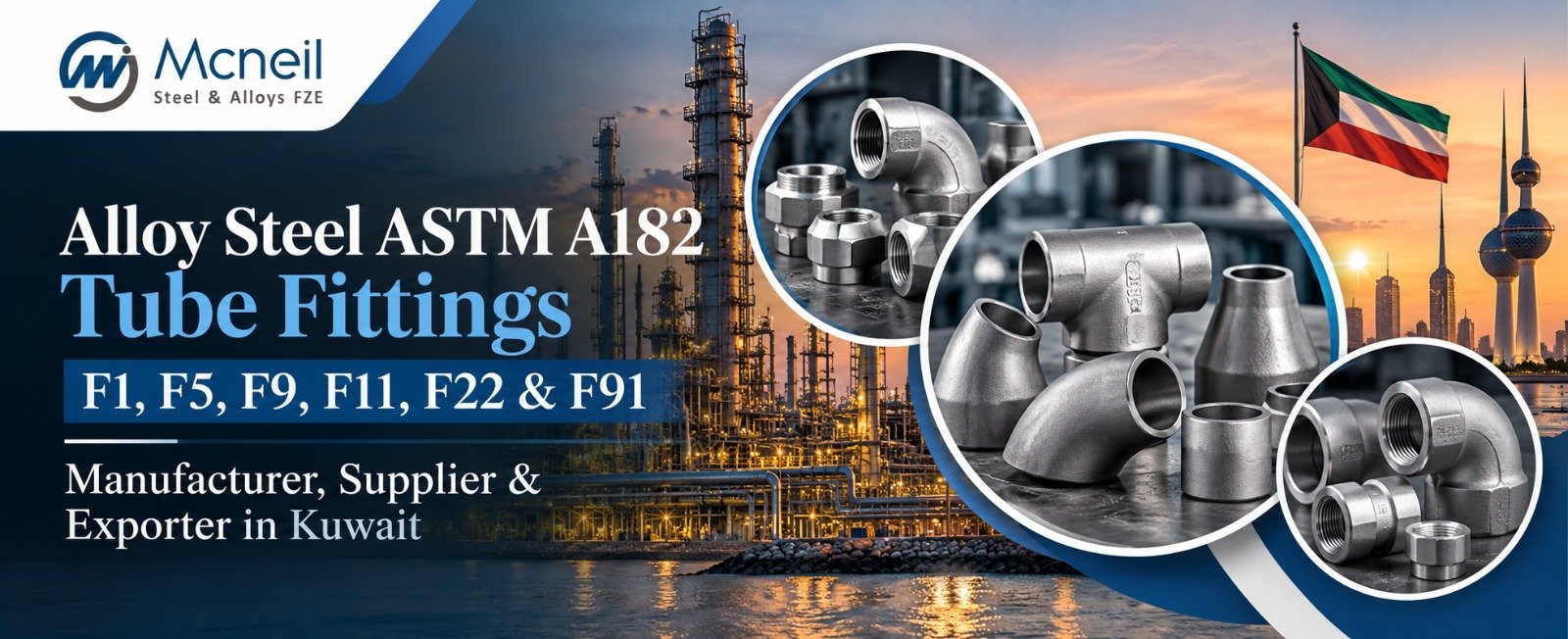
Alloy Steel Tube Fittings are important components in high-pressure and high-temperature piping systems used across oil and gas, power generation, petrochemical processing, refineries, and heavy industrial facilities. Manufactured from chromium-molybdenum alloy steels, these fittings are designed to provide the mechanical strength and thermal performance required for demanding operating conditions.
Mcneil Alloys supplies Alloy Steel ASTM A182 fittings in grades F1, F5, F9, F11, F22 and F91 for industrial projects in Kuwait and other Gulf Cooperation Council (GCC) markets. These fittings are used in piping assemblies where material strength, temperature resistance, dimensional accuracy, and dependable welded connections are essential.
For engineering companies, EPC contractors, plant operators, and procurement teams in Kuwait, selecting the correct alloy steel fitting requires careful evaluation of the grade, pressure and temperature conditions, connection type, applicable standards, and project documentation.
What Are Alloy Steel ASTM A182 Tube Fittings?
ASTM A182 is a specification covering forged or rolled alloy and stainless steel pipe flanges, forged fittings, and valves and parts intended for high-temperature service. The F-series grades covered in this article are alloy steel grades used in appropriate pressure piping applications.
These components are manufactured with controlled alloy compositions to achieve the properties required by their intended service conditions. Chromium and molybdenum contribute to high-temperature performance, while specific grades may include other alloying elements to meet additional mechanical requirements.
Alloy steel fittings are available in configurations such as elbows, tees, reducers, and caps. Depending on the product and engineering specification, they may be supplied as butt-weld fittings or other specified fitting types.
Key Characteristics of ASTM A182 Alloy Steel Fittings
High-temperature performance: Suitable grades can retain required mechanical properties under specified elevated-temperature conditions.
Pressure-bearing capability: Designed for use in pressure piping systems when properly selected and installed.
Chromium-molybdenum composition: Provides specific strength and thermal properties.
Welded connection options: Butt-weld configurations can create permanent joints when fabricated according to approved procedures.
Multiple grade choices: F1, F5, F9, F11, F22 and F91 offer different material characteristics for different applications.
Industrial versatility: Used in suitable power, refinery, petrochemical, and energy-sector installations.
The final material selection must follow the applicable design code, approved material specification, and operating conditions.
ASTM A182 Alloy Steel Fitting Grades Available
Mcneil Alloys lists ASTM A182 alloy steel fitting grades F1, F5, F9, F11, F22 and F91. Each grade has a distinct composition and intended service profile.
1. ASTM A182 F1 Alloy Steel Fittings
F1 is a low-alloy chromium-molybdenum steel grade used in suitable industrial pressure systems. Its material characteristics make it relevant to selected applications where elevated-temperature strength and dimensional stability are required.
Typical applications:
Industrial process piping
Selected refinery systems
Pressure piping assemblies
Heat-transfer equipment
Industrial utility systems
F1 should be specified only where its chemical composition and mechanical properties meet the project’s approved material requirements.
2. ASTM A182 F5 Alloy Steel Fittings
F5 is a chromium-molybdenum alloy steel grade commonly associated with high-temperature industrial services. Its chromium content contributes to oxidation resistance under appropriate operating conditions.
Typical applications:
Refinery piping systems
Industrial heating equipment
High-temperature process lines
Petrochemical facilities
Selected heat-transfer systems
F5 is appropriate when its specified properties satisfy the required operating temperature, pressure, and material compatibility requirements.
3. ASTM A182 F9 Alloy Steel Fittings
F9 is a higher-chromium alloy steel grade used in selected demanding thermal applications. Its composition is relevant to systems where high-temperature performance and oxidation resistance are important.
Typical applications:
Refinery process equipment
High-temperature piping assemblies
Industrial heating systems
Petrochemical installations
Selected power and energy applications
The suitability of F9 depends on the service environment, design conditions, and the applicable piping specification.
4. ASTM A182 F11 Alloy Steel Fittings
F11 is a chromium-molybdenum alloy steel grade used in industrial pressure systems exposed to elevated temperatures and mechanical stress.
Typical applications:
Boiler-related piping
Steam systems
Power generation equipment
Refinery installations
High-temperature process piping
F11 can be considered when its mechanical properties, heat treatment, and fabrication requirements align with the project’s engineering specification.
5. ASTM A182 F22 Alloy Steel Fittings
F22 is a chromium-molybdenum alloy steel grade commonly used in demanding high-temperature applications. It is associated with systems requiring appropriate strength, thermal performance, and resistance to creep under specified service conditions.
Typical applications:
Power plants
Boiler systems
High-temperature steam piping
Heat exchangers
Refinery and petrochemical facilities
The final selection should account for design pressure, operating temperature, fabrication procedures, and applicable code requirements.
6. ASTM A182 F91 Alloy Steel Fittings
F91 is a high-strength chromium-molybdenum-vanadium alloy steel grade developed for demanding elevated-temperature service. Its alloy system supports high-temperature strength and creep resistance when the material is correctly manufactured, heat-treated, and installed.
Typical applications:
Power generation facilities
Critical steam piping
High-temperature pressure systems
Boiler and reheater-related assemblies
Advanced energy installations
F91 requires particular attention to material verification, welding procedures, heat treatment, and inspection. These controls should be defined in the approved project documentation.
Comparison of ASTM A182 F1, F5, F9, F11, F22 and F91
Grade General material characteristics Typical applications
F1 Low-alloy chromium-molybdenum steel Selected pressure and process systems
F5 Chromium-molybdenum alloy steel with higher chromium content Refineries and high-temperature process piping
F9 Higher-chromium alloy steel Selected thermal and refinery applications
F11 Chromium-molybdenum alloy steel Steam systems, boilers and power plants
F22 Chromium-molybdenum alloy steel for demanding thermal service Boilers, heat exchangers and power systems
F91 High-strength chromium-molybdenum-vanadium alloy steel Critical high-temperature power and steam applications
These grades are not interchangeable. Material selection should be based on the complete chemical composition, mechanical properties, heat-treatment requirements, design conditions, and applicable engineering standards.
Technical Specifications of ASTM A182 Alloy Steel Fittings
The following table summarizes key procurement considerations for the product range.
Parameter Specification
Product Alloy Steel ASTM A182 Fittings
Grades F1, F5, F9, F11, F22 and F91
Standard ASTM A182 / ASME SA182
Material type Forged alloy steel, as applicable to the specified fitting
Fitting configurations Elbows, tees, reducers, caps and other specified configurations
Connection type Butt-weld or other specified connection type
Heat treatment As required by the applicable grade and standard
Testing According to the governing specification and purchase order
Documentation Material Test Certificates and inspection records, as required
Important: ASTM A182 is primarily a forged fitting and component specification. The exact product form must be confirmed with the supplier, especially if the requirement is for tube fittings rather than conventional pipe fittings. Dimensions, pressure limits, testing, and availability should be verified for the specific product.
Applications of Alloy Steel Fittings in Kuwait
Kuwait’s industrial sectors include oil production, refining, petrochemical processing, power generation, and energy infrastructure. These facilities may require alloy steel fittings for piping systems operating under demanding thermal and pressure conditions.
Oil and Gas Industry
Alloy steel fittings are used in suitable pressure piping assemblies throughout oil and gas facilities. Material selection depends on operating temperature, pressure, process fluids, and project-specific requirements.
Oil Refineries
Refineries use high-temperature piping systems in selected process units, heating systems, and related equipment. Appropriate alloy steel grades may be specified where elevated-temperature performance is required.
Petrochemical Facilities
Petrochemical processing can involve demanding operating conditions and specialized piping materials. ASTM A182 fittings may be used in suitable installations when the selected grade matches the process requirements.
Power Generation Plants
Boiler, steam, and other high-temperature systems may require alloy steel fittings with specific mechanical and thermal properties. F11, F22 and F91 may be considered for different applications, subject to the engineering design.
Industrial Heating and Heat-Transfer Systems
Alloy steel fittings can form part of piping assemblies used in selected heating and heat-transfer equipment. The grade must be compatible with the temperature, pressure, and process environment.
EPC and Heavy Engineering Projects
Engineering, procurement, and construction contractors require fittings that match approved drawings, piping material classes, and inspection requirements. Confirming material identification and traceability helps support project compliance.
Benefits of Alloy Steel ASTM A182 Fittings
Strength Under Demanding Conditions
Suitable alloy steel grades offer mechanical properties required for specified high-pressure and high-temperature applications.
Thermal Performance
Chromium-molybdenum alloy compositions support performance in selected elevated-temperature services. The actual allowable conditions depend on the grade and applicable design code.
Permanent Welded Connections
Butt-weld fittings can provide permanent piping joints when their dimensions, material, and welding procedures are compatible with the piping system.
Grade Selection Flexibility
The availability of multiple grades allows engineers to select materials according to the intended service conditions and project requirements.
Suitability for Critical Industrial Systems
When correctly specified and installed, alloy steel fittings can support demanding process and energy applications.
Traceability and Quality Documentation
Material certification and inspection records help procurement teams verify compliance with the specified requirements.
How to Select the Right Alloy Steel Fittings in Kuwait
Before placing an order, buyers should evaluate the following factors.
1. Confirm the material specification. Verify that ASTM A182 / ASME SA182 applies to the required product form and identify the exact grade.
2. Define operating temperature and pressure. Check that the selected material and fitting design meet the applicable design conditions.
3. Specify the fitting type. Identify elbows, tees, reducers, caps, or another required configuration.
4. Confirm dimensions. Provide nominal size, schedule, wall thickness, end preparation, and dimensional standard where applicable.
5. Review the welding requirements. Confirm material compatibility and approved welding and heat-treatment procedures.
6. Consider the service environment. Evaluate the process medium and relevant corrosion, oxidation, and thermal conditions.
7. Define inspection and certification. Specify chemical analysis, mechanical testing, material certification, non-destructive examination, and third-party inspection where required.
8. Confirm availability and delivery. Verify the required grade, size, quantity, lead time, and delivery location in Kuwait.
Quality Testing and Inspection
Quality assurance helps verify that alloy steel fittings conform to the material and dimensional requirements specified for a project.
Depending on the grade and purchase order, inspection may include:
Chemical analysis: Verifies material composition against the specified grade.
Mechanical testing: Confirms the required mechanical properties.
Hardness testing: Checks compliance with the applicable acceptance criteria.
Dimensional inspection: Verifies dimensions, tolerances, and fitting geometry.
Heat-treatment verification: Confirms the required heat-treatment condition.
Non-destructive examination: Performed when required by the governing specification or project.
Material Test Certificates: Provide relevant chemical and mechanical test information.
Material traceability: Links the product to its material identification and inspection records.
Testing requirements vary by grade and product type. The inspection scope and acceptance criteria should be agreed upon before procurement.
Why Choose Mcneil Alloys for Alloy Steel Fittings in Kuwait?
Mcneil Alloys lists ASTM A182 alloy steel fitting grades F1, F5, F9, F11, F22 and F91 and identifies Kuwait among its export markets. Its product information highlights applications in high-pressure and high-temperature industrial piping systems.
For industrial buyers in Kuwait, providing complete technical details helps establish whether the available product matches the project specification.
When requesting a quotation, share:
Required grade and material standard
Fitting type and connection arrangement
Nominal size and schedule
Design pressure and operating temperature
Required heat treatment
Inspection and testing requirements
Material certification requirements
Quantity and delivery location
Mcneil Alloys supports enquiries for alloy steel fittings intended for industrial projects across Kuwait and the wider GCC region. Confirm product form, technical compliance, availability, and delivery arrangements for each order.
Frequently Asked Questions
What are ASTM A182 alloy steel fittings?
ASTM A182 covers forged or rolled alloy and stainless steel pipe flanges, forged fittings, valves, and parts intended for high-temperature service. The exact product form and grade should be confirmed against the purchase specification.
Which grades are included in this product range?
The listed alloy steel grades are F1, F5, F9, F11, F22 and F91. Each grade has different chemical and mechanical properties.
Are ASTM A182 fittings suitable for high-temperature applications?
Suitable grades can be used in high-temperature pressure systems when selected according to the design conditions and applicable standards.
What is the difference between F22 and F91?
F22 is a chromium-molybdenum alloy steel grade, while F91 is a higher-strength chromium-molybdenum-vanadium alloy steel. They have different material properties and fabrication requirements, so the approved engineering specification must determine the correct choice.
Does Mcneil Alloys supply alloy steel fittings in Kuwait?
Mcneil Alloys identifies Kuwait as an export destination for its alloy steel fitting range. Buyers should confirm the required grade, product form, size, availability, and delivery schedule directly with the supplier.
What documents should accompany an alloy steel fitting order?
Depending on the project, documents may include Material Test Certificates, chemical and mechanical test results, heat-treatment records, dimensional inspection reports, and traceability documentation.
What information is required for a quotation?
Provide the material grade, standard, fitting type, size, schedule, quantity, operating conditions, testing requirements, documentation, and delivery location in Kuwait.
Conclusion
Alloy Steel ASTM A182 fittings in grades F1, F5, F9, F11, F22 and F91 support selected industrial piping applications where material strength and high-temperature performance are important. Each grade offers different properties, making careful specification and engineering-based selection essential for refineries, power plants, petrochemical facilities, and other demanding industrial systems.
Mcneil Alloys supplies alloy steel fitting solutions for regional and international industrial markets, including Kuwait. Before purchasing, verify the exact product form, grade, dimensions, design requirements, inspection scope, and material documentation to ensure the supplied fittings align with the project’s approved specifications.
For companies searching for an Alloy Steel ASTM A182 Fittings Supplier in Kuwait, Mcneil Alloys offers a listed range of F1, F5, F9, F11, F22 and F91 grades for suitable industrial requirements.