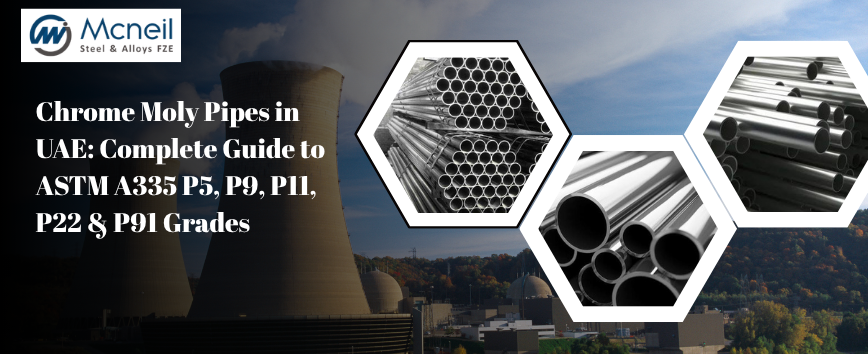
Chrome Moly Pipes in UAE: Complete Guide to ASTM A335 P5, P9, P11, P22 & P91 Grades

Introduction
High-temperature and high-pressure piping systems require materials that can maintain their strength and structural integrity under demanding operating conditions. Industries such as oil and gas, petrochemical processing, refineries, power generation, chemical processing, and heavy engineering rely on specialized alloy steel pipes for these applications.
Chrome Moly Pipes are widely used for high-temperature industrial service because chromium and molybdenum improve the material’s resistance to oxidation, heat, creep, and mechanical stress. These properties make Chrome Moly Pipes suitable for critical process and steam piping systems where conventional carbon steel may not provide the required performance.
Mcneil Alloys supplies Chrome Moly Pipes in the UAE in grades including P5, P9, P11, P22, and P91, providing alloy steel piping solutions for demanding industrial applications.
What Are Chrome Moly Pipes?
Chrome Moly Pipes, short for chromium-molybdenum alloy steel pipes, are manufactured with chromium and molybdenum as important alloying elements.
Chromium contributes to oxidation and corrosion resistance, while molybdenum improves high-temperature strength and resistance to creep.
These characteristics make Chrome Moly Pipes suitable for systems exposed to:
- High temperatures
- High pressures
- Steam
- Thermal cycling
- Oxidizing environments
- Continuous mechanical stress
They are commonly associated with ASTM A335 / ASME SA335 alloy steel pipe grades used for elevated-temperature service.
Why Are Chrome Moly Pipes Used in Industrial Applications?
Material selection becomes particularly important when piping systems operate continuously at elevated temperatures.
High-Temperature Strength
Chrome Moly alloy steel retains useful mechanical strength under elevated-temperature conditions.
Creep Resistance
Creep resistance is important in systems exposed to sustained heat and pressure for long periods.
Oxidation Resistance
Chromium helps improve resistance to oxidation and scaling during high-temperature service.
Pressure Resistance
These alloy steel pipes are suitable for demanding high-pressure piping applications when the correct grade and wall thickness are selected.
Long-Term Reliability
Properly selected Chrome Moly Pipes can provide reliable service in critical industrial systems.
Chrome Moly Pipe Grades
The most commonly specified grades in this range include:
- ASTM A335 P5
- ASTM A335 P9
- ASTM A335 P11
- ASTM A335 P22
- ASTM A335 P91
Although these grades belong to the Chrome Moly alloy steel family, their alloy composition and mechanical characteristics differ. The appropriate grade should therefore be selected according to the application’s temperature, pressure, process conditions, fabrication requirements, and applicable standards.
ASTM A335 P5 Chrome Moly Pipes
Suitable for Elevated-Temperature Service
P5 Chrome Moly Pipes are chromium-molybdenum alloy steel pipes designed for elevated-temperature applications.
Their combination of chromium and molybdenum provides improved thermal performance and oxidation resistance compared with conventional carbon steel.
Common Applications
- Refineries
- Petrochemical plants
- Heat exchangers
- Boilers
- High-temperature process piping
Key Characteristics
- Good high-temperature strength
- Improved oxidation resistance
- Suitable for elevated-temperature service
- Reliable mechanical performance
ASTM A335 P9 Chrome Moly Pipes
Enhanced Chromium Content for High-Temperature Applications
P9 Chrome Moly Pipes provide enhanced high-temperature and oxidation resistance and are used in demanding industrial process systems.
Common Applications
- Power generation
- Steam systems
- Refineries
- Petrochemical plants
- Industrial heating systems
Key Characteristics
- Excellent oxidation resistance
- Good high-temperature strength
- Suitable for elevated-temperature service
- Reliable performance under demanding conditions
P9 is often selected when higher chromium content is beneficial for the operating environment.
ASTM A335 P11 Chrome Moly Pipes
A Widely Used Grade for Boilers and Steam Systems
P11 Chrome Moly Pipes provide a practical combination of strength, weldability, and high-temperature performance.
They are widely associated with boiler and steam applications where reliable performance under elevated temperatures is required.
Common Applications
- Boilers
- Steam pipelines
- Power plants
- Heat exchangers
- Pressure systems
- Petrochemical plants
Key Characteristics
- Good weldability
- Good high-temperature strength
- Reliable mechanical properties
- Suitable for steam service
ASTM A335 P22 Chrome Moly Pipes
Designed for Demanding High-Temperature Service
P22 Chrome Moly Pipes offer enhanced high-temperature performance and creep resistance, making them suitable for demanding power and process applications.
Common Applications
- Superheaters
- Reheaters
- High-pressure boilers
- Thermal power plants
- Petrochemical processing
- Steam pipelines
Key Characteristics
- Strong creep resistance
- Good high-temperature strength
- Suitable for prolonged thermal exposure
- Reliable performance in high-pressure systems
P22 is particularly relevant for applications where piping is exposed to continuous elevated temperatures and pressure.
ASTM A335 P91 Chrome Moly Pipes
Advanced Grade for Critical Power Applications
P91 Chrome Moly Pipes are designed for demanding high-temperature applications requiring high strength and creep resistance.
P91 belongs to the modified chromium-molybdenum alloy steel family and includes additional alloying elements that contribute to its elevated-temperature mechanical performance.
Common Applications
- Supercritical power plants
- High-pressure steam pipelines
- Boilers
- Superheaters
- Reheaters
- Advanced power-generation systems
Key Characteristics
- High creep strength
- Excellent high-temperature mechanical performance
- Strong resistance to thermal degradation
- Suitable for demanding steam applications
P91 requires careful welding, heat treatment, and fabrication control, making material handling and installation particularly important for critical projects.
Chrome Moly Pipe Grade Comparison
| Grade | Primary Strength | Typical Applications |
| P5 | High-temperature and oxidation resistance | Refineries, heat exchangers |
| P9 | Enhanced oxidation and thermal performance | Power, petrochemical |
| P11 | Strength and weldability | Boilers, steam systems |
| P22 | Creep and high-temperature strength | Power plants, superheaters |
| P91 | Advanced high-temperature strength and creep resistance | Critical power and steam systems |
The best grade depends on the actual operating conditions rather than simply selecting the highest grade available.
Chrome Moly Pipes vs Carbon Steel Pipes
One of the key reasons industries select Chrome Moly Pipes is their performance under elevated temperatures.
| Property | Chrome Moly Pipes | Conventional Carbon Steel Pipes |
| High-temperature performance | High | More limited |
| Creep resistance | Improved | More limited |
| Oxidation resistance | Improved | Lower |
| Thermal stability | High for suitable grades | Lower at elevated temperatures |
| Typical service | High-temperature and high-pressure systems | General industrial service |
This does not mean Chrome Moly Pipes are automatically the correct choice for every application. Material selection should always consider the complete process environment, design temperature, pressure, corrosion conditions, welding requirements, and applicable engineering standards.
Applications of Chrome Moly Pipes
Chrome Moly Pipes are used across several industries where high-temperature and high-pressure performance are important.
Power Generation
Applications include:
- Boilers
- Superheaters
- Reheaters
- Steam pipelines
- Turbine-related systems
P22 and P91 are particularly relevant to demanding power-generation applications.
Oil & Gas
Chrome Moly Pipes can be used in refinery and process systems where elevated temperatures and pressure place significant demands on piping materials.
Applications include:
- Refinery process lines
- High-temperature piping
- Steam systems
- Process equipment connections
Petrochemical Industry
Petrochemical plants use high-performance alloy steel piping for:
- Process lines
- Heat exchangers
- High-temperature systems
- Steam distribution
- Process equipment
Chemical Processing
Chrome Moly Pipes can be selected for chemical process systems where temperature and pressure requirements exceed the practical range of standard carbon steel.
Boiler and Steam Systems
Boiler systems require piping materials capable of maintaining mechanical integrity under continuous heat and pressure.
Chrome Moly grades such as P11, P22, and P91 are commonly associated with these demanding applications.
How to Select the Right Chrome Moly Pipe Grade
Choosing the right grade requires more than comparing alloy composition.
1. Operating Temperature
Determine the maximum continuous operating temperature as well as the design temperature.
2. Operating Pressure
Consider the design pressure, wall thickness, pipe diameter, and applicable pressure design requirements.
3. Creep Requirements
Long-term exposure to high temperature can cause creep. Select a grade appropriate for the expected service conditions.
4. Oxidation Environment
Evaluate whether the pipe will be exposed to high-temperature oxidation or scaling.
5. Welding Requirements
Some Chrome Moly grades require controlled welding procedures and post-weld heat treatment. P91, in particular, requires careful fabrication control.
6. Applicable Standards
Confirm the required ASTM, ASME, project, or industry specification before purchasing.
7. Application
The grade used in a refinery process line may not be the same grade required for a supercritical steam system.
Importance of Seamless Construction
Chrome Moly Pipes used in critical applications are often specified as seamless pipes because seamless construction eliminates a longitudinal welded seam.
Potential benefits include:
- Uniform construction
- High structural integrity
- Reliable pressure performance
- Suitability for demanding service
- Reduced concerns associated with longitudinal welds
The final pipe construction should always match the applicable project specification and service requirements.
Quality Considerations for Chrome Moly Pipes
Quality assurance is particularly important when alloy steel pipes are used in high-pressure and high-temperature systems.
Important quality checks can include:
- Chemical composition analysis
- Mechanical testing
- Hydrostatic testing
- Dimensional inspection
- Hardness testing
- Positive Material Identification
- Ultrasonic testing where specified
- Visual inspection
- Heat treatment verification
- Material traceability
The exact inspection and testing requirements should be established according to the applicable ASTM/ASME specification and project quality plan.
Chrome Moly Pipes in the UAE
The UAE has a major industrial base covering oil & gas, refining, petrochemicals, power generation, desalination, and infrastructure. These industries frequently require piping systems capable of handling elevated temperatures, pressure, and demanding process conditions.
For such applications, Chrome Moly Pipes in UAE can provide an effective alloy steel solution when the required grade is correctly matched to the service environment.
Mcneil Alloys supplies Chrome Moly Pipe grades including P5, P9, P11, P22, and P91 for industrial requirements in the UAE and international markets.
Why Choose Mcneil Alloys?
Mcneil Alloys provides Chrome Moly alloy steel piping solutions for demanding industrial applications.
The product range focuses on grades including:
- ASTM A335 P5
- ASTM A335 P9
- ASTM A335 P11
- ASTM A335 P22
- ASTM A335 P91
The company serves industrial requirements involving power generation, oil & gas, petrochemical processing, refineries, and other high-temperature applications.
For project procurement, buyers should confirm the required grade, dimensions, schedule, end preparation, testing requirements, certificates, and applicable standards before placing an order.
Conclusion
Chrome Moly Pipes are an important piping solution for industrial systems operating under elevated temperatures and pressure. Their chromium and molybdenum alloying provides improved high-temperature strength, oxidation resistance, and creep performance compared with conventional carbon steel in suitable applications.
The ASTM A335 P5, P9, P11, P22, and P91 grades offer different performance characteristics for different service conditions. P5 and P9 are useful for elevated-temperature and oxidation-resistant applications, P11 provides a balance of strength and weldability, P22 offers stronger creep performance, while P91 is designed for demanding high-temperature power and steam applications.
For industrial projects in the Mcneil Alloys UAE requiring Chrome Moly Pipes, selecting the correct grade, dimensions, manufacturing specification, and inspection requirements is essential for achieving safe and dependable long-term performance.
Frequently Asked Questions
What are Chrome Moly Pipes?
Chrome Moly Pipes are chromium-molybdenum alloy steel pipes designed for demanding applications involving elevated temperatures and pressure.
Which Chrome Moly grades are available?
Common ASTM A335 grades include P5, P9, P11, P22, and P91.
What is P91 Chrome Moly Pipe used for?
P91 is generally associated with demanding high-temperature and high-pressure applications, particularly advanced power-generation and steam systems.
Are Chrome Moly Pipes suitable for power plants?
Yes. Appropriate Chrome Moly grades are widely used in boilers, steam pipelines, superheaters, reheaters, and other high-temperature power-generation systems.
What standard applies to Chrome Moly Pipes?
The commonly associated specification for seamless ferritic alloy steel pipes for elevated-temperature service is ASTM A335, with the corresponding ASME specification SA335.