Hastelloy C276 Pipe Fittings: Reliable Performance in Highly Corrosive Environments

Industrial piping systems used in chemical processing, petrochemical production, pollution control and other demanding applications must withstand aggressive chemicals, elevated temperatures and challenging operating conditions. Selecting the right piping material is essential for maintaining system integrity, reducing maintenance requirements and supporting reliable plant operations.
Hastelloy C276 pipe fittings are widely considered for applications where resistance to severe corrosion is a major material-selection requirement. This nickel-based alloy combines chromium, molybdenum and tungsten to provide resistance to various corrosive environments, including many oxidizing and reducing media.
At Mcneil Alloys, we understand the importance of selecting suitable materials for critical industrial piping systems. This guide explains the properties, benefits, applications and selection considerations associated with Hastelloy C276 pipe fittings.
What Are Hastelloy C276 Pipe Fittings?
Hastelloy C276, also identified as UNS N10276, is a nickel-molybdenum-chromium alloy containing tungsten. It is designed for service in a wide range of aggressive chemical environments where conventional materials may experience excessive corrosion.
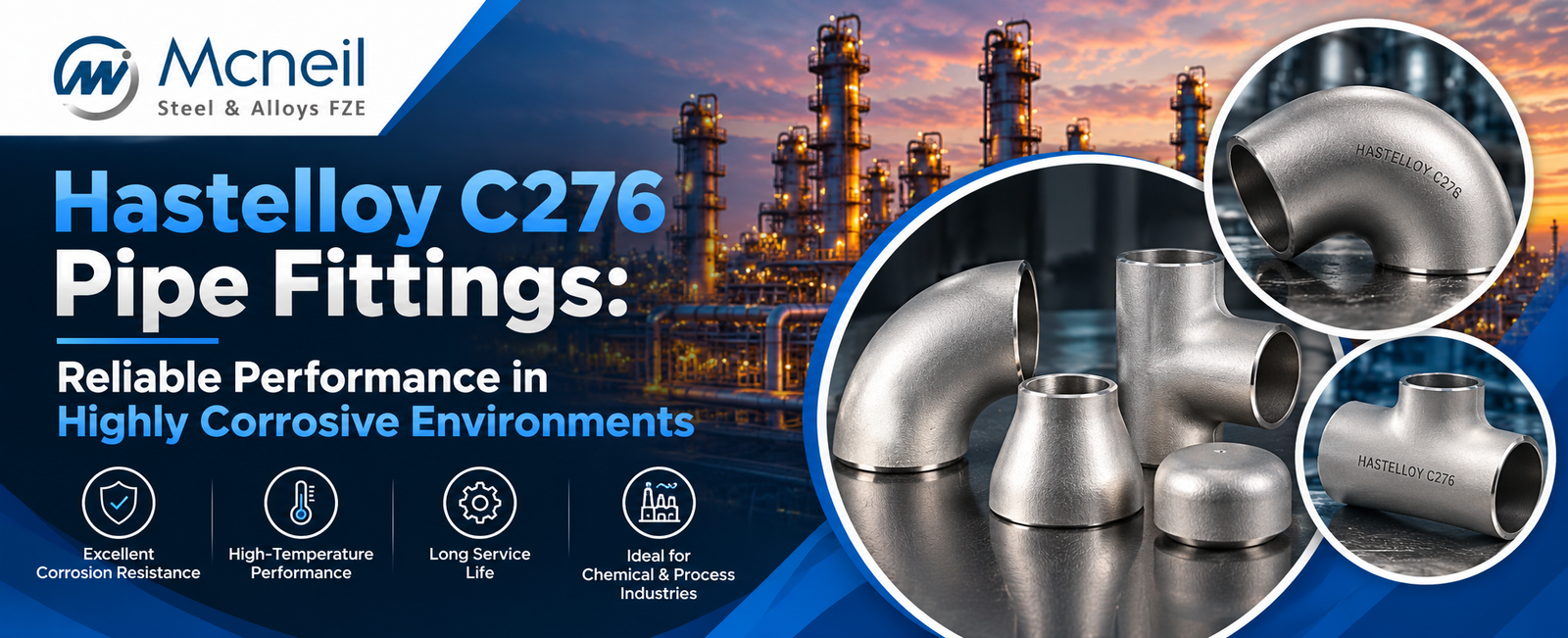
Hastelloy C276 pipe fittings connect piping sections, change flow direction, create branch connections or reduce pipe diameter. Depending on the piping design, common fitting configurations include elbows, tees, reducers, caps and other specialized components.
These fittings are used in process lines where material compatibility, dimensional accuracy and resistance to corrosion are essential to long-term performance.
Why Is Hastelloy C276 Suitable for Corrosive Environments?
The performance of Hastelloy C276 comes from its carefully balanced alloy composition and resistance to several forms of localized and general corrosion.
1. Resistance to a Wide Range of Chemicals
Hastelloy C276 offers strong resistance to many aggressive chemical environments, including selected acid solutions, chloride-containing media and contaminated process streams. Its suitability depends on chemical concentration, temperature, impurities and operating conditions.
This makes it a valuable material to evaluate for chemical processing equipment and industrial piping systems exposed to challenging media.
2. Protection Against Pitting and Crevice Corrosion
Pitting and crevice corrosion can create localized damage that compromises piping integrity. The chromium and molybdenum content of Hastelloy C276 helps provide resistance to these corrosion mechanisms in many environments.
The alloy is particularly useful where chloride exposure and localized corrosion risks must be carefully evaluated.
3. Resistance to Stress-Corrosion Cracking
Some industrial environments combine corrosive chemicals with mechanical stress, increasing the risk of cracking. Hastelloy C276 can provide improved resistance to several forms of stress-corrosion cracking compared with less suitable materials.
Actual performance depends on the service environment, fabrication quality and applied stresses.
4. Good Fabrication and Welding Characteristics
Hastelloy C276 is used in fabricated piping systems because it offers good fabrication characteristics when appropriate procedures are followed. Correct welding consumables, joint preparation and fabrication practices remain important for maintaining the intended corrosion resistance.
5. Performance in Demanding Operating Conditions
In addition to corrosion resistance, Hastelloy C276 offers useful mechanical properties for demanding industrial service. The allowable operating temperature and pressure must be established from the applicable design code, component specifications and process conditions rather than from the alloy grade alone.
Common Types of Hastelloy C276 Pipe Fittings
Different fitting configurations serve different purposes in industrial piping networks.
Hastelloy C276 Elbows: Change the direction of fluid flow in process pipelines.
Hastelloy C276 Tees: Create branch connections for distributing process fluids.
Hastelloy C276 Reducers: Connect pipes of different diameters.
Hastelloy C276 Caps: Close pipe ends where required by the system design.
Hastelloy C276 Crosses: Provide multiple branch connections in suitable piping arrangements.
Hastelloy C276 Stub Ends: Work with compatible lap-joint flange assemblies where specified.
The required configuration, dimensions, wall thickness and connection type should be confirmed against the project specification.
Industrial Applications of Hastelloy C276 Pipe Fittings
Chemical and Petrochemical Processing
Chemical plants frequently handle corrosive acids, solvents and mixed process streams. Hastelloy C276 fittings may be selected for suitable process lines, reactors and transfer systems after a material compatibility assessment.
Pollution Control and Flue Gas Treatment
Flue gas desulfurization and related pollution-control systems can expose equipment to corrosive condensates and chloride-containing solutions. Hastelloy C276 may be considered for selected components operating in these conditions.
Pulp and Paper Manufacturing
Certain pulp and paper processes involve bleaching chemicals and other corrosive media. Appropriate Hastelloy C276 fittings can help address corrosion challenges in compatible applications.
Oil and Gas Processing
Oil and gas facilities may contain corrosive process fluids, chlorides and other challenging contaminants. Material selection should account for the actual fluid composition, pressure, temperature and any applicable sour-service requirements.
Industrial Waste Treatment
Waste treatment facilities may process chemically aggressive liquids and variable waste streams. Hastelloy C276 can be evaluated for components that require enhanced corrosion resistance.
Hastelloy C276 vs Stainless Steel 316: Which Should You Choose?
Stainless Steel 316 is suitable for many industrial applications, but certain aggressive chemical environments may require a more corrosion-resistant alloy.
Hastelloy C276 offers enhanced resistance to many reducing and oxidizing corrosive environments, including selected chloride-containing conditions. Stainless Steel 316 is often a practical option where its corrosion resistance meets the application’s requirements and overall project economics are important.
The correct choice depends on the process chemistry, chemical concentration, temperature, pressure, design requirements and expected service life. Neither material should be selected solely by comparing its alloy name or purchase price.
Standards and Quality Considerations
When procuring Hastelloy C276 pipe fittings, buyers should verify that the supplied components meet the requirements specified for the project.
Important considerations include:
Material specification: ASTM B366 / ASME SB366 for applicable wrought nickel-alloy fittings.
Dimensional requirements: Confirm the applicable dimensional standard, such as ASME B16.9 for fittings within its scope.
Material certification: Review material test certificates and verify the alloy designation and chemical composition.
Inspection requirements: Confirm dimensional inspection, testing, traceability and documentation requirements.
Service suitability: Check chemical compatibility, pressure-temperature limits and applicable piping design codes.
Not every standard applies to every fitting type. Buyers should confirm the required specification, product form and dimensional standard before placing an order.
How to Select the Right Hastelloy C276 Pipe Fittings
Selecting the right fitting involves more than identifying the alloy grade. Consider the following factors before finalizing your purchase.
1. Process fluid: Identify the chemicals, concentrations, impurities and potential contaminants present in the system.
2. Operating conditions: Review operating and design temperatures, pressures, flow requirements and possible transient conditions.
3. Fitting configuration: Determine whether the system requires elbows, tees, reducers, caps or custom configurations.
4. Dimensions and wall thickness: Confirm nominal pipe size, schedule, end preparation and dimensional compatibility with adjoining components.
5. Standards and documentation: Specify the required material standards, inspection procedures, certifications and traceability documentation.
6. Supplier capability: Choose a supplier that can provide the specified material grade, required documentation and components suitable for your application.
Why Choose Mcneil Alloys for Hastelloy C276 Pipe Fittings?
At Mcneil Alloys, we recognize that critical piping projects require careful attention to material selection, product specifications and quality requirements.
When sourcing Hastelloy C276 pipe fittings, buyers should look for a supplier that can support their project requirements with appropriate product information, material documentation and dependable communication.
Our team can help you discuss your required fitting type, dimensions, material grade and applicable specifications to identify a suitable solution for your industrial piping application.
Conclusion
Hastelloy C276 pipe fittings are an important option for industrial piping systems exposed to demanding corrosive environments. Their resistance to a wide range of corrosive media, together with useful mechanical and fabrication characteristics, makes them suitable for evaluation across chemical processing, pollution control, petrochemical and other industrial applications.
However, reliable performance depends on choosing the correct material for the actual process conditions and ensuring that the finished fittings meet the applicable project specifications.
Mcneil Alloys supports your piping requirements with a focus on material suitability, product specifications and industrial application needs. Contact our team to discuss Hastelloy C276 pipe fittings for your next project.
Looking for Reliable Hastelloy C276 Pipe Fittings?
Choose the right piping components for your corrosion-critical industrial applications with Mcneil Alloys. Contact our team to discuss your material specifications, fitting requirements and project needs.
Request a Quote Today and connect with our team for your Hastelloy C276 pipe fitting requirements.
FAQs
1. What are Hastelloy C276 pipe fittings used for?
Hastelloy C276 pipe fittings are used in piping systems that handle corrosive chemicals and demanding process fluids. Common applications include chemical processing, petrochemical plants, pollution control systems, pulp and paper production, and selected oil and gas operations.
2. What makes Hastelloy C276 resistant to corrosion?
Hastelloy C276 is a nickel-molybdenum-chromium alloy containing tungsten. Its composition provides resistance to many aggressive chemical environments, including several oxidizing and reducing media, and helps protect against pitting and crevice corrosion in suitable conditions.
3. Which types of Hastelloy C276 pipe fittings are available?
Common fitting configurations include elbows, tees, reducers, caps, crosses and stub ends. Availability depends on the required dimensions, product form, manufacturing specification and supplier capabilities.
4. Which standard applies to Hastelloy C276 pipe fittings?
ASTM B366 / ASME SB366 covers applicable wrought nickel and nickel-alloy fittings. Dimensional standards depend on the fitting type and design, so the relevant product and project specifications should be verified before ordering.
5. Is Hastelloy C276 better than Stainless Steel 316?
Hastelloy C276 generally offers better resistance to many aggressive chemical environments than Stainless Steel 316. However, the best choice depends on the specific chemicals, temperature, concentration, pressure and project requirements.
6. Can Hastelloy C276 pipe fittings be used in high-temperature applications?
Hastelloy C276 can be considered for certain elevated-temperature applications, but its suitability depends on the operating environment, mechanical design limits, corrosion conditions and applicable engineering codes.
7. How do I select the right Hastelloy C276 pipe fittings?
Consider the process fluid, chemical concentration, operating temperature and pressure, fitting type, pipe size, wall thickness, connection requirements and applicable standards. Material certification and traceability should also be verified.
8. What information is needed to request a quotation for Hastelloy C276 pipe fittings?
Provide the fitting type, alloy grade, nominal size, schedule or wall thickness, applicable standard, quantity, required documentation and delivery destination. Sharing a project specification or technical drawing can also help clarify your requirements.