Manufacturer & Exporters of:
Instrumentation Pipe Fittings & Valves

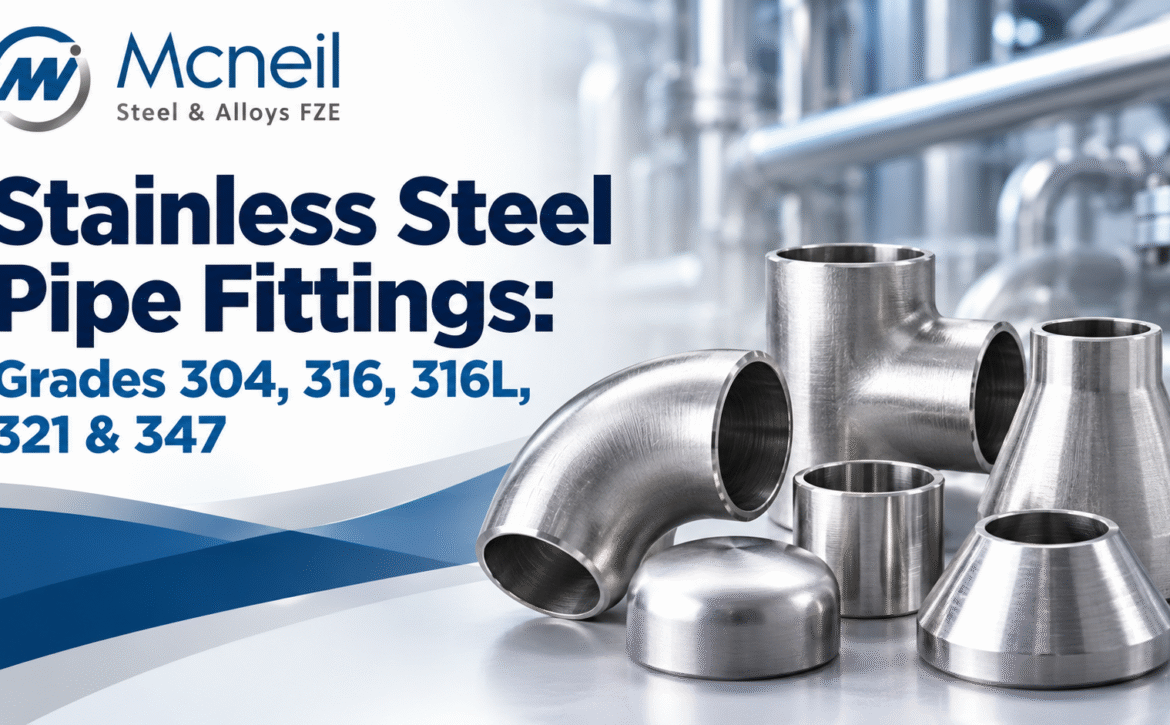
Stainless Steel Pipe Fittings: Grades 304, 316, 316L, 321 & 347

Introduction

Stainless steel pipe fittings are essential components in industrial piping systems, helping connect pipes, change flow direction, reduce pipe sizes, and create secure pipeline connections. These fittings are widely used in industries such as oil and gas, petrochemicals, chemical processing, power generation, pharmaceuticals, and food processing because of their corrosion resistance, durability, and dependable performance.

However, not all stainless steel grades offer the same properties. Grades 304, 316, 316L, 321, and 347 have different chemical compositions and performance characteristics, making each suitable for specific operating conditions. Selecting the right grade is important for achieving long-term reliability, minimizing maintenance requirements, and meeting project specifications.

At Mcneil Alloys, we understand the importance of choosing suitable stainless steel materials for industrial applications. This guide explains the key features, differences, and applications of these five stainless steel grades to help you make an informed decision.

What Are Stainless Steel Pipe Fittings?

Stainless steel pipe fittings are components used to connect, redirect, branch, or modify piping systems. They are available in different shapes, sizes, pressure classes, and material grades to accommodate various industrial requirements.

Common types of stainless steel pipe fittings include elbows, tees, reducers, caps, crosses, and stub ends. Depending on the application, fittings may be manufactured as butt-weld, socket-weld, or threaded fittings.

The appropriate fitting depends on factors such as operating pressure, temperature, fluid composition, corrosion exposure, installation method, and applicable industry standards.

Stainless Steel Grade 304 Pipe Fittings

Grade 304 is one of the most widely used austenitic stainless steel grades. It contains chromium and nickel, providing good corrosion resistance in many general industrial and commercial environments.

Key Features of Grade 304
Good corrosion resistance in many atmospheric and industrial environments.
Good formability and weldability.
Suitable for a wide range of general-purpose applications.
Available in various fitting configurations and dimensions.
Applications of Grade 304 Pipe Fittings

Grade 304 stainless steel pipe fittings are commonly used in food processing equipment, water systems, general industrial pipelines, architectural applications, and manufacturing facilities.

However, Grade 304 may not be the best choice for environments with significant chloride exposure, where localized corrosion can become a concern.

Stainless Steel Grade 316 Pipe Fittings

Grade 316 stainless steel contains molybdenum, which improves its resistance to pitting and crevice corrosion in many chloride-containing environments compared with Grade 304.

Key Features of Grade 316
Improved resistance to chloride-related corrosion compared with Grade 304.
Good mechanical properties across a range of operating conditions.
Suitable for many chemical processing and marine-related applications.
Good weldability using appropriate procedures.
Applications of Grade 316 Pipe Fittings

Grade 316 pipe fittings are widely used in chemical processing plants, marine equipment, pharmaceutical manufacturing, coastal industrial facilities, and selected oil and gas applications.

Although Grade 316 offers improved corrosion resistance, it is not immune to corrosion in every chloride-containing environment. The concentration, temperature, and exposure conditions must be considered when selecting the material.

Stainless Steel Grade 316L Pipe Fittings

Grade 316L is the low-carbon version of Grade 316. Its reduced carbon content helps minimize the risk of sensitization and associated intergranular corrosion during welding, particularly in applications where post-weld heat treatment is not performed.

Key Features of Grade 316L
Lower carbon content than standard Grade 316.
Reduced susceptibility to sensitization during welding.
Good corrosion resistance in many industrial environments.
Suitable for fabricated and welded piping systems.

Applications of Grade 316L Pipe Fittings

Grade 316L fittings are commonly used in pharmaceutical facilities, chemical processing plants, food and beverage production, water treatment systems, and industrial piping networks requiring welded stainless steel components.

For projects involving extensive welding or exposure to corrosive process media, Grade 316L may be preferred over Grade 316, subject to the design requirements.

Stainless Steel Grade 321 Pipe Fittings

Grade 321 is a titanium-stabilized austenitic stainless steel. Titanium helps stabilize the material against chromium carbide precipitation during exposure to certain elevated-temperature conditions.

Key Features of Grade 321
Titanium stabilization helps reduce sensitization-related concerns.
Suitable for selected elevated-temperature applications.
Good oxidation resistance under appropriate service conditions.
Good weldability when suitable fabrication procedures are followed.

Applications of Grade 321 Pipe Fittings

Grade 321 stainless steel pipe fittings are used in selected high-temperature process piping systems, exhaust systems, thermal processing equipment, chemical processing facilities, and aerospace-related applications.

The suitability of Grade 321 depends on the actual operating temperature, thermal cycling, corrosive environment, and applicable engineering standards.

Stainless Steel Grade 347 Pipe Fittings

Grade 347 is a niobium-stabilized austenitic stainless steel. Niobium, also known as columbium, helps reduce the risk of chromium carbide precipitation during exposure to certain temperature ranges.

Key Features of Grade 347
Niobium stabilization supports resistance to sensitization.
Suitable for selected elevated-temperature applications.
Good oxidation resistance under appropriate operating conditions.
Useful in welded components exposed to demanding thermal conditions.

Applications of Grade 347 Pipe Fittings

Grade 347 fittings are used in selected power generation systems, refinery equipment, chemical processing plants, heat exchangers, and elevated-temperature piping applications.

The final grade selection should account for service temperature, corrosion conditions, mechanical requirements, fabrication methods, and project specifications.

Difference Between Stainless Steel Grades 304, 316, 316L, 321, and 347

Each stainless steel grade offers distinct advantages depending on the operating environment.

Grade 304: A versatile choice for general-purpose applications requiring good corrosion resistance and fabrication characteristics.

Grade 316: Contains molybdenum, improving resistance to pitting and crevice corrosion in many chloride-containing environments.

Grade 316L: A low-carbon version of Grade 316, often preferred for welded components where reducing sensitization risk is important.

Grade 321: A titanium-stabilized grade used in selected applications involving elevated temperatures and thermal exposure.

Grade 347: A niobium-stabilized grade suitable for selected elevated-temperature applications where stabilization is beneficial.

The most suitable grade cannot be determined by price or alloy composition alone. Engineers should evaluate the complete operating environment, applicable standards, and material requirements before making a final selection.

How to Choose the Right Stainless Steel Pipe Fittings

Selecting the correct stainless steel pipe fittings requires careful consideration of several factors.

1. Corrosion Resistance
Evaluate the chemicals, moisture, chlorides, and other substances that the piping system will encounter. Grade 316 and 316L may provide advantages over Grade 304 in many chloride-containing environments, but severe conditions may require a different alloy.

2. Operating Temperature
Determine the normal operating temperature, maximum temperature, and any thermal cycling. Grades 321 and 347 may be suitable for certain elevated-temperature applications, depending on the engineering design.

3. Welding Requirements
Consider the fabrication method and extent of welding. Grade 316L is often preferred where its lower carbon content offers an advantage. Stabilized grades such as 321 and 347 may also be appropriate for particular thermal and fabrication conditions.

4. Pressure and Dimensions
Confirm the required fitting type, nominal pipe size, wall thickness, pressure rating, end connection, and dimensional standard.

5. Industry Standards
Check the applicable material specification, fitting standard, inspection requirements, and project documentation. Material grade alone does not establish suitability for a particular pressure or temperature.

6. Supplier Reliability
Choose a supplier that can support your procurement requirements with appropriate material identification, traceability, inspection records, and material test certificates.

Why Choose Mcneil Alloys for Stainless Steel Pipe Fittings?

Finding the right stainless steel pipe fittings involves matching material properties with project specifications, service conditions, and quality requirements.

Mcneil Alloys supports industrial buyers looking for alloy and stainless steel products for demanding applications. When sourcing Grades 304, 316, 316L, 321, or 347, buyers should confirm the available product forms, dimensions, specifications, documentation, and delivery requirements.

Whether your project involves chemical processing, oil and gas, power generation, marine applications, or general industrial piping, selecting the correct stainless steel grade can help support reliable system performance.

Contact Mcneil Alloys to discuss your stainless steel pipe fitting requirements and request information about suitable material options.

Conclusion

Stainless steel pipe fittings play an important role in maintaining the reliability and efficiency of industrial piping systems. Grades 304, 316, 316L, 321, and 347 each offer different advantages, from general corrosion resistance to improved resistance to chloride-related corrosion and stabilization for selected elevated-temperature applications.

Choosing the right grade requires evaluating corrosion exposure, temperature, welding requirements, pressure conditions, and applicable standards. By understanding these differences and working with a reliable supplier, businesses can make better material selection decisions for their industrial projects.

Need High-Quality Stainless Steel Pipe Fittings for Your Industrial Project?

Mcneil Alloys can help you explore stainless steel material options for your piping requirements. Contact our team to discuss Grades 304, 316, 316L, 321, and 347, along with your required dimensions, specifications, and documentation.

Website: https://mcneilalloys.ae/
Phone: +91 98708 83613
Email: info@mcneilalloys.ae

Get in touch with Mcneil Alloys to discuss your requirements and request a quotation.

Frequently Asked Questions (FAQs)

1. What are stainless steel pipe fittings used for?
Stainless steel pipe fittings connect pipes, change flow direction, create branches, and modify pipe sizes. They are widely used in oil and gas, chemical processing, power generation, pharmaceuticals, food processing, and other industries.

2. What is the difference between stainless steel Grades 304 and 316?
Grade 316 contains molybdenum, which improves resistance to pitting and crevice corrosion in many chloride-containing environments compared with Grade 304. The best choice depends on the actual service conditions.

3. What is the difference between Grade 316 and Grade 316L?
Grade 316L has a lower carbon content than Grade 316. This reduces the risk of sensitization during welding and can make Grade 316L preferable for certain welded piping applications.

4. Why are Grade 321 stainless steel pipe fittings used at elevated temperatures?
Grade 321 contains titanium, which stabilizes the steel and helps reduce chromium carbide precipitation under certain thermal exposure conditions. Its suitability depends on the application and operating temperature.

5. What makes Grade 347 stainless steel different?
Grade 347 is stabilized with niobium, which helps reduce sensitization-related concerns during exposure to certain temperature ranges. It is used in selected welded and elevated-temperature applications.

6. Which stainless steel grade is best for chemical processing?
Grades 316 and 316L are often considered for chemical processing because of their corrosion resistance. However, the appropriate grade depends on the specific chemical, concentration, temperature, and operating conditions.

7. Are stainless steel pipe fittings available in different types?
Yes. Common types include elbows, tees, reducers, caps, crosses, and stub ends. They may also be available in butt-weld, socket-weld, and threaded configurations, depending on the product range.

8. How can I verify the quality of stainless steel pipe fittings?
Review the applicable material specification, material test certificate, chemical composition, mechanical test results where required, dimensional inspection records, and traceability documentation.

9. How do I select the right stainless steel pipe fitting grade?
Consider corrosion resistance, operating temperature, pressure, welding requirements, fitting dimensions, applicable standards, and the process medium before selecting a grade.

10. How can I enquire about stainless steel pipe fittings from Mcneil Alloys?
Visit the official Mcneil Alloys website to contact the team, discuss your project specifications, confirm product availability, and request a quotation.

Read More
admin October 23, 2026 0 Comments

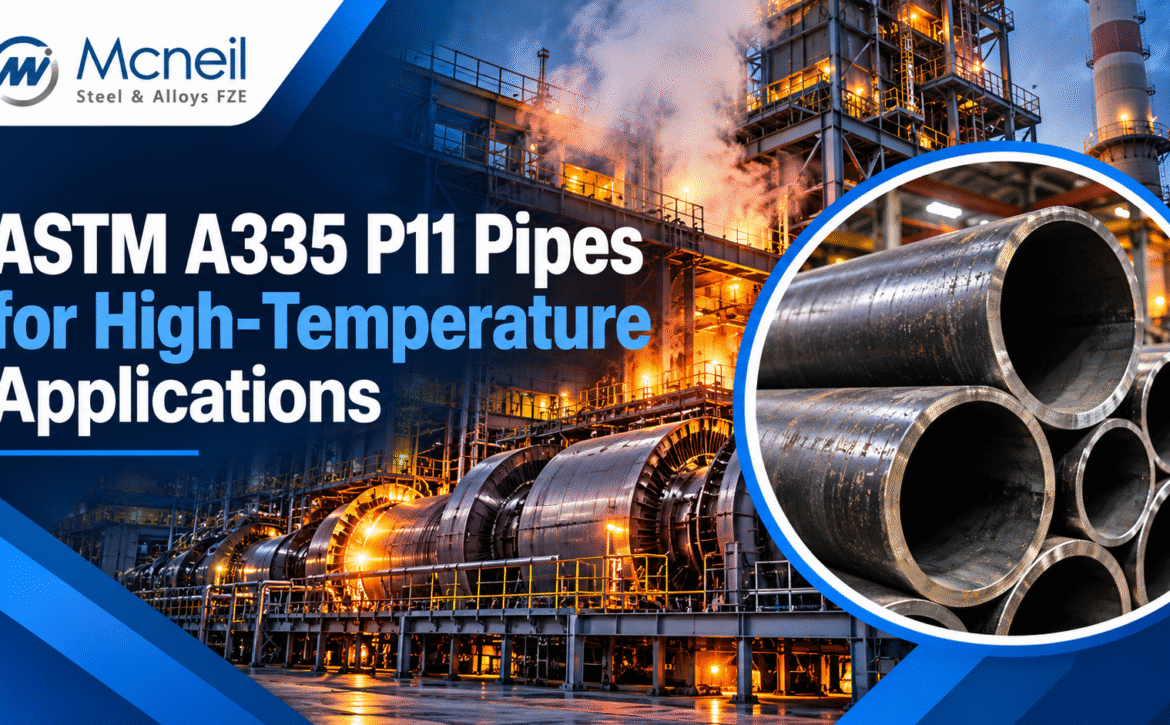
ASTM A335 P11 Pipes for High-Temperature Applications: A Buyer & Engineering Guide

In severe industrial environments where extreme heat, elevated pressure, and thermal stress are daily challenges, selecting the right piping material is essential for plant safety, operational uptime, and long-term asset integrity.

Among alloy steel specifications, ASTM A335 P11 seamless pipe remains an industry workhorse. Formulated with a balanced Chromium-Molybdenum (“chrome-moly”) alloy composition, Grade P11 provides exceptional elevated-temperature strength, thermal stability, and resistance to oxidation.

At Mcneil Alloys, we supply mill-certified, fully traceable alloy steel piping tailored to the precise engineering demands of power plants, refineries, petrochemical facilities, and heavy industrial steam systems.

What Are ASTM A335 P11 Pipes?

ASTM A335 Grade P11 (frequently dual-certified as ASME SA335 Grade P11) is a seamless ferritic alloy steel pipe specifically designed for high-temperature service.

Belonging to the low-alloy steel family, Grade P11 maintains its structural integrity and mechanical properties under prolonged thermal exposure. It is widely specified across critical high-heat installations, including superheaters, main steam headers, boiler tubing, and process unit lines where standard carbon steel falls short.

Engineering Tip: Grade P11 selection must always align with project design codes (e.g., ASME B31.1 or B31.3), maximum operating temperatures, allowable stress limits, and fluid characteristics.

Key Properties & Engineering Advantages

Grade P11 is selected for high-temperature service due to several key metallurgical properties:

1. Chromium-Molybdenum Alloy Balance
Chromium (1.00% – 1.50%): Enhances oxidation resistance, surface scaling protection, and high-temperature corrosion resistance.
Molybdenum (0.44% – 0.65%): Increases high-temperature yield strength and provides resistance against mechanical deformation under sustained loads.
2. Creep & Deformation Resistance
Creep is the gradual, permanent deformation of a metal subjected to long-term mechanical stress at high temperatures. The chrome-moly composition of P11 resists thermal creep-rupture, extending the operational life of high-pressure steam circuits.
3. Elevated-Temperature Strength
Unlike standard carbon steel, which suffers significant tensile strength loss above $425^\circ\text{C}$ ($800^\circ\text{F}$), Grade P11 retains higher allowable design stresses at elevated temperatures.
4. Fabricability & Weldability
P11 can be fabricated and welded using standard industrial methods. To maintain joint integrity and prevent microstructural cracking, proper preheating, approved filler metals, post-weld heat treatment (PWHT), and mandatory non-destructive examination (NDE) should be applied as specified by design codes.

Core Industrial Applications

Due to its balance of thermal resistance, structural durability, and cost-effectiveness, P11 seamless pipe is widely utilized across multiple sectors:

Power Generation: Main steam headers, hot reheat lines, boiler feed lines, and superheater tubes.
Oil Refineries: High-temperature hydrocarbon transfer, catalytic cracking units, and hydrotreaters.
Petrochemical Plants: Process piping and heat exchanger circuits operating under combined thermal and pressure stresses.
Industrial Steam & Boilers: Utility boilers, heat recovery steam generators (HRSGs), and high-pressure steam lines.

ASTM A335 P11 vs. Grade P22: Key Comparison

Both P11 and P22 are popular chrome-moly grades, but understanding their differences helps prevent over-specifying or under-specifying materials:

Feature / Metric ASTM A335 Grade P11 ASTM A335 Grade P22
Chromium Content $1.00\% – 1.50\%$ $1.90\% – 2.60\%$
Molybdenum Content $0.44\% – 0.65\%$ $0.87\% – 1.13\%$
High-Temp Capability Excellent up to moderate-high heat Superior strength at higher heat regimes
Creep Resistance High Very High
Primary Advantage Cost-effective for medium-high temp applications Higher allowable stress at severe temperatures

Essential Checklist Before Sourcing P11 Pipes

To prevent procurement delays and ensure strict site compliance, confirm these technical factors before placing your order:

Material Standard: Specify ASTM A335 / A335M or ASME SA335 Grade P11.
Dimensional Specs: Nominal Pipe Size (NPS), Outside Diameter (OD), Wall Thickness, and Schedule (e.g., Sch 40, Sch 80, Sch 160, XXS).
Traceability & Certification: Require Mill Test Certificates (EN 10204 3.1) with explicit heat number stenciling.
Testing Requirements: Hydrostatic testing or non-destructive examination (Ultrasonic / Eddy Current) per specification.
Fabrication Notes: Beveled vs. plain ends, surface coatings, and custom cut-to-length requirements.

Why Source ASTM A335 P11 Pipes from Mcneil Alloys?

Sourcing high-temperature piping requires a partner who understands material integrity and strict compliance standards. Mcneil Alloys provides comprehensive supply solutions tailored to major project requirements:

Extensive Stock & Sizing: Access to standard schedules, heavy wall thickness, and custom dimensions.
Full Documentation: Complete MTCs, heat-lot traceability, and support for third-party inspection (TPI).
Reliable Logistics: Timely delivery and specialized export packaging to keep your project on schedule.

Need ASTM A335 P11 Pipes for Your Next Project?

Whether you are building a new process line, upgrading boiler infrastructure, or performing plant maintenance, Mcneil Alloys delivers high-performance piping solutions built to your exact specifications.

👉 Contact Mcneil Alloys today: Reach out to our technical sales team with your required pipe sizes, schedules, quantities, and documentation needs to receive a quote.

Frequently Asked Questions (FAQs)

1. What are ASTM A335 P11 pipes?
ASTM A335 P11 pipes are seamless ferritic alloy steel pipes infused with chromium and molybdenum, designed for high-temperature and high-pressure service.
2. What is the chemical composition of ASTM A335 P11 pipes?
P11 contains 1.00–1.50% Chromium and 0.44–0.65% Molybdenum, along with controlled levels of Carbon, Manganese, Silicon, Phosphorus, and Sulfur to optimize mechanical properties.
3. What is the main difference between P11 and P22 pipes?
P22 contains higher levels of chromium (~2.25%) and molybdenum (~1.00%) compared to P11. This gives P22 higher creep resistance and allowable stress limits under extreme temperature regimes.
4. Are ASTM A335 P11 pipes suitable for high-pressure applications?
Yes, P11 seamless pipes are routinely used in high-pressure steam and process lines, provided the wall thickness and schedule meet design code calculations for the operating temperature.
5. Do ASTM A335 P11 pipes require Post-Weld Heat Treatment (PWHT)?
Yes, under standard piping codes like ASME B31.3, welding Grade P11 generally requires preheating and Post-Weld Heat Treatment (PWHT) to relieve residual stresses and maintain heat-affected zone (HAZ) toughness.
6. Can P11 pipes be used in power plant steam lines?
Yes, P11 is extensively used in power generation for superheater tubes, steam headers, and auxiliary high-temperature piping circuits.
7. What documentation should I request when buying P11 pipes?
Always request EN 10204 3.1 Mill Test Certificates (MTCs), chemical analysis, mechanical test reports, hydrostatic test records, and heat-number traceability matching physical pipe stencils.
8. How do I request a quote from Mcneil Alloys?
Submit your project details—including pipe size, schedule/wall thickness, total length/quantity, and delivery destination—directly to the Mcneil Alloys team to receive a detailed quotation.

Read More
admin October 17, 2026 0 Comments

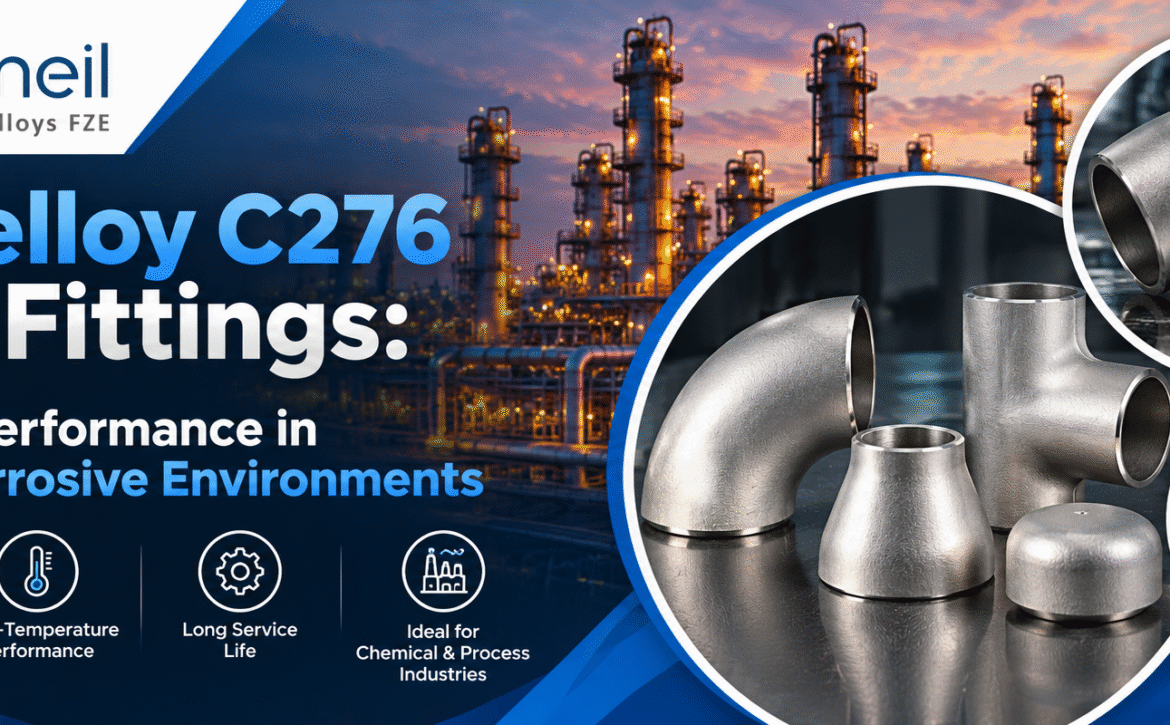
Hastelloy C276 Pipe Fittings: Reliable Performance in Highly Corrosive Environments

Industrial piping systems used in chemical processing, petrochemical production, pollution control and other demanding applications must withstand aggressive chemicals, elevated temperatures and challenging operating conditions. Selecting the right piping material is essential for maintaining system integrity, reducing maintenance requirements and supporting reliable plant operations.
Hastelloy C276 pipe fittings are widely considered for applications where resistance to severe corrosion is a major material-selection requirement. This nickel-based alloy combines chromium, molybdenum and tungsten to provide resistance to various corrosive environments, including many oxidizing and reducing media.
At Mcneil Alloys, we understand the importance of selecting suitable materials for critical industrial piping systems. This guide explains the properties, benefits, applications and selection considerations associated with Hastelloy C276 pipe fittings.

What Are Hastelloy C276 Pipe Fittings?

Hastelloy C276, also identified as UNS N10276, is a nickel-molybdenum-chromium alloy containing tungsten. It is designed for service in a wide range of aggressive chemical environments where conventional materials may experience excessive corrosion.
Hastelloy C276 pipe fittings connect piping sections, change flow direction, create branch connections or reduce pipe diameter. Depending on the piping design, common fitting configurations include elbows, tees, reducers, caps and other specialized components.
These fittings are used in process lines where material compatibility, dimensional accuracy and resistance to corrosion are essential to long-term performance.

Why Is Hastelloy C276 Suitable for Corrosive Environments?

The performance of Hastelloy C276 comes from its carefully balanced alloy composition and resistance to several forms of localized and general corrosion.
1. Resistance to a Wide Range of Chemicals
Hastelloy C276 offers strong resistance to many aggressive chemical environments, including selected acid solutions, chloride-containing media and contaminated process streams. Its suitability depends on chemical concentration, temperature, impurities and operating conditions.
This makes it a valuable material to evaluate for chemical processing equipment and industrial piping systems exposed to challenging media.
2. Protection Against Pitting and Crevice Corrosion
Pitting and crevice corrosion can create localized damage that compromises piping integrity. The chromium and molybdenum content of Hastelloy C276 helps provide resistance to these corrosion mechanisms in many environments.
The alloy is particularly useful where chloride exposure and localized corrosion risks must be carefully evaluated.
3. Resistance to Stress-Corrosion Cracking
Some industrial environments combine corrosive chemicals with mechanical stress, increasing the risk of cracking. Hastelloy C276 can provide improved resistance to several forms of stress-corrosion cracking compared with less suitable materials.
Actual performance depends on the service environment, fabrication quality and applied stresses.
4. Good Fabrication and Welding Characteristics
Hastelloy C276 is used in fabricated piping systems because it offers good fabrication characteristics when appropriate procedures are followed. Correct welding consumables, joint preparation and fabrication practices remain important for maintaining the intended corrosion resistance.
5. Performance in Demanding Operating Conditions
In addition to corrosion resistance, Hastelloy C276 offers useful mechanical properties for demanding industrial service. The allowable operating temperature and pressure must be established from the applicable design code, component specifications and process conditions rather than from the alloy grade alone.

Common Types of Hastelloy C276 Pipe Fittings

Different fitting configurations serve different purposes in industrial piping networks.
Hastelloy C276 Elbows: Change the direction of fluid flow in process pipelines.
Hastelloy C276 Tees: Create branch connections for distributing process fluids.
Hastelloy C276 Reducers: Connect pipes of different diameters.
Hastelloy C276 Caps: Close pipe ends where required by the system design.
Hastelloy C276 Crosses: Provide multiple branch connections in suitable piping arrangements.
Hastelloy C276 Stub Ends: Work with compatible lap-joint flange assemblies where specified.
The required configuration, dimensions, wall thickness and connection type should be confirmed against the project specification.

Industrial Applications of Hastelloy C276 Pipe Fittings

Chemical and Petrochemical Processing
Chemical plants frequently handle corrosive acids, solvents and mixed process streams. Hastelloy C276 fittings may be selected for suitable process lines, reactors and transfer systems after a material compatibility assessment.
Pollution Control and Flue Gas Treatment
Flue gas desulfurization and related pollution-control systems can expose equipment to corrosive condensates and chloride-containing solutions. Hastelloy C276 may be considered for selected components operating in these conditions.
Pulp and Paper Manufacturing
Certain pulp and paper processes involve bleaching chemicals and other corrosive media. Appropriate Hastelloy C276 fittings can help address corrosion challenges in compatible applications.
Oil and Gas Processing
Oil and gas facilities may contain corrosive process fluids, chlorides and other challenging contaminants. Material selection should account for the actual fluid composition, pressure, temperature and any applicable sour-service requirements.
Industrial Waste Treatment
Waste treatment facilities may process chemically aggressive liquids and variable waste streams. Hastelloy C276 can be evaluated for components that require enhanced corrosion resistance.

Hastelloy C276 vs Stainless Steel 316: Which Should You Choose?

Stainless Steel 316 is suitable for many industrial applications, but certain aggressive chemical environments may require a more corrosion-resistant alloy.
Hastelloy C276 offers enhanced resistance to many reducing and oxidizing corrosive environments, including selected chloride-containing conditions. Stainless Steel 316 is often a practical option where its corrosion resistance meets the application’s requirements and overall project economics are important.
The correct choice depends on the process chemistry, chemical concentration, temperature, pressure, design requirements and expected service life. Neither material should be selected solely by comparing its alloy name or purchase price.

Standards and Quality Considerations

When procuring Hastelloy C276 pipe fittings, buyers should verify that the supplied components meet the requirements specified for the project.
Important considerations include:
Material specification: ASTM B366 / ASME SB366 for applicable wrought nickel-alloy fittings.
Dimensional requirements: Confirm the applicable dimensional standard, such as ASME B16.9 for fittings within its scope.
Material certification: Review material test certificates and verify the alloy designation and chemical composition.
Inspection requirements: Confirm dimensional inspection, testing, traceability and documentation requirements.
Service suitability: Check chemical compatibility, pressure-temperature limits and applicable piping design codes.
Not every standard applies to every fitting type. Buyers should confirm the required specification, product form and dimensional standard before placing an order.

How to Select the Right Hastelloy C276 Pipe Fittings

Selecting the right fitting involves more than identifying the alloy grade. Consider the following factors before finalizing your purchase.
1. Process fluid: Identify the chemicals, concentrations, impurities and potential contaminants present in the system.
2. Operating conditions: Review operating and design temperatures, pressures, flow requirements and possible transient conditions.
3. Fitting configuration: Determine whether the system requires elbows, tees, reducers, caps or custom configurations.
4. Dimensions and wall thickness: Confirm nominal pipe size, schedule, end preparation and dimensional compatibility with adjoining components.
5. Standards and documentation: Specify the required material standards, inspection procedures, certifications and traceability documentation.
6. Supplier capability: Choose a supplier that can provide the specified material grade, required documentation and components suitable for your application.

Why Choose Mcneil Alloys for Hastelloy C276 Pipe Fittings?

At Mcneil Alloys, we recognize that critical piping projects require careful attention to material selection, product specifications and quality requirements.
When sourcing Hastelloy C276 pipe fittings, buyers should look for a supplier that can support their project requirements with appropriate product information, material documentation and dependable communication.
Our team can help you discuss your required fitting type, dimensions, material grade and applicable specifications to identify a suitable solution for your industrial piping application.

Conclusion

Hastelloy C276 pipe fittings are an important option for industrial piping systems exposed to demanding corrosive environments. Their resistance to a wide range of corrosive media, together with useful mechanical and fabrication characteristics, makes them suitable for evaluation across chemical processing, pollution control, petrochemical and other industrial applications.
However, reliable performance depends on choosing the correct material for the actual process conditions and ensuring that the finished fittings meet the applicable project specifications.
Mcneil Alloys supports your piping requirements with a focus on material suitability, product specifications and industrial application needs. Contact our team to discuss Hastelloy C276 pipe fittings for your next project.

Looking for Reliable Hastelloy C276 Pipe Fittings?

Choose the right piping components for your corrosion-critical industrial applications with Mcneil Alloys. Contact our team to discuss your material specifications, fitting requirements and project needs.
Request a Quote Today and connect with our team for your Hastelloy C276 pipe fitting requirements.

FAQs

1. What are Hastelloy C276 pipe fittings used for?
Hastelloy C276 pipe fittings are used in piping systems that handle corrosive chemicals and demanding process fluids. Common applications include chemical processing, petrochemical plants, pollution control systems, pulp and paper production, and selected oil and gas operations.
2. What makes Hastelloy C276 resistant to corrosion?
Hastelloy C276 is a nickel-molybdenum-chromium alloy containing tungsten. Its composition provides resistance to many aggressive chemical environments, including several oxidizing and reducing media, and helps protect against pitting and crevice corrosion in suitable conditions.
3. Which types of Hastelloy C276 pipe fittings are available?
Common fitting configurations include elbows, tees, reducers, caps, crosses and stub ends. Availability depends on the required dimensions, product form, manufacturing specification and supplier capabilities.
4. Which standard applies to Hastelloy C276 pipe fittings?
ASTM B366 / ASME SB366 covers applicable wrought nickel and nickel-alloy fittings. Dimensional standards depend on the fitting type and design, so the relevant product and project specifications should be verified before ordering.
5. Is Hastelloy C276 better than Stainless Steel 316?
Hastelloy C276 generally offers better resistance to many aggressive chemical environments than Stainless Steel 316. However, the best choice depends on the specific chemicals, temperature, concentration, pressure and project requirements.
6. Can Hastelloy C276 pipe fittings be used in high-temperature applications?
Hastelloy C276 can be considered for certain elevated-temperature applications, but its suitability depends on the operating environment, mechanical design limits, corrosion conditions and applicable engineering codes.
7. How do I select the right Hastelloy C276 pipe fittings?
Consider the process fluid, chemical concentration, operating temperature and pressure, fitting type, pipe size, wall thickness, connection requirements and applicable standards. Material certification and traceability should also be verified.
8. What information is needed to request a quotation for Hastelloy C276 pipe fittings?
Provide the fitting type, alloy grade, nominal size, schedule or wall thickness, applicable standard, quantity, required documentation and delivery destination. Sharing a project specification or technical drawing can also help clarify your requirements.

Read More
admin October 15, 2026 0 Comments

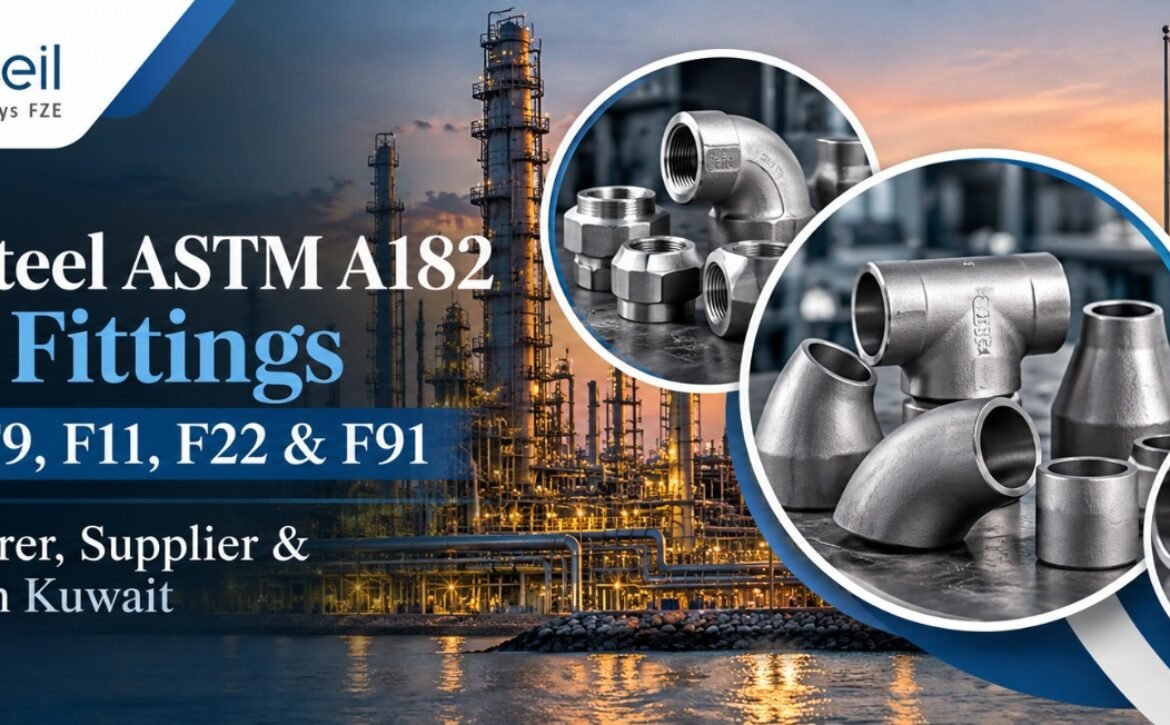
Alloy Steel ASTM A182 Tube Fittings F1, F5, F9, F11, F22 & F91 Manufacturer, Supplier & Exporter in Kuwait

Alloy Steel Tube Fittings are important components in high-pressure and high-temperature piping systems used across oil and gas, power generation, petrochemical processing, refineries, and heavy industrial facilities. Manufactured from chromium-molybdenum alloy steels, these fittings are designed to provide the mechanical strength and thermal performance required for demanding operating conditions.

Mcneil Alloys supplies Alloy Steel ASTM A182 fittings in grades F1, F5, F9, F11, F22 and F91 for industrial projects in Kuwait and other Gulf Cooperation Council (GCC) markets. These fittings are used in piping assemblies where material strength, temperature resistance, dimensional accuracy, and dependable welded connections are essential.

For engineering companies, EPC contractors, plant operators, and procurement teams in Kuwait, selecting the correct alloy steel fitting requires careful evaluation of the grade, pressure and temperature conditions, connection type, applicable standards, and project documentation.

What Are Alloy Steel ASTM A182 Tube Fittings?

ASTM A182 is a specification covering forged or rolled alloy and stainless steel pipe flanges, forged fittings, and valves and parts intended for high-temperature service. The F-series grades covered in this article are alloy steel grades used in appropriate pressure piping applications.

These components are manufactured with controlled alloy compositions to achieve the properties required by their intended service conditions. Chromium and molybdenum contribute to high-temperature performance, while specific grades may include other alloying elements to meet additional mechanical requirements.

Alloy steel fittings are available in configurations such as elbows, tees, reducers, and caps. Depending on the product and engineering specification, they may be supplied as butt-weld fittings or other specified fitting types.

Key Characteristics of ASTM A182 Alloy Steel Fittings

High-temperature performance: Suitable grades can retain required mechanical properties under specified elevated-temperature conditions.
Pressure-bearing capability: Designed for use in pressure piping systems when properly selected and installed.
Chromium-molybdenum composition: Provides specific strength and thermal properties.
Welded connection options: Butt-weld configurations can create permanent joints when fabricated according to approved procedures.
Multiple grade choices: F1, F5, F9, F11, F22 and F91 offer different material characteristics for different applications.
Industrial versatility: Used in suitable power, refinery, petrochemical, and energy-sector installations.
The final material selection must follow the applicable design code, approved material specification, and operating conditions.

ASTM A182 Alloy Steel Fitting Grades Available

Mcneil Alloys lists ASTM A182 alloy steel fitting grades F1, F5, F9, F11, F22 and F91. Each grade has a distinct composition and intended service profile.

1. ASTM A182 F1 Alloy Steel Fittings
F1 is a low-alloy chromium-molybdenum steel grade used in suitable industrial pressure systems. Its material characteristics make it relevant to selected applications where elevated-temperature strength and dimensional stability are required.
Typical applications:
Industrial process piping
Selected refinery systems
Pressure piping assemblies
Heat-transfer equipment
Industrial utility systems
F1 should be specified only where its chemical composition and mechanical properties meet the project’s approved material requirements.

2. ASTM A182 F5 Alloy Steel Fittings
F5 is a chromium-molybdenum alloy steel grade commonly associated with high-temperature industrial services. Its chromium content contributes to oxidation resistance under appropriate operating conditions.
Typical applications:
Refinery piping systems
Industrial heating equipment
High-temperature process lines
Petrochemical facilities
Selected heat-transfer systems
F5 is appropriate when its specified properties satisfy the required operating temperature, pressure, and material compatibility requirements.

3. ASTM A182 F9 Alloy Steel Fittings
F9 is a higher-chromium alloy steel grade used in selected demanding thermal applications. Its composition is relevant to systems where high-temperature performance and oxidation resistance are important.
Typical applications:
Refinery process equipment
High-temperature piping assemblies
Industrial heating systems
Petrochemical installations
Selected power and energy applications
The suitability of F9 depends on the service environment, design conditions, and the applicable piping specification.

4. ASTM A182 F11 Alloy Steel Fittings
F11 is a chromium-molybdenum alloy steel grade used in industrial pressure systems exposed to elevated temperatures and mechanical stress.
Typical applications:
Boiler-related piping
Steam systems
Power generation equipment
Refinery installations
High-temperature process piping
F11 can be considered when its mechanical properties, heat treatment, and fabrication requirements align with the project’s engineering specification.

5. ASTM A182 F22 Alloy Steel Fittings
F22 is a chromium-molybdenum alloy steel grade commonly used in demanding high-temperature applications. It is associated with systems requiring appropriate strength, thermal performance, and resistance to creep under specified service conditions.
Typical applications:
Power plants
Boiler systems
High-temperature steam piping
Heat exchangers
Refinery and petrochemical facilities
The final selection should account for design pressure, operating temperature, fabrication procedures, and applicable code requirements.

6. ASTM A182 F91 Alloy Steel Fittings
F91 is a high-strength chromium-molybdenum-vanadium alloy steel grade developed for demanding elevated-temperature service. Its alloy system supports high-temperature strength and creep resistance when the material is correctly manufactured, heat-treated, and installed.
Typical applications:
Power generation facilities
Critical steam piping
High-temperature pressure systems
Boiler and reheater-related assemblies
Advanced energy installations
F91 requires particular attention to material verification, welding procedures, heat treatment, and inspection. These controls should be defined in the approved project documentation.

Comparison of ASTM A182 F1, F5, F9, F11, F22 and F91

Grade General material characteristics Typical applications
F1 Low-alloy chromium-molybdenum steel Selected pressure and process systems
F5 Chromium-molybdenum alloy steel with higher chromium content Refineries and high-temperature process piping
F9 Higher-chromium alloy steel Selected thermal and refinery applications
F11 Chromium-molybdenum alloy steel Steam systems, boilers and power plants
F22 Chromium-molybdenum alloy steel for demanding thermal service Boilers, heat exchangers and power systems
F91 High-strength chromium-molybdenum-vanadium alloy steel Critical high-temperature power and steam applications
These grades are not interchangeable. Material selection should be based on the complete chemical composition, mechanical properties, heat-treatment requirements, design conditions, and applicable engineering standards.

Technical Specifications of ASTM A182 Alloy Steel Fittings

The following table summarizes key procurement considerations for the product range.

Parameter Specification
Product Alloy Steel ASTM A182 Fittings
Grades F1, F5, F9, F11, F22 and F91
Standard ASTM A182 / ASME SA182
Material type Forged alloy steel, as applicable to the specified fitting
Fitting configurations Elbows, tees, reducers, caps and other specified configurations
Connection type Butt-weld or other specified connection type
Heat treatment As required by the applicable grade and standard
Testing According to the governing specification and purchase order
Documentation Material Test Certificates and inspection records, as required
Important: ASTM A182 is primarily a forged fitting and component specification. The exact product form must be confirmed with the supplier, especially if the requirement is for tube fittings rather than conventional pipe fittings. Dimensions, pressure limits, testing, and availability should be verified for the specific product.

Applications of Alloy Steel Fittings in Kuwait

Kuwait’s industrial sectors include oil production, refining, petrochemical processing, power generation, and energy infrastructure. These facilities may require alloy steel fittings for piping systems operating under demanding thermal and pressure conditions.

Oil and Gas Industry
Alloy steel fittings are used in suitable pressure piping assemblies throughout oil and gas facilities. Material selection depends on operating temperature, pressure, process fluids, and project-specific requirements.

Oil Refineries
Refineries use high-temperature piping systems in selected process units, heating systems, and related equipment. Appropriate alloy steel grades may be specified where elevated-temperature performance is required.

Petrochemical Facilities
Petrochemical processing can involve demanding operating conditions and specialized piping materials. ASTM A182 fittings may be used in suitable installations when the selected grade matches the process requirements.

Power Generation Plants
Boiler, steam, and other high-temperature systems may require alloy steel fittings with specific mechanical and thermal properties. F11, F22 and F91 may be considered for different applications, subject to the engineering design.

Industrial Heating and Heat-Transfer Systems
Alloy steel fittings can form part of piping assemblies used in selected heating and heat-transfer equipment. The grade must be compatible with the temperature, pressure, and process environment.

EPC and Heavy Engineering Projects
Engineering, procurement, and construction contractors require fittings that match approved drawings, piping material classes, and inspection requirements. Confirming material identification and traceability helps support project compliance.

Benefits of Alloy Steel ASTM A182 Fittings

Strength Under Demanding Conditions
Suitable alloy steel grades offer mechanical properties required for specified high-pressure and high-temperature applications.
Thermal Performance
Chromium-molybdenum alloy compositions support performance in selected elevated-temperature services. The actual allowable conditions depend on the grade and applicable design code.
Permanent Welded Connections
Butt-weld fittings can provide permanent piping joints when their dimensions, material, and welding procedures are compatible with the piping system.
Grade Selection Flexibility
The availability of multiple grades allows engineers to select materials according to the intended service conditions and project requirements.
Suitability for Critical Industrial Systems
When correctly specified and installed, alloy steel fittings can support demanding process and energy applications.
Traceability and Quality Documentation
Material certification and inspection records help procurement teams verify compliance with the specified requirements.

How to Select the Right Alloy Steel Fittings in Kuwait

Before placing an order, buyers should evaluate the following factors.
1. Confirm the material specification. Verify that ASTM A182 / ASME SA182 applies to the required product form and identify the exact grade.
2. Define operating temperature and pressure. Check that the selected material and fitting design meet the applicable design conditions.
3. Specify the fitting type. Identify elbows, tees, reducers, caps, or another required configuration.
4. Confirm dimensions. Provide nominal size, schedule, wall thickness, end preparation, and dimensional standard where applicable.
5. Review the welding requirements. Confirm material compatibility and approved welding and heat-treatment procedures.
6. Consider the service environment. Evaluate the process medium and relevant corrosion, oxidation, and thermal conditions.
7. Define inspection and certification. Specify chemical analysis, mechanical testing, material certification, non-destructive examination, and third-party inspection where required.
8. Confirm availability and delivery. Verify the required grade, size, quantity, lead time, and delivery location in Kuwait.

Quality Testing and Inspection

Quality assurance helps verify that alloy steel fittings conform to the material and dimensional requirements specified for a project.
Depending on the grade and purchase order, inspection may include:
Chemical analysis: Verifies material composition against the specified grade.
Mechanical testing: Confirms the required mechanical properties.
Hardness testing: Checks compliance with the applicable acceptance criteria.
Dimensional inspection: Verifies dimensions, tolerances, and fitting geometry.
Heat-treatment verification: Confirms the required heat-treatment condition.
Non-destructive examination: Performed when required by the governing specification or project.
Material Test Certificates: Provide relevant chemical and mechanical test information.
Material traceability: Links the product to its material identification and inspection records.
Testing requirements vary by grade and product type. The inspection scope and acceptance criteria should be agreed upon before procurement.

Why Choose Mcneil Alloys for Alloy Steel Fittings in Kuwait?

Mcneil Alloys lists ASTM A182 alloy steel fitting grades F1, F5, F9, F11, F22 and F91 and identifies Kuwait among its export markets. Its product information highlights applications in high-pressure and high-temperature industrial piping systems.

For industrial buyers in Kuwait, providing complete technical details helps establish whether the available product matches the project specification.
When requesting a quotation, share:
Required grade and material standard
Fitting type and connection arrangement
Nominal size and schedule
Design pressure and operating temperature
Required heat treatment
Inspection and testing requirements
Material certification requirements
Quantity and delivery location

Mcneil Alloys supports enquiries for alloy steel fittings intended for industrial projects across Kuwait and the wider GCC region. Confirm product form, technical compliance, availability, and delivery arrangements for each order.

Frequently Asked Questions

What are ASTM A182 alloy steel fittings?
ASTM A182 covers forged or rolled alloy and stainless steel pipe flanges, forged fittings, valves, and parts intended for high-temperature service. The exact product form and grade should be confirmed against the purchase specification.
Which grades are included in this product range?
The listed alloy steel grades are F1, F5, F9, F11, F22 and F91. Each grade has different chemical and mechanical properties.
Are ASTM A182 fittings suitable for high-temperature applications?
Suitable grades can be used in high-temperature pressure systems when selected according to the design conditions and applicable standards.
What is the difference between F22 and F91?
F22 is a chromium-molybdenum alloy steel grade, while F91 is a higher-strength chromium-molybdenum-vanadium alloy steel. They have different material properties and fabrication requirements, so the approved engineering specification must determine the correct choice.
Does Mcneil Alloys supply alloy steel fittings in Kuwait?
Mcneil Alloys identifies Kuwait as an export destination for its alloy steel fitting range. Buyers should confirm the required grade, product form, size, availability, and delivery schedule directly with the supplier.
What documents should accompany an alloy steel fitting order?
Depending on the project, documents may include Material Test Certificates, chemical and mechanical test results, heat-treatment records, dimensional inspection reports, and traceability documentation.
What information is required for a quotation?
Provide the material grade, standard, fitting type, size, schedule, quantity, operating conditions, testing requirements, documentation, and delivery location in Kuwait.

Conclusion

Alloy Steel ASTM A182 fittings in grades F1, F5, F9, F11, F22 and F91 support selected industrial piping applications where material strength and high-temperature performance are important. Each grade offers different properties, making careful specification and engineering-based selection essential for refineries, power plants, petrochemical facilities, and other demanding industrial systems.

Mcneil Alloys supplies alloy steel fitting solutions for regional and international industrial markets, including Kuwait. Before purchasing, verify the exact product form, grade, dimensions, design requirements, inspection scope, and material documentation to ensure the supplied fittings align with the project’s approved specifications.

For companies searching for an Alloy Steel ASTM A182 Fittings Supplier in Kuwait, Mcneil Alloys offers a listed range of F1, F5, F9, F11, F22 and F91 grades for suitable industrial requirements.

Read More
admin October 12, 2026 0 Comments

Why Corrosion Resistance Is Critical in Petrochemical Piping Applications

Petrochemical piping systems operate under some of the most demanding conditions in industrial processing. High temperatures, pressure fluctuations, hydrocarbons, acids, chlorides, moisture, sulfur-containing compounds and other aggressive process media can gradually attack piping materials and reduce their service life.

For this reason, corrosion resistance is a critical consideration when selecting pipes, flanges, pipe fittings, valves and other pressure-containing components for petrochemical applications.

Corrosion does more than affect the appearance of a metal surface. Depending on the mechanism and operating conditions, it can cause wall thinning, pitting, cracking, leakage, loss of mechanical integrity and unplanned shutdowns.

Material selection therefore needs to consider the complete service environment rather than simply choosing a material based on pressure or temperature.

Mcneil Alloys supplies industrial piping products in carbon steel, stainless steel, alloy steel, duplex, super duplex and nickel-based alloys for demanding applications across oil & gas, petrochemical, chemical processing, power and other industries.

What Is Corrosion in Petrochemical Piping?

Corrosion is the deterioration of a material caused by interaction with its surrounding environment.
In petrochemical piping, corrosion can occur internally, externally, or at localized areas such as welds, joints and crevices.
Common factors that contribute to corrosion include:
Water and moisture
Chlorides
Acids
Sulfur-containing compounds
Oxygen
Carbon dioxide
High temperatures
Contaminants
Chemical process fluids
Marine or coastal environments
Poor material compatibility
Incorrect fabrication or surface treatment

The specific corrosion mechanism depends on the process chemistry, temperature, pressure, material and operating conditions.
ASME’s technical literature on corrosion and materials in hydrocarbon production identifies corrosion threats, material selection and corrosion mitigation as important parts of hydrocarbon facility engineering and integrity management.

Why Corrosion Resistance Matters in Petrochemical Piping

A petrochemical plant can contain hundreds or thousands of metres of interconnected piping.
If the selected material has inadequate corrosion resistance, degradation can progressively affect:
Pipe walls
Elbows
Tees
Reducers
Flanges
Valves
Welded joints
Instrumentation connections
Pumps and equipment connections
The resulting problems can include:
Reduced wall thickness
Localized holes or pits
Leakage
Loss of pressure containment
Contamination
Reduced flow capacity
Increased maintenance requirements
Unplanned shutdowns
Replacement costs
Safety and environmental risks
Corrosion-resistant material selection is therefore closely connected to piping reliability and long-term plant operation.

Common Types of Corrosion in Petrochemical Piping

Different environments can produce different corrosion mechanisms.
1. General Corrosion
General corrosion occurs relatively uniformly across a metal surface.
Over time, continuous metal loss can reduce the wall thickness of a pipe or fitting.
This can become particularly important in systems where the component is expected to remain in service for many years.
2. Pitting Corrosion
Pitting is a localized form of corrosion that produces small cavities or pits in the metal.
The visible affected area can be relatively small, but individual pits can penetrate deeply into the material.
Pitting resistance is particularly important in environments containing chlorides.
Mcneil Alloys identifies stainless steel 316 pipe fittings as suitable for demanding environments involving saltwater, chemicals and industrial fluids, with corrosion and pitting resistance among their relevant properties.
3. Crevice Corrosion
Crevice corrosion can occur in confined areas where stagnant fluid or deposits develop.
Potential locations include:
Flange interfaces
Gasket areas
Bolted connections
Lap joints
Under deposits
Fitting connections
Material selection and good system design can help reduce susceptibility to localized corrosion.
4. Stress Corrosion Cracking
Stress corrosion cracking can occur when a susceptible material is exposed to a specific corrosive environment while subjected to tensile stress.
Chloride-containing environments are an important consideration for susceptible stainless steels.
Duplex and super duplex stainless steels are often considered where resistance to chloride-related corrosion mechanisms is required.
Mcneil Alloys states that Duplex 2205 and Super Duplex 2507 provide resistance to chloride stress corrosion cracking, pitting and crevice corrosion.
5. Erosion-Corrosion
High-velocity fluids, turbulence and suspended particles can accelerate material degradation.
Areas around:
Elbows
Tees
Reducers
Control valves
Flow restrictions
may experience increased turbulence.
The material must therefore be capable of handling both the chemical environment and the mechanical effects of fluid flow.
6. Corrosion Under Insulation
External corrosion can develop beneath insulation when moisture enters and remains trapped against the pipe surface.
This can be difficult to detect because the affected area is hidden beneath the insulation.
Proper insulation design, inspection and maintenance are therefore important parts of piping integrity management.

How Petrochemical Conditions Affect Material Selection

There is no single corrosion-resistant material that is suitable for every petrochemical application.
Material selection should consider:
Operating Factor Why It Matters
Process fluid Determines chemical compatibility
Chloride level Influences pitting and localized corrosion
Temperature Can accelerate corrosion and affect material strength
Pressure Determines mechanical requirements
Water content Can promote several corrosion mechanisms
Sulfur/H₂S Important for sour-service material selection
Flow velocity Can influence erosion-corrosion
pH Affects chemical attack
Marine exposure Increases chloride exposure
Welded construction Requires consideration of weld metallurgy and heat effects
Service life Influences lifecycle material selection
The objective is not simply to choose the most corrosion-resistant alloy available. The objective is to select a material that provides the required combination of corrosion resistance, mechanical strength, temperature capability, fabrication suitability and lifecycle value.

Stainless Steel in Petrochemical Piping

Stainless steel is widely used when corrosion resistance is required alongside mechanical performance and fabrication practicality.
Common grades include:
304
304L
316
316L
321
347
Mcneil Alloys supplies these stainless-steel grades in pipe fittings for applications including petrochemical plants, refineries, chemical processing, marine systems and other demanding industrial environments.

Stainless Steel 304
SS 304 provides general corrosion resistance and is widely used for industrial piping and process applications where the environment is not excessively aggressive.

Stainless Steel 316
SS 316 contains molybdenum, which improves resistance to localized corrosion compared with conventional 304 stainless steel.
It can be considered for applications involving:
Chloride exposure
Saltwater
Chemical processing
Petrochemical fluids
Marine environments
Stainless Steel 316L
316L is the low-carbon version of 316.
The lower carbon content can be beneficial for welded construction because it reduces the potential for sensitization associated with welding under applicable conditions.
Mcneil Alloys specifically positions 316L fittings for corrosive environments including chemical, petrochemical, marine and offshore applications.

Stainless Steel 321 and 347
High-temperature petrochemical systems may require stabilized stainless-steel grades.
321 uses titanium stabilization, while 347 uses niobium stabilization.

Mcneil Alloys describes 321 and 347 pipe fittings for high-temperature applications including petrochemical plants, chemical processing, refineries and heat exchangers.

Duplex Stainless Steel for Corrosion and Strength

Duplex stainless steels combine austenitic and ferritic metallurgical structures.
This combination provides a useful balance of:
High mechanical strength
Corrosion resistance
Resistance to chloride-related degradation
Pressure capability
Long service life
Duplex 2205
Duplex 2205 is commonly considered for demanding process environments where conventional austenitic stainless steels may not provide the required combination of strength and corrosion resistance.
Mcneil Alloys lists Duplex 2205 with approximately:
Chromium: 21–23%
Nickel: 4.5–6.5%
Molybdenum: 2.5–3.5%
Tensile strength: ≥620 MPa
Yield strength: ≥450 MPa
Temperature range listed by Mcneil Alloys: −50°C to +300°C
The listed standards include ASTM A182, ASTM A789 and ASME SA182.

Super Duplex 2507 for More Aggressive Environments

Super Duplex 2507 provides higher alloy content and higher mechanical strength than Duplex 2205.
Mcneil Alloys lists approximately:
Chromium: 24–26%
Nickel: 6–8%
Molybdenum: 3–5%
Nitrogen: 0.24–0.32%
Tensile strength: ≥800 MPa
Yield strength: ≥550 MPa
Temperature range listed: −50°C to +300°C
The material is positioned for aggressive, high-pressure and high-chloride applications where corrosion resistance and mechanical strength are both important.
Applications can include:
Offshore oil & gas
Seawater systems
Desalination
Petrochemical processing
Chemical plants
High-pressure process piping

Nickel Alloys for Severe Corrosion Service

Some petrochemical environments are too aggressive for conventional stainless steels.
In such situations, nickel-based alloys may be considered.
Examples include:
Inconel
Hastelloy
Monel
Incoloy
These materials can provide specialized combinations of corrosion resistance, high-temperature capability and mechanical performance.
Material selection must nevertheless be based on the actual process chemistry rather than simply selecting a nickel alloy because the service is classified as “corrosive.”

Corrosion Resistance and Flange Selection

Flanges are critical connection points in petrochemical piping.
A corrosion-resistant pipe connected to an unsuitable flange can still create a reliability problem.
Flange selection should consider:
Flange material
Process fluid
Pressure
Temperature
Corrosion environment
Flange facing
Gasket material
Bolting
Welding requirements
Applicable standard

Mcneil Alloys supplies flanges in materials including carbon steel, alloy steel, stainless steel, duplex, super duplex and nickel alloys for demanding energy and petrochemical applications. Its current project-focused flange information also highlights the importance of material condition, facing accuracy, traceability and documentation.

Corrosion Resistance of Pipe Fittings

Pipe fittings are particularly important because changes in flow direction can increase turbulence and localized stresses.
Common fittings include:
45° elbows
90° elbows
180° elbows
Equal tees
Reducing tees
Concentric reducers
Eccentric reducers
Crosses
Caps
Stub ends
Couplings

The fitting material should be compatible with the pipe and process environment.
Mcneil Alloys supplies stainless steel, duplex, super duplex, alloy steel and other piping materials for industrial applications.

Why Material Traceability Matters

Corrosion-resistant alloys only provide their expected performance when the supplied material actually meets the specified chemistry and mechanical requirements.

Material traceability can therefore be important for critical petrochemical projects.
Documentation may include:
Material Test Certificates
Heat numbers
Chemical composition
Mechanical test results
PMI reports
Dimensional inspection
NDT reports
Hydrostatic testing
Third-party inspection records

Mcneil Alloys’ project-oriented supply information emphasizes heat-number traceability, inspection and documentation for demanding piping applications.

The Role of PMI in Corrosion-Resistant Piping

Positive Material Identification, or PMI, is used to verify the alloy composition of materials.
This can be particularly important when multiple stainless steel, duplex or nickel alloy grades are present on a project site.
PMI can help verify that:
The correct material was supplied
Materials have not been incorrectly mixed
Specified alloying elements are present
Components can be traced to project documentation

For critical petrochemical piping, material verification can form an important part of quality assurance.

Welding and Corrosion Resistance

Welding can influence the corrosion performance of piping materials.

Important considerations include:
Welding procedure
Filler metal
Heat input
Interpass temperature
Post-weld treatment where required
Weld inspection
Heat-affected zone behavior
This is especially relevant for stainless steel and duplex stainless steel.

For example, duplex stainless steel requires appropriate control of welding parameters because the resulting metallurgical balance can influence mechanical and corrosion properties.

The material’s corrosion resistance therefore needs to be considered not only in its base-metal condition but also after fabrication.

Corrosion Resistance vs Initial Cost

A common misconception is that the least expensive material always provides the lowest project cost.

A lower-cost material can become more expensive over the complete service life if it requires:
Frequent replacement
Corrosion monitoring
Repairs
Coating maintenance
Additional inspection
Production shutdowns
Emergency intervention

A higher-alloy material may have a greater initial purchase price while providing a longer service life or reduced maintenance requirement in the right application.

The appropriate comparison should therefore consider total lifecycle cost, not only initial material price.

How Corrosion Can Affect Petrochemical Plant Reliability

Corrosion can gradually reduce the reliability of a piping network.
A simplified chain can look like:
Aggressive Environment → Material Degradation → Wall Loss/Pitting → Reduced Integrity → Leakage or Failure → Maintenance/Downtime
Preventing this progression requires a combination of:
Correct material selection
Corrosion assessment
Appropriate fabrication
Inspection
Monitoring
Maintenance
Operating control
Material selection is one part of a broader corrosion-management strategy.

How to Select Corrosion-Resistant Piping Materials

A practical material-selection process can include the following steps.
Step 1: Identify the Process Medium
Determine whether the piping carries:
Hydrocarbons
Water
Steam
Acids
Alkaline chemicals
Sour gas
Chloride-containing fluids
Seawater
Mixed-phase fluids
Step 2: Establish Operating Conditions
Document:
Pressure
Temperature
Flow velocity
Temperature cycling
Pressure cycling
Normal and upset conditions
Step 3: Identify Corrosion Threats
Consider:
General corrosion
Pitting
Crevice corrosion
Stress corrosion cracking
Erosion-corrosion
Sulfide-related damage
Corrosion under insulation
Galvanic corrosion
Step 4: Compare Candidate Materials
Depending on the application, candidates may include:
Carbon steel
304/304L stainless steel
316/316L stainless steel
321/347 stainless steel
Duplex 2205
Super Duplex 2507
Monel
Inconel
Hastelloy
Other specialized alloys
Step 5: Verify Fabrication Requirements
Check:
Welding
Heat treatment
Forming
Machining
Surface finish
Inspection requirements
Step 6: Establish Inspection and Documentation
Define requirements for:
PMI
MTCs
NDT
Hydrotesting
Dimensional inspection
Traceability
Third-party inspection

Carbon Steel vs Corrosion-Resistant Alloys

Carbon steel remains widely used in petrochemical infrastructure because it can provide useful mechanical performance and cost advantages.
However, it may require additional corrosion-management measures depending on the environment.
Corrosion-resistant alloys may provide advantages where the process environment creates a greater corrosion threat.
Material General Characteristics Typical Considerations
Carbon Steel Strength and cost efficiency May require corrosion-control measures
SS 304/304L General corrosion resistance Moderate industrial environments
SS 316/316L Improved localized corrosion resistance Chlorides, chemicals, marine environments
SS 321/347 High-temperature stainless grades Elevated-temperature process service
Duplex 2205 High strength + corrosion resistance Chloride and demanding process environments
Super Duplex 2507 Very high strength + aggressive corrosion resistance High-chloride and severe service
Nickel Alloys Specialized corrosion/high-temperature performance Highly demanding chemical environments
This comparison is a general material-selection guide. Actual suitability must be determined from the process chemistry, operating conditions and applicable engineering requirements.

Petrochemical Applications Where Corrosion Resistance Is Important

Corrosion-resistant piping materials may be required in:
Refineries
Refinery systems can expose piping to hydrocarbons, chemicals, sulfur-containing compounds and elevated temperatures.
Petrochemical Processing Plants
Chemical processing streams may contain aggressive fluids that require carefully selected piping materials.
Oil & Gas Processing
Produced fluids and process streams can contain water, salts, gases and other corrosive constituents.
Offshore Facilities
Offshore piping is exposed to marine atmospheres and potentially chloride-rich environments.
Desalination and Water Treatment
High-chloride water and seawater can create significant corrosion challenges.
Chemical Plants
Chemical composition, concentration and temperature can strongly influence material compatibility.

Mcneil Alloys for Corrosion-Resistant Petrochemical Piping

Mcneil Alloys provides piping products across several material categories to address different industrial service requirements.

Its current portfolio includes:
Stainless steel pipe fittings
Duplex 2205 fittings
Super Duplex 2507 fittings
Alloy steel fittings
Stainless steel flanges
Duplex and super duplex components
Nickel-alloy products
Industrial pipes and related piping components

Mcneil Alloys’ published product information positions Duplex 2205 and Super Duplex 2507 for demanding corrosive and high-pressure environments, while its stainless-steel fittings include grades such as 316L, 321 and 347 for chemical, petrochemical and high-temperature applications.
The company also supplies piping materials for oil & gas, petrochemical, chemical, power, marine and offshore applications.

Best Practices for Reducing Corrosion in Petrochemical Piping

A reliable corrosion-control strategy can include:
Select materials based on actual process chemistry.
Consider temperature and pressure alongside corrosion exposure.
Evaluate chloride and sour-service conditions.
Use appropriate corrosion-resistant alloys where required.
Verify material identity through documentation and PMI.
Use qualified welding procedures.
Control fluid velocity where erosion-corrosion is a concern.
Inspect high-risk areas regularly.
Monitor wall thickness where applicable.
Maintain insulation and external protective systems.
Avoid incompatible material combinations where galvanic corrosion may occur.
Maintain complete material traceability.

Frequently Asked Questions

Why is corrosion resistance important in petrochemical piping?
Corrosion can cause wall thinning, pitting, cracking and leakage, potentially reducing piping integrity and increasing maintenance and downtime. Selecting materials with appropriate corrosion resistance helps address the specific threats presented by the process environment.
Which stainless steel is commonly considered for corrosive petrochemical service?
Grades such as 316 and 316L may be considered where improved localized corrosion resistance is required compared with 304 grades. The correct material depends on the actual process chemistry and operating conditions.
Is Duplex 2205 suitable for petrochemical piping?
Duplex 2205 combines high mechanical strength with corrosion resistance and is used for demanding applications. Mcneil Alloys lists it for high-pressure and corrosive environments and identifies resistance to chloride stress corrosion cracking, pitting and crevice corrosion.
When is Super Duplex 2507 considered?
Super Duplex 2507 can be considered for aggressive environments requiring a combination of high strength and strong resistance to localized and chloride-related corrosion.
Is stainless steel always better than carbon steel for petrochemical piping?
Not necessarily. Material selection depends on the specific process environment, mechanical requirements, temperature, corrosion mechanism, fabrication requirements and lifecycle economics. Carbon steel can remain appropriate for many services when the overall corrosion-control strategy supports its use.
What is PMI in petrochemical piping?
PMI, or Positive Material Identification, is a method used to verify the alloy composition of a material. It can help confirm that the supplied piping component corresponds to the specified material grade.
How does temperature affect corrosion?
Temperature can influence the rate and mechanism of corrosion and can also affect the mechanical properties and allowable service conditions of piping materials. Therefore, corrosion assessment should consider both process chemistry and temperature.
What documentation is important for corrosion-resistant piping?
Depending on project requirements, documentation can include Material Test Certificates, heat-number traceability, chemical and mechanical test results, PMI, dimensional inspection, NDT and pressure-test records.

Conclusion

Corrosion resistance is critical in petrochemical piping because the process environment can continuously challenge the material’s mechanical integrity and service life.

The correct material cannot be selected by looking at pressure or temperature alone. Engineers must consider the process fluid, chloride exposure, chemical composition, temperature, flow conditions, corrosion mechanisms, welding requirements and expected service life.

Stainless steel grades such as 316L, stabilized grades such as 321 and 347, Duplex 2205, Super Duplex 2507 and nickel-based alloys each provide different combinations of corrosion resistance and mechanical performance. Mcneil Alloys’ current product portfolio covers several of these material families for demanding petrochemical, oil & gas, chemical, offshore and industrial applications.

The most effective approach is therefore to treat material selection as part of the overall piping integrity and corrosion-management strategy. When the correct alloy is combined with appropriate fabrication, inspection, traceability and maintenance practices, petrochemical piping systems can achieve the reliability required for demanding continuous-service operations.

Read More
admin October 3, 2026 0 Comments

Why Hastelloy Pipes Are the Preferred Choice for Corrosive and High-Performance Industrial Applications

Introduction

Industries operating in highly corrosive and chemically aggressive environments require materials that can withstand extreme conditions while maintaining reliability and performance. From chemical processing plants and offshore platforms to power generation facilities and petrochemical industries, selecting the right piping material is crucial for ensuring operational safety and long service life.

Among the most trusted nickel-based alloys available today, Hastelloy Pipes stand out for their exceptional resistance to corrosion, oxidation, and harsh chemical exposure.

As a leading manufacturer, supplier, exporter, and stockist, Mcneil Alloys offers premium-quality Hastelloy Pipesdesigned to meet the demanding requirements of modern industries worldwide.


What Are Hastelloy Pipes?

Hastelloy Pipes are high-performance nickel-molybdenum-chromium alloy pipes developed specifically for environments where conventional stainless steel and other alloys may fail.

These pipes are engineered to provide:

  • Outstanding corrosion resistance
    • Excellent mechanical strength
    • Superior resistance to pitting and crevice corrosion
    • High-temperature performance
    • Long service life in aggressive environments

Because of these properties, Hastelloy pipes are widely used in critical industrial applications where reliability is essential.


Key Features of Hastelloy Pipes

Exceptional Corrosion Resistance

One of the primary reasons industries choose Hastelloy pipes is their ability to resist corrosion caused by:

  • Sulfuric acid
    • Hydrochloric acid
    • Phosphoric acid
    • Chlorides
    • Seawater
    • Oxidizing chemicals
    • Reducing agents

This makes them ideal for highly corrosive processing environments.


Excellent High-Temperature Strength

Many industrial operations involve elevated temperatures and pressure conditions.

Hastelloy Pipes maintain their mechanical properties even under extreme thermal stress, making them suitable for:

  • Heat exchangers
    • Chemical reactors
    • Power plants
    • Petrochemical facilities


Resistance to Pitting and Crevice Corrosion

Traditional metals often suffer localized corrosion in aggressive environments.

Hastelloy alloys offer superior protection against:

  • Pitting corrosion
    • Crevice corrosion
    • Stress corrosion cracking
    • Intergranular attack

This significantly extends service life and reduces maintenance costs.


Outstanding Weldability

Hastelloy pipes can be fabricated and welded effectively without compromising corrosion resistance.

Benefits include:

  • Easy installation
    • Reduced fabrication complexity
    • Strong welded joints
    • Improved project efficiency


Types of Hastelloy Pipes Offered by Mcneil Alloys

Hastelloy C276 Pipes

Hastelloy C276 Pipes are among the most widely used grades due to their exceptional resistance to both oxidizing and reducing environments.

Applications include:

  • Chemical processing plants
    • Waste treatment facilities
    • Pollution control systems
    • Marine environments


Hastelloy C22 Pipes

Hastelloy C22 Pipes provide excellent protection against aggressive chemicals and chloride-containing environments.

Advantages include:

  • Superior versatility
    • High corrosion resistance
    • Excellent durability


Hastelloy B2 Pipes

Hastelloy B2 Pipes are specifically designed for reducing environments, particularly hydrochloric acid applications.

Industries using B2 pipes include:

  • Chemical processing
    • Acid production facilities
    • Specialty manufacturing plants


Hastelloy B3 Pipes

Hastelloy B3 Pipes offer enhanced thermal stability and improved fabrication characteristics compared to previous grades.

Common applications include:

  • Chemical reactors
    • Process equipment
    • Acid handling systems


Hastelloy X Pipes

Hastelloy X Pipes are known for their excellent oxidation resistance and high-temperature strength.

Widely used in:

  • Gas turbine systems
    • Aerospace applications
    • Industrial furnaces
    • Heat treatment equipment


Applications of Hastelloy Pipes

Chemical Processing Industry

Chemical plants frequently handle aggressive substances that can quickly damage standard materials.

Hastelloy pipes are used for:

  • Acid transfer systems
    • Chemical reactors
    • Process piping
    • Storage facilities


Petrochemical Industry

Petrochemical operations require materials capable of resisting corrosive chemicals and extreme temperatures.

Applications include:

  • Refinery units
    • Processing plants
    • Heat exchangers
    • Transfer pipelines


Oil and Gas Industry

Offshore and onshore facilities depend on corrosion-resistant piping systems.

Hastelloy pipes are used for:

  • Offshore platforms
    • Production facilities
    • Subsea systems
    • Gas processing plants


Marine Industry

Marine environments present constant exposure to saltwater and corrosive conditions.

Applications include:

  • Shipbuilding
    • Marine piping systems
    • Offshore vessels
    • Seawater handling systems


Power Generation Plants

Power facilities require durable piping capable of handling high pressure and elevated temperatures.

Common applications include:

  • Boiler systems
    • Heat recovery units
    • Steam lines
    • Cooling systems


Pharmaceutical Industry

The pharmaceutical sector relies on contamination-free and corrosion-resistant piping systems.

Applications include:

  • Process piping
    • Clean manufacturing systems
    • Chemical transfer lines


Benefits of Choosing Hastelloy Pipes

Longer Service Life

Superior corrosion resistance helps reduce replacement frequency and maintenance expenses.

Reduced Downtime

Reliable performance minimizes unexpected failures and production interruptions.

Enhanced Safety

Strong resistance to aggressive chemicals reduces operational risks.

Cost Savings Over Time

Although the initial investment may be higher, the long-term durability often results in lower lifecycle costs.

Versatile Applications

Suitable for a wide range of industries and operating environments.


Why Choose Mcneil Alloys for Hastelloy Pipes?

Comprehensive Product Range

Mcneil Alloys supplies a complete range of Hastelloy pipe grades to meet diverse industrial requirements.

Strict Quality Standards

Products are manufactured and inspected according to international specifications and industry standards.

Global Supply Capabilities

Serving customers across multiple countries with reliable export and logistics support.

Ready Stock Availability

Maintaining inventory for faster delivery and urgent project requirements.

Technical Expertise

A knowledgeable team helps customers select the right material and specifications for their applications.

Competitive Pricing

Delivering premium-quality products while maintaining cost-effective procurement solutions.


Industries Served by Mcneil Alloys

  • Chemical Processing Plants
    • Petrochemical Industries
    • Refineries
    • Oil & Gas Facilities
    • Offshore Platforms
    • Marine Industry
    • Power Generation Plants
    • Pharmaceutical Facilities
    • Water Treatment Plants
    • Fertilizer Plants
    • Aerospace Applications
    • Industrial Manufacturing Facilities


Conclusion

When corrosion resistance, reliability, and long-term performance are critical, Hastelloy Pipes remain one of the best solutions available. Their ability to withstand aggressive chemicals, extreme temperatures, and demanding operating conditions makes them indispensable across a wide range of industries.

With a comprehensive inventory of Hastelloy C276 Pipes, Hastelloy C22 Pipes, Hastelloy B2 Pipes, Hastelloy B3 Pipes, and Hastelloy X Pipes, Mcneil Alloys continues to provide high-quality piping solutions that help industries achieve safe, efficient, and dependable operations.

Whether for chemical processing, oil and gas, marine, petrochemical, or power generation applications, Mcneil Alloys is your trusted partner for premium-quality Hastelloy Pipes.

Read More
admin June 15, 2026 0 Comments

Building Strong Industrial Connections: Stainless Steel Pipe Fittings Manufacturer, Supplier, and Exporter in UAE – Mcneil Alloys

In every industrial project, there are components that quietly determine long-term success. Stainless steel pipe fittings are one such backbone—often unseen, yet critical to safety, performance, and durability. From oil refineries and desalination plants to commercial infrastructure and chemical processing units, the quality of pipe fittings directly impacts efficiency and operational life.

This is where Mcneil Alloys steps in. Recognized as a reliable manufacturer, supplier, wholesaler, distributor, and exporter of stainless steel pipe fittings in the UAE, Mcneil Alloys combines technical expertise with a deep understanding of regional industrial needs. With a complete range of grades including 304, 304L, 316, 316L, 321, and 347, the company supports projects across the UAE and the wider Gulf region with confidence and consistency.

A Leading Stainless Steel Pipe Fittings Manufacturer You Can Trust

As an established manufacturer, Mcneil Alloys focuses on producing stainless steel pipe fittings that meet international standards and real-world site conditions. Each product is manufactured using high-quality raw materials, advanced machinery, and strict quality control procedures to ensure dimensional accuracy and mechanical strength.

Mcneil Alloys specializes in butt welding pipe fittings, engineered for leak-proof connections and smooth flow characteristics. These fittings are widely used in high-pressure and high-temperature environments where performance cannot be compromised. The company’s manufacturing approach emphasizes consistency, reliability, and long service life—qualities that contractors and engineers value deeply.

Complete Stainless Steel Pipe Fittings Range Under One Roof

One of the key strengths of Mcneil Alloys as a supplier and wholesaler is its ability to offer multiple stainless steel grades without compromising on availability or quality. This makes sourcing simpler and more efficient for clients managing diverse project requirements.

Stainless Steel 304 Pipe Fittings – Versatile and Widely Used

Stainless Steel 304 pipe fittings are known for their excellent balance of strength, corrosion resistance, and cost efficiency.

  • Good resistance to oxidation and corrosion in most environments

  • Smooth internal finish ideal for hygienic and fluid-handling systems

  • Easy fabrication and forming properties

  • Commonly supplied by Mcneil Alloys for construction and industrial projects across the UAE

These fittings are a popular choice for general-purpose piping systems where reliability and affordability matter.

Stainless Steel 304L Pipe Fittings – Designed for Welded Structures

Stainless Steel 304L is the low-carbon variant of 304, making it ideal for applications involving extensive welding.

  • Reduced risk of intergranular corrosion after welding

  • Maintains corrosion resistance in heat-affected zones

  • Suitable for pressure vessels, pipelines, and structural applications

  • Frequently distributed by Mcneil Alloys for fabrication-intensive projects

As an experienced distributor, Mcneil Alloys ensures these fittings meet both design and safety expectations.

Stainless Steel 316 Pipe Fittings – Strength in Harsh Conditions

Stainless Steel 316 pipe fittings are engineered for environments exposed to chemicals, moisture, and salt.

  • Enhanced resistance to chlorides due to molybdenum content

  • Ideal for marine, offshore, and chemical processing industries

  • Strong mechanical properties across a wide temperature range

  • Preferred grade for export projects handled by Mcneil Alloys

These fittings are often chosen where long-term corrosion resistance is critical.

Stainless Steel 316L Pipe Fittings – Reliable Performance After Welding

Stainless Steel 316L pipe fittings offer superior corrosion resistance along with improved weld integrity.

  • Low carbon content minimizes carbide precipitation

  • Excellent for pharmaceutical, desalination, and chemical plants

  • Long service life with minimal maintenance requirements

  • Supplied by Mcneil Alloys as a trusted supplier and exporter

This grade is ideal for complex piping systems that demand both strength and cleanliness.

Stainless Steel 321 Pipe Fittings – Stability at Elevated Temperatures

Stainless Steel 321 pipe fittings are titanium-stabilized, making them suitable for high-temperature applications.

  • Excellent resistance to thermal fatigue and oxidation

  • Prevents corrosion during prolonged heat exposure

  • Ideal for heat exchangers, exhaust systems, and refinery lines

  • Manufactured and supplied by Mcneil Alloys for demanding industries

These fittings are often selected for projects where temperature fluctuations are frequent.

Stainless Steel 347 Pipe Fittings – Built for Critical Applications

Stainless Steel 347 pipe fittings are designed for severe operating conditions requiring long-term strength.

  • Niobium stabilization enhances resistance to intergranular corrosion

  • Excellent creep resistance at elevated temperatures

  • Suitable for power plants and petrochemical facilities

  • Exported by Mcneil Alloys to GCC countries with full quality assurance

This grade is trusted for applications where safety and durability are paramount.

Butt Welding Pipe Fittings for Seamless Industrial Flow

Butt welding fittings form the core of many industrial piping systems. Mcneil Alloys manufactures a complete range of elbows, tees, reducers, caps, and custom fittings designed for precision alignment and strong welded joints.

These fittings offer:

  • Smooth flow with minimal pressure drop

  • High resistance to vibration and fatigue

  • Strong, permanent connections

  • Compatibility with high-pressure systems

As a reliable manufacturer and distributor, Mcneil Alloys ensures availability for both standard and project-specific requirements.

Supplying Stainless Steel Pipe Fittings Across the UAE

Mcneil Alloys has developed a strong presence as a supplier and wholesaler across major UAE industrial regions, including Dubai, Abu Dhabi, Sharjah, Fujairah, and Ras Al Khaimah.

Each region has unique industrial demands, from energy and infrastructure to manufacturing and logistics. Mcneil Alloys supports these markets with timely delivery, consistent stock availability, and technical assistance.

Exporter of Stainless Steel Pipe Fittings to the GCC Region

Beyond the UAE, Mcneil Alloys is a well-established exporter serving major Gulf markets. The company provides seamless export support to Saudi Arabia, Qatar, Oman, Kuwait, and Bahrain.

With experience in international logistics, documentation, and packaging standards, Mcneil Alloys ensures that every shipment reaches its destination safely and on schedule.

Why Mcneil Alloys Is the Preferred Manufacturer and Supplier

Clients choose Mcneil Alloys not just for products, but for reliability and partnership. As a trusted manufacturer, supplier, wholesaler, distributor, and exporter, the company delivers value at every stage of the supply chain.

Key advantages include:

  • Wide range of stainless steel grades and fittings

  • Strict quality control and material traceability

  • Competitive pricing for bulk and export orders

  • Strong distribution network across the UAE

  • Responsive customer support and technical guidance

Partner with Mcneil Alloys for Quality That Lasts

When your project demands strength, precision, and long-term performance, choosing the right stainless steel pipe fittings partner matters. Mcneil Alloys continues to support industries across the UAE and GCC with products that meet international standards and real-world demands.

If you are searching for a dependable stainless steel pipe fittings manufacturer, supplier, and exporter in the UAE, Mcneil Alloys is ready to support your requirements. Contact Mcneil Alloys today for a detailed quotation, technical consultation, or bulk supply inquiries. Build your piping systems with confidence—choose Mcneil Alloys for quality you can rely on.

Read More
admin December 25, 2025 0 Comments

Flow Control Evolved: Why UAE Industries Choose Mcneil Alloys for Critical Valve Applications

In every industrial plant—whether it’s a refinery in Abu Dhabi, a desalination facility in Sharjah, or an offshore oil platform near Oman—one thing remains constant: flow control determines the rhythm of the entire operation. The accuracy with which fluids are measured, regulated, isolated, or redirected can make the difference between seamless efficiency and costly downtime.

This is where Mcneil Alloys, a trusted Manufacturer, Supplier, and Exporter in UAE, has become a name associated with reliability, durability, and engineering excellence. For decades, we’ve supplied world-class Ball Valves, Needle Valves, and Manifold Valves to mission-critical projects across the region.

With a strong presence in Dubai, Abu Dhabi, Sharjah, Ajman, Ras Al Khaimah, Fujairah, and Umm Al Quwain—and supplying widely to Saudi Arabia, Qatar, Oman, Bahrain, and Kuwait—we deliver precision-engineered valve solutions built to withstand the Middle East’s toughest industrial conditions.

This blog takes you deep into the engineering brilliance behind our valves, explaining how each product contributes to safer, more efficient, and more intelligent industrial systems.


The Backbone of Industrial Systems – Why Valves Matter Now More Than Ever

Every drop of fluid that flows through a refinery, chemical plant, or power station must be controlled with exceptional accuracy. Modern industries in the UAE and GCC operate in challenging environments—extreme heat, corrosive chemicals, high-pressure pipelines, and nonstop operational demands.

In systems like these, a valve is more than a component.
It is:

  • A safety shield preventing leaks and failures
  • A precision device ensuring stable process conditions
  • A reliability partner that industries depend on
  • A long-term investment that must survive harsh climates

At Mcneil Alloys, we design valves not just to function—but to endure, outperform, and elevate the efficiency of entire industrial networks.

Let’s explore each valve category in depth.


Ball Valves – Engineered for Strength, Stability & Seamless Shut-Off

When industries need quick shut-off, smooth operation, and long-term sealing reliability, they turn to Ball Valves. These valves are a staple in refineries, petrochemical plants, water treatment facilities, and high-pressure pipelines across the GCC.

As a leading Ball Valve Manufacturer, Supplier, and Exporter in UAE, Mcneil Alloys creates ball valves built to deliver consistent performance even in the harshest environments of the Middle East.

How Ball Valves Transform Industrial Flow Control

Ball valves are admired for their simplicity, robustness, and low-torque operation. They provide a tight, bubble-proof seal that prevents leakage and ensures safe pipeline operation.

Key Features of Mcneil Alloys Ball Valves

✔ Heavy-Duty Material Construction
Our ball valves are crafted from high-grade stainless steel, carbon steel, and alloy steel—materials chosen for their corrosion resistance, thermal stability, and mechanical strength.

✔ Smooth and Reliable Operation
The fully machined, polished ball ensures:

  • effortless rotation
  • minimal friction
  • precise sealing
  • long-term operational stability

This makes the valve ideal for quick shut-off systems in oil, gas, water, and chemical lines.

✔ Versatile Industrial Applications
Industries rely on our ball valves in:

  • desalination plants
  • petrochemical units
  • chemical refineries
  • offshore platforms
  • gas skids
  • pipeline networks

Their adaptability makes them a preferred choice across UAE and GCC engineering sectors.

✔ Customizable Sizes, Ratings & Connection Types
Whether you need threaded, flanged, butt-weld, or socket-weld connections, Mcneil Alloys provides tailor-made solutions.

✔ Manufactured to International Standards
Built strictly to API, ASME, ANSI, and ISO standards, ensuring global acceptance and compliance.

✔ Safe, Low-Maintenance Design
The anti-blowout stem design enhances safety—especially crucial for high-pressure environments in Saudi Arabia, Qatar, and Oman.


Needle Valves – When Precision Matters More Than Power

In instrumentation, small adjustments create big differences. That’s why industries across Dubai, Abu Dhabi, Ras Al Khaimah, and Kuwait depend on Needle Valves —the masters of fine flow regulation.

As a trusted Needle Valve Manufacturer, Supplier, and Exporter in UAE, Mcneil Alloys delivers precision-engineered valves designed to control even the smallest flow variations with accuracy.

Why Needle Valves Are Essential for Instrumentation Systems

A needle valve’s tapered needle design allows operators to slowly and delicately adjust flow, making it indispensable in metering systems, sampling lines, chemical dosing, and high-accuracy instrumentation setups.

Key Features of Mcneil Alloys Needle Valves

✔ Robust Material Engineering for Harsh Conditions
Made with stainless steel, carbon steel, and alloy steel, our needle valves can handle corrosive chemicals, high temperatures, and aggressive industrial environments.

✔ Precision Flow Control for Instruments & Metering
The fine-threaded stem and sharp needle provide:

  • gradual flow adjustment
  • stable control
  • high repeatability
  • excellent metering accuracy

This is essential for sensitive systems in power plants, chemical dosing units, and analytical lines.

✔ Wide Application Across Multiple Industries
Needle valves from Mcneil Alloys are widely used in:

  • oil and gas pipelines
  • pressure gauge isolation
  • chemical injection systems
  • water purification plants
  • pneumatic and hydraulic circuits

✔ Customizable Options for Every Requirement
Offered in a range of:

  • pressure classes
  • sizes
  • end connections

to fit perfectly into customized instrumentation setups.

✔ International Standard Compliance
The valves are manufactured as per API, ANSI, ASME, and ISO norms to ensure reliability and international compatibility.

✔ Leak-Proof Operation & Long Service Life
Designed with high-quality sealing and durable internals for long-term performance with minimal maintenance.


Manifold Valves – Compact, Safe & Highly Efficient

In modern instrumentation, space-saving compact solutions are in high demand. This is where Manifold Valves shine. As a leading Manifold Valve Manufacturer, Supplier, and Exporter in UAE, Mcneil Alloys delivers manifolds designed for accuracy, isolation, equalizing, and venting functions—all within one strong, compact body.

How Manifold Valves Improve Industrial Accuracy

A manifold valve combines multiple valves into one assembly, reducing leak points and simplifying instrumentation layouts. It is widely used with pressure transmitters, gauges, and differential pressure indicators.

Key Features of Mcneil Alloys Manifold Valves

✔ One-Piece Forged Body for Maximum Strength
This seamless body construction eliminates weld joints and ensures long-term leak-tight performance.

✔ Cold Rolled Stem Threads for High Accuracy
Enhanced durability and dimensional precision, especially beneficial for high-cycle operations in refineries and power plants.

✔ Packing Below Stem Threads
Prevents lubrication washout and protects threads from corrosive fluids—improving operational longevity.

✔ Anti-Blowout Stem for High-Pressure Safety
Essential in hazardous zones where safety cannot be compromised.

✔ Stainless Steel Lock Pin for Secure Assembly
Prevents accidental loosening and maintains consistent operational integrity.

✔ 100% Pressure Tested Before Dispatch
Every valve undergoes:

  • seat leak testing
  • shell testing
  • gland sealing checks

ensuring total reliability before installation.


Why UAE & GCC Industries Rely on Mcneil Alloys

From large onshore refineries in Abu Dhabi to offshore rigs near Qatar, industries choose Mcneil Alloys because we offer:

  • Engineering excellence backed by global standards
  • Materials selected for Middle East climate and corrosion conditions
  • Precision manufacturing for critical applications
  • Custom-built solutions for unique industrial needs
  • Fast supply and dedicated support across the UAE and GCC

Our strong distribution network across Dubai, Abu Dhabi, Sharjah, Ajman, Ras Al Khaimah, Fujairah, and Umm Al Quwain, along with active supply to Saudi Arabia, Qatar, Oman, Bahrain, and Kuwait, ensures timely delivery and uninterrupted support for complex industrial projects.


Conclusion: The Future of Flow Control Begins with Reliable Engineering

Valves may be small components in the grand scheme of industrial machinery, but their impact is enormous. Whether it’s the rugged dependability of a ball valve, the fine-tuned accuracy of a needle valve, or the intelligent compactness of a manifold valve, the right valve elevates the safety, efficiency, and reliability of the entire system.

As industries across the UAE and GCC continue to grow, Mcneil Alloys remains committed to providing reliable, durable, and precision-engineered flow control solutions that meet global expectations and regional challenges.


Ready to enhance your industrial flow-control systems?

Connect with Mcneil Alloys today for high-performance Ball Valves, Needle Valves, and Manifold Valves engineered for reliability across the UAE and GCC.
Request a quote now and let our experts assist you with the perfect solution for your project.

Read More
admin December 9, 2025 0 Comments