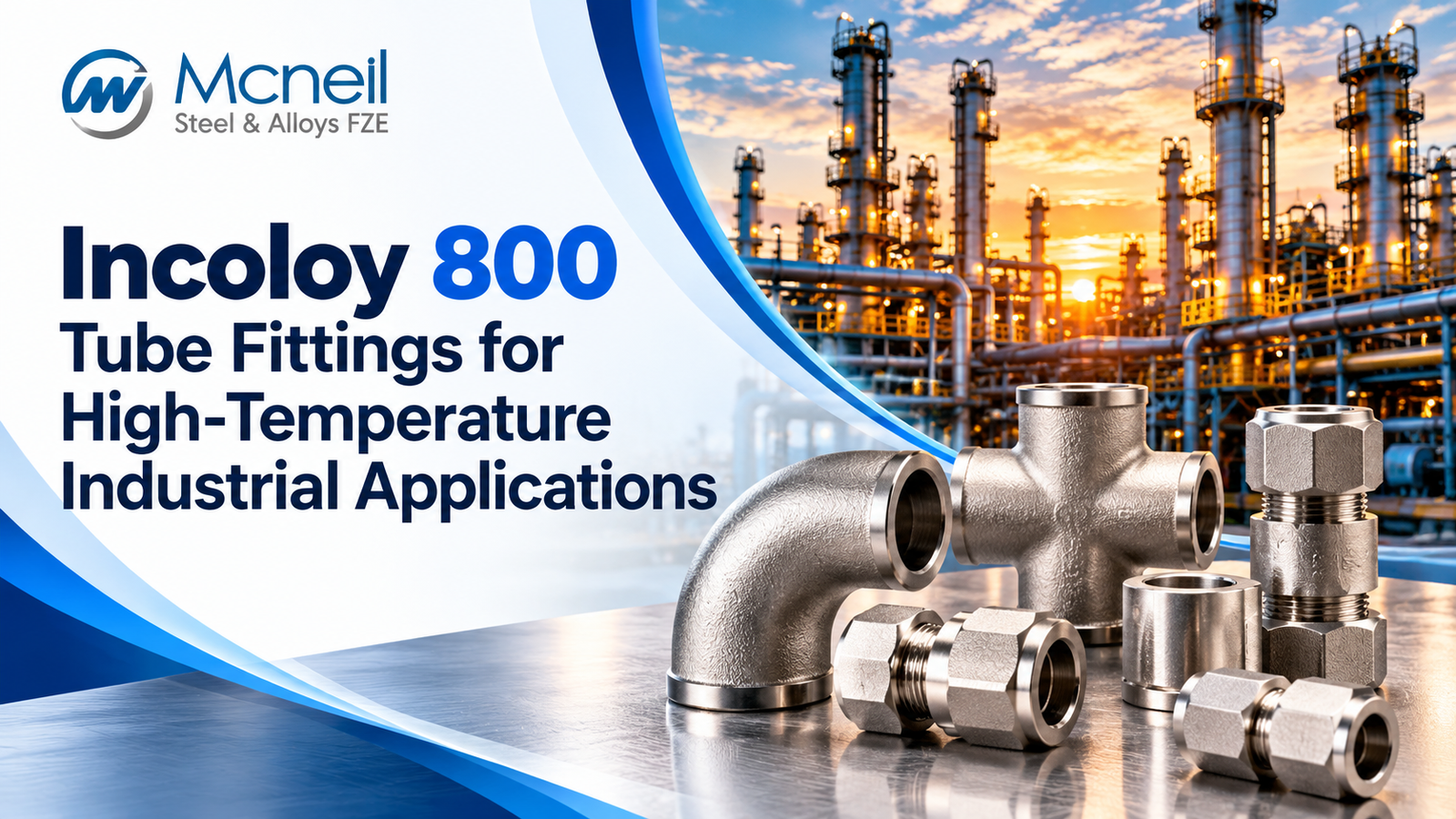
Incoloy 800 Tube Fittings for High-Temperature Industrial Applications

Introduction
Industrial facilities operating under high temperatures require materials that can maintain strength, resist oxidation, and deliver reliable performance over extended operating periods. In industries such as petrochemicals, power generation, chemical processing, and oil and gas, selecting the right tube fittings is essential for maintaining system reliability and reducing unplanned maintenance.
Incoloy 800 tube fittings are designed for demanding industrial environments where thermal stability, mechanical strength, and resistance to high-temperature oxidation are important. Manufactured from a nickel-iron-chromium alloy, these fittings are suitable for selected applications involving elevated temperatures and challenging process conditions.
Mcneil Steel & Alloys FZE provides alloy solutions for industrial requirements where material selection and product reliability are critical considerations.
What Are Incoloy 800 Tube Fittings?
Incoloy 800 tube fittings are connection components manufactured from Incoloy 800 alloy, also identified by UNS designation N08800. This nickel-iron-chromium alloy is known for its resistance to oxidation and carburization at elevated temperatures.
Tube fittings connect tubing sections and help create secure connections in industrial instrumentation and fluid-handling systems. Depending on their design, they can also connect tubing to equipment, change flow direction, or provide branching connections.
These fittings may be considered for applications where conventional materials do not provide the required combination of temperature resistance, strength, and service life. Final suitability depends on operating temperature, pressure, process media, fitting design, and applicable engineering standards.
Key Benefits of Incoloy 800 Tube Fittings
1. Excellent High-Temperature Performance
Incoloy 800 is used in selected high-temperature industrial applications because of its ability to maintain useful mechanical properties under elevated-temperature conditions. This makes it a potential material choice for thermal processing equipment, heat exchangers, furnace-related systems, and petrochemical process installations.
The maximum permissible operating temperature of a finished fitting depends on its design, manufacturing condition, pressure rating, and service environment.
2. Resistance to Oxidation and Carburization
High-temperature environments can expose metal components to oxidation and carbon-rich atmospheres. Incoloy 800 offers resistance to these forms of high-temperature degradation, making it useful in appropriately specified furnace and process equipment.
Choosing a suitable alloy can help improve component durability when the material is compatible with the actual operating atmosphere.
3. Mechanical Strength and Durability
Industrial tubing connections must withstand operating pressure, temperature changes, vibration, and mechanical loading. Incoloy 800 offers a useful combination of mechanical properties for applications that require dependable performance under demanding conditions.
Correct sizing, installation, material verification, and pressure-rating compliance remain essential for achieving reliable connections.
4. Potential for Longer Service Life
Selecting a suitable alloy can help reduce premature component degradation in compatible operating environments. By matching the fitting material to the process conditions, industrial operators can support equipment reliability and potentially reduce maintenance interruptions.
Actual service life depends on temperature, pressure, process chemistry, installation quality, and maintenance practices.
Industrial Applications of Incoloy 800 Tube Fittings
Chemical Processing Plants
Chemical processing facilities use tubing and connection components in process monitoring, fluid transfer, and equipment connections. Incoloy 800 may be considered where elevated temperatures and oxidation resistance are important. Chemical compatibility must be verified for the specific process media.
Petrochemical Plants and Refineries
Petrochemical facilities and refineries operate equipment exposed to elevated temperatures and demanding process conditions. Incoloy 800 is used in selected heat-transfer and high-temperature process applications, including certain furnace and reactor-related systems.
The suitability of individual tube fittings depends on the precise service conditions and engineering specifications.
Heat Exchangers and Thermal Processing Equipment
Heat exchangers and thermal processing systems require materials selected for their operating temperatures, pressure conditions, and exposure to process fluids. Incoloy 800 can be a suitable candidate in applications where its thermal and oxidation-resistance characteristics meet the design requirements.
Industrial Furnaces
Furnace-related equipment may expose components to prolonged heat and oxidizing or carburizing atmospheres. Incoloy 800 is used in selected high-temperature furnace applications because of its resistance to these conditions.
For sustained high-temperature service requiring enhanced creep and rupture strength, engineers may also evaluate Incoloy 800H or 800HT, depending on the applicable specifications.
Power Generation and Energy Facilities
Power generation facilities rely on reliable components throughout thermal and process systems. Incoloy alloys may be considered for selected applications involving elevated temperatures, but each component must be assessed against the relevant pressure, temperature, and service requirements.
Incoloy 800 vs. Incoloy 800H: What Is the Difference?
Although Incoloy 800 and Incoloy 800H belong to the same alloy family, they are not interchangeable in every application.
Incoloy 800 is commonly considered for applications requiring oxidation resistance and reliable mechanical performance at elevated temperatures. Incoloy 800H has controlled carbon content and metallurgical requirements intended to provide improved creep and rupture strength during prolonged high-temperature service.
The correct grade should be selected according to design codes, operating conditions, material certification, and the requirements of the equipment manufacturer.
How to Choose the Right Incoloy 800 Tube Fittings
Before purchasing Incoloy 800 tube fittings, industrial buyers should evaluate several factors.
Operating temperature and pressure: Confirm that the selected fitting is suitable for the actual operating and design conditions.
Tube dimensions and connection type: Specify the tube outside diameter, wall thickness where relevant, thread type, connection configuration, and required tolerances.
Material verification: Request material certificates and verify the alloy designation and traceability requirements.
Manufacturing standards: Confirm the applicable product standard, dimensional requirements, inspection criteria, and pressure-rating documentation for the specific fitting.
Process compatibility: Assess the chemical composition of the process media, operating atmosphere, and potential corrosion mechanisms.
Supplier capability: Evaluate the supplier’s ability to provide consistent product quality, inspection documentation, technical assistance, and delivery support.
Taking these steps helps procurement teams select fittings that align with project requirements and operational expectations.
Why Choose Mcneil Steel & Alloys FZE?
Industrial buyers need more than a product name when sourcing specialty alloy fittings. They need clear specifications, dependable communication, and products that match their application requirements.
Mcneil Steel & Alloys FZE works with industrial alloy requirements across demanding applications. When enquiring about Incoloy 800 tube fittings, buyers should provide their required grade, dimensions, quantity, connection configuration, applicable standards, and operating conditions to support an accurate quotation.
For project-specific requirements, confirm product availability, material certification, inspection documentation, and delivery schedules directly with the supplier.
Conclusion
Incoloy 800 tube fittings can be a suitable choice for selected high-temperature industrial applications where oxidation resistance, mechanical strength, and material durability are important. Their use in thermal processing, furnace-related equipment, heat exchangers, and certain petrochemical systems makes correct material selection an important part of industrial engineering and procurement.
Before placing an order, verify the fitting design, material grade, pressure and temperature limits, and applicable standards for the intended service.
Looking for Incoloy 800 tube fittings for your next industrial project? Contact Mcneil Steel & Alloys FZE to discuss your specifications, request a quotation, and confirm availability for your application.
Need Incoloy 800 Tube Fittings for High-Temperature Industrial Applications?
Partner with Mcneil Steel & Alloys FZE for your specialty alloy sourcing requirements. Share your technical specifications and quantity requirements with our team to request a quotation and confirm product availability.
Contact us today to discuss your industrial alloy requirements.
Website: https://mcneilalloys.ae/
Email: info@mcneilalloys.ae
Phone: +91 98708 83613
Frequently Asked Questions (FAQs)
1. What are Incoloy 800 tube fittings used for?
Incoloy 800 tube fittings are considered for selected high-temperature industrial systems, including furnace-related equipment, heat exchangers, thermal processing installations, and certain petrochemical applications.
2. What is Incoloy 800?
Incoloy 800 is a nickel-iron-chromium alloy identified by UNS N08800. It is known for its resistance to oxidation and carburization and its useful mechanical properties at elevated temperatures.
3. Are Incoloy 800 tube fittings suitable for high-temperature applications?
Yes, they can be suitable for specified high-temperature applications. However, the permissible temperature depends on the fitting design, pressure, material condition, and operating environment.
4. What is the difference between Incoloy 800 and Incoloy 800H?
Incoloy 800H has controlled carbon content and metallurgical requirements that improve creep and rupture strength for prolonged high-temperature service. The appropriate grade depends on the design and operating conditions.
5. Are Incoloy 800 tube fittings suitable for chemical processing?
They may be suitable for certain chemical processing applications, particularly where high-temperature performance is important. Compatibility must be checked against the actual chemicals, concentrations, and process conditions.
6. How do I select the correct Incoloy 800 tube fitting?
Consider operating pressure and temperature, tube dimensions, connection type, process media, applicable standards, material certification, and installation requirements before selecting a fitting.
7. What information should I provide when requesting a quotation?
Provide the required alloy grade, fitting type, tube size, connection details, quantity, applicable specifications, material certification requirements, and intended operating conditions.
8. Where can I source Incoloy 800 tube fittings?
Contact Mcneil Steel & Alloys FZE through its official website at www.mcneilalloys.ae to enquire about product specifications, availability, pricing, and delivery options.