Stainless Steel Pipe Fittings: Grades 304, 316, 316L, 321 & 347

Introduction
Stainless steel pipe fittings are essential components in industrial piping systems, helping connect pipes, change flow direction, reduce pipe sizes, and create secure pipeline connections. These fittings are widely used in industries such as oil and gas, petrochemicals, chemical processing, power generation, pharmaceuticals, and food processing because of their corrosion resistance, durability, and dependable performance.
However, not all stainless steel grades offer the same properties. Grades 304, 316, 316L, 321, and 347 have different chemical compositions and performance characteristics, making each suitable for specific operating conditions. Selecting the right grade is important for achieving long-term reliability, minimizing maintenance requirements, and meeting project specifications.
At Mcneil Alloys, we understand the importance of choosing suitable stainless steel materials for industrial applications. This guide explains the key features, differences, and applications of these five stainless steel grades to help you make an informed decision.
What Are Stainless Steel Pipe Fittings?
Stainless steel pipe fittings are components used to connect, redirect, branch, or modify piping systems. They are available in different shapes, sizes, pressure classes, and material grades to accommodate various industrial requirements.
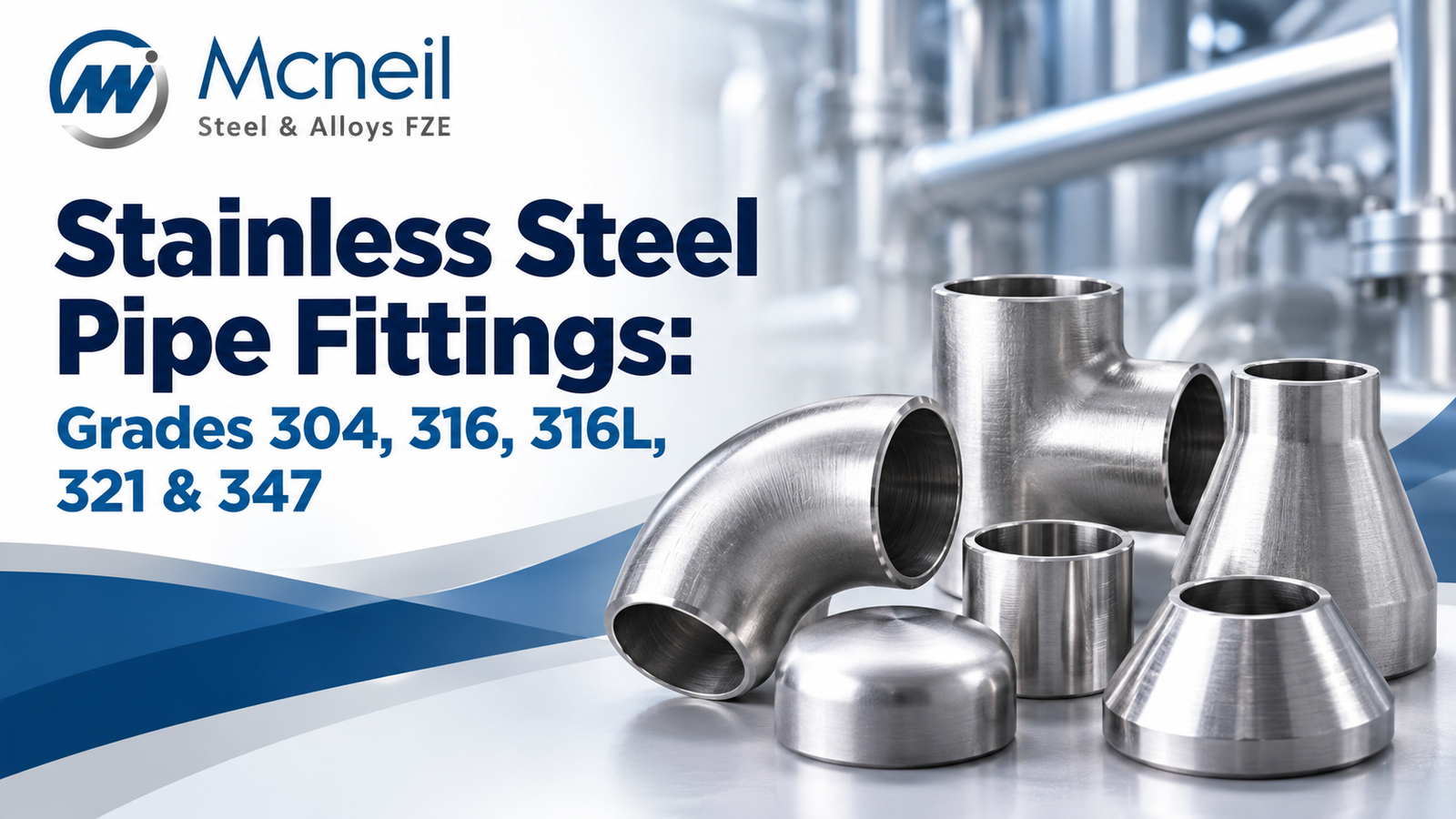
Common types of stainless steel pipe fittings include elbows, tees, reducers, caps, crosses, and stub ends. Depending on the application, fittings may be manufactured as butt-weld, socket-weld, or threaded fittings.
The appropriate fitting depends on factors such as operating pressure, temperature, fluid composition, corrosion exposure, installation method, and applicable industry standards.
Stainless Steel Grade 304 Pipe Fittings
Grade 304 is one of the most widely used austenitic stainless steel grades. It contains chromium and nickel, providing good corrosion resistance in many general industrial and commercial environments.
Key Features of Grade 304
Good corrosion resistance in many atmospheric and industrial environments.
Good formability and weldability.
Suitable for a wide range of general-purpose applications.
Available in various fitting configurations and dimensions.
Applications of Grade 304 Pipe Fittings
Grade 304 stainless steel pipe fittings are commonly used in food processing equipment, water systems, general industrial pipelines, architectural applications, and manufacturing facilities.
However, Grade 304 may not be the best choice for environments with significant chloride exposure, where localized corrosion can become a concern.
Stainless Steel Grade 316 Pipe Fittings
Grade 316 stainless steel contains molybdenum, which improves its resistance to pitting and crevice corrosion in many chloride-containing environments compared with Grade 304.
Key Features of Grade 316
Improved resistance to chloride-related corrosion compared with Grade 304.
Good mechanical properties across a range of operating conditions.
Suitable for many chemical processing and marine-related applications.
Good weldability using appropriate procedures.
Applications of Grade 316 Pipe Fittings
Grade 316 pipe fittings are widely used in chemical processing plants, marine equipment, pharmaceutical manufacturing, coastal industrial facilities, and selected oil and gas applications.
Although Grade 316 offers improved corrosion resistance, it is not immune to corrosion in every chloride-containing environment. The concentration, temperature, and exposure conditions must be considered when selecting the material.
Stainless Steel Grade 316L Pipe Fittings
Grade 316L is the low-carbon version of Grade 316. Its reduced carbon content helps minimize the risk of sensitization and associated intergranular corrosion during welding, particularly in applications where post-weld heat treatment is not performed.
Key Features of Grade 316L
Lower carbon content than standard Grade 316.
Reduced susceptibility to sensitization during welding.
Good corrosion resistance in many industrial environments.
Suitable for fabricated and welded piping systems.
Applications of Grade 316L Pipe Fittings
Grade 316L fittings are commonly used in pharmaceutical facilities, chemical processing plants, food and beverage production, water treatment systems, and industrial piping networks requiring welded stainless steel components.
For projects involving extensive welding or exposure to corrosive process media, Grade 316L may be preferred over Grade 316, subject to the design requirements.
Stainless Steel Grade 321 Pipe Fittings
Grade 321 is a titanium-stabilized austenitic stainless steel. Titanium helps stabilize the material against chromium carbide precipitation during exposure to certain elevated-temperature conditions.
Key Features of Grade 321
Titanium stabilization helps reduce sensitization-related concerns.
Suitable for selected elevated-temperature applications.
Good oxidation resistance under appropriate service conditions.
Good weldability when suitable fabrication procedures are followed.
Applications of Grade 321 Pipe Fittings
Grade 321 stainless steel pipe fittings are used in selected high-temperature process piping systems, exhaust systems, thermal processing equipment, chemical processing facilities, and aerospace-related applications.
The suitability of Grade 321 depends on the actual operating temperature, thermal cycling, corrosive environment, and applicable engineering standards.
Stainless Steel Grade 347 Pipe Fittings
Grade 347 is a niobium-stabilized austenitic stainless steel. Niobium, also known as columbium, helps reduce the risk of chromium carbide precipitation during exposure to certain temperature ranges.
Key Features of Grade 347
Niobium stabilization supports resistance to sensitization.
Suitable for selected elevated-temperature applications.
Good oxidation resistance under appropriate operating conditions.
Useful in welded components exposed to demanding thermal conditions.
Applications of Grade 347 Pipe Fittings
Grade 347 fittings are used in selected power generation systems, refinery equipment, chemical processing plants, heat exchangers, and elevated-temperature piping applications.
The final grade selection should account for service temperature, corrosion conditions, mechanical requirements, fabrication methods, and project specifications.
Difference Between Stainless Steel Grades 304, 316, 316L, 321, and 347
Each stainless steel grade offers distinct advantages depending on the operating environment.
Grade 304: A versatile choice for general-purpose applications requiring good corrosion resistance and fabrication characteristics.
Grade 316: Contains molybdenum, improving resistance to pitting and crevice corrosion in many chloride-containing environments.
Grade 316L: A low-carbon version of Grade 316, often preferred for welded components where reducing sensitization risk is important.
Grade 321: A titanium-stabilized grade used in selected applications involving elevated temperatures and thermal exposure.
Grade 347: A niobium-stabilized grade suitable for selected elevated-temperature applications where stabilization is beneficial.
The most suitable grade cannot be determined by price or alloy composition alone. Engineers should evaluate the complete operating environment, applicable standards, and material requirements before making a final selection.
How to Choose the Right Stainless Steel Pipe Fittings
Selecting the correct stainless steel pipe fittings requires careful consideration of several factors.
1. Corrosion Resistance
Evaluate the chemicals, moisture, chlorides, and other substances that the piping system will encounter. Grade 316 and 316L may provide advantages over Grade 304 in many chloride-containing environments, but severe conditions may require a different alloy.
2. Operating Temperature
Determine the normal operating temperature, maximum temperature, and any thermal cycling. Grades 321 and 347 may be suitable for certain elevated-temperature applications, depending on the engineering design.
3. Welding Requirements
Consider the fabrication method and extent of welding. Grade 316L is often preferred where its lower carbon content offers an advantage. Stabilized grades such as 321 and 347 may also be appropriate for particular thermal and fabrication conditions.
4. Pressure and Dimensions
Confirm the required fitting type, nominal pipe size, wall thickness, pressure rating, end connection, and dimensional standard.
5. Industry Standards
Check the applicable material specification, fitting standard, inspection requirements, and project documentation. Material grade alone does not establish suitability for a particular pressure or temperature.
6. Supplier Reliability
Choose a supplier that can support your procurement requirements with appropriate material identification, traceability, inspection records, and material test certificates.
Why Choose Mcneil Alloys for Stainless Steel Pipe Fittings?
Finding the right stainless steel pipe fittings involves matching material properties with project specifications, service conditions, and quality requirements.
Mcneil Alloys supports industrial buyers looking for alloy and stainless steel products for demanding applications. When sourcing Grades 304, 316, 316L, 321, or 347, buyers should confirm the available product forms, dimensions, specifications, documentation, and delivery requirements.
Whether your project involves chemical processing, oil and gas, power generation, marine applications, or general industrial piping, selecting the correct stainless steel grade can help support reliable system performance.
Contact Mcneil Alloys to discuss your stainless steel pipe fitting requirements and request information about suitable material options.
Conclusion
Stainless steel pipe fittings play an important role in maintaining the reliability and efficiency of industrial piping systems. Grades 304, 316, 316L, 321, and 347 each offer different advantages, from general corrosion resistance to improved resistance to chloride-related corrosion and stabilization for selected elevated-temperature applications.
Choosing the right grade requires evaluating corrosion exposure, temperature, welding requirements, pressure conditions, and applicable standards. By understanding these differences and working with a reliable supplier, businesses can make better material selection decisions for their industrial projects.
Need High-Quality Stainless Steel Pipe Fittings for Your Industrial Project?
Mcneil Alloys can help you explore stainless steel material options for your piping requirements. Contact our team to discuss Grades 304, 316, 316L, 321, and 347, along with your required dimensions, specifications, and documentation.
Website: https://mcneilalloys.ae/
Phone: +91 98708 83613
Email: info@mcneilalloys.ae
Get in touch with Mcneil Alloys to discuss your requirements and request a quotation.
Frequently Asked Questions (FAQs)
1. What are stainless steel pipe fittings used for?
Stainless steel pipe fittings connect pipes, change flow direction, create branches, and modify pipe sizes. They are widely used in oil and gas, chemical processing, power generation, pharmaceuticals, food processing, and other industries.
2. What is the difference between stainless steel Grades 304 and 316?
Grade 316 contains molybdenum, which improves resistance to pitting and crevice corrosion in many chloride-containing environments compared with Grade 304. The best choice depends on the actual service conditions.
3. What is the difference between Grade 316 and Grade 316L?
Grade 316L has a lower carbon content than Grade 316. This reduces the risk of sensitization during welding and can make Grade 316L preferable for certain welded piping applications.
4. Why are Grade 321 stainless steel pipe fittings used at elevated temperatures?
Grade 321 contains titanium, which stabilizes the steel and helps reduce chromium carbide precipitation under certain thermal exposure conditions. Its suitability depends on the application and operating temperature.
5. What makes Grade 347 stainless steel different?
Grade 347 is stabilized with niobium, which helps reduce sensitization-related concerns during exposure to certain temperature ranges. It is used in selected welded and elevated-temperature applications.
6. Which stainless steel grade is best for chemical processing?
Grades 316 and 316L are often considered for chemical processing because of their corrosion resistance. However, the appropriate grade depends on the specific chemical, concentration, temperature, and operating conditions.
7. Are stainless steel pipe fittings available in different types?
Yes. Common types include elbows, tees, reducers, caps, crosses, and stub ends. They may also be available in butt-weld, socket-weld, and threaded configurations, depending on the product range.
8. How can I verify the quality of stainless steel pipe fittings?
Review the applicable material specification, material test certificate, chemical composition, mechanical test results where required, dimensional inspection records, and traceability documentation.
9. How do I select the right stainless steel pipe fitting grade?
Consider corrosion resistance, operating temperature, pressure, welding requirements, fitting dimensions, applicable standards, and the process medium before selecting a grade.
10. How can I enquire about stainless steel pipe fittings from Mcneil Alloys?
Visit the official Mcneil Alloys website to contact the team, discuss your project specifications, confirm product availability, and request a quotation.